
During Vivat Fluxus, an event organized by Performer Stammtisch in Berlin in 2009, performance artist Norbert Klaasen (1941–2011) performed a series of Fluxus scores. One of them read:
A hammer in your right hand, a hammer in your left hand. Hit the flat ends of the two hammers against each other. This produces a high-pitched sound. Repeat.
Florian Feigl, a performance artist and educator based in Berlin who was a guest speaker in our SNSF project Performance: Conservation, Materiality, Knowledge (Monday, March 8, 2021), recalls that Klaasen—who had witnessed Fluxus during his artistic career—must have repeated the action several hundred times. At first glance, the enactment of the score seems simple. The work appears to be about producing sonic effects by hitting two hammers against each other. But this seemingly straightforward action can generate a range of outcomes, creating radically different sonic and haptic experiences—a fact that only reveals itself in the moment of putting the information into action.
If we choose two heavy hammers to perform the score, we might soon discover not only that the sound becomes unbearable, but also that our physical endurance is limited by the weight. If, on the other hand, the hammers are light and handy—like the French hammers used in shoemaking—we might manage several hundred repetitions, accompanied by a distinct sonic effect. These two experiences of hammering differ so significantly that it is as if they were enacted from two entirely different scores.
When performing the score and experiencing it firsthand, we can no longer simply say that the work is about hammering. The material in our hands produces the sensation; it is the action. The ordinary patterns of thought are challenged once we remove the “about.” As Fluxus scholar Hannah B. Higgins reminds us, “if a piece is not about things but actually is them, then the signifying chain often applied to visual art in semiotic analyses needs to be modified to make physical or actual experiences central to the process of signification” (Fluxus Experience, 2002). Higgins highlights how Fluxus works problematize the Western metaphysical tradition—since Plato and Aristotle—which separates primary experience, such as the feel of hammering with a hammer, from secondary experience, that is, the mental concepts associated with it.
Is performance, then, an experience? What actually is performance?
For Florian Feigl, who is deeply reflective about his practice and an excellent discussant, performance is about practice, continuity, and processes—things that lead to one another, things we do. Known for 300 (2009–ongoing), a series of performances built around everyday activities that take place within a prescribed time interval of approximately five minutes (or 300 seconds), his work exemplifies this notion of continuity. Conceived during a moment of personal crisis, when he felt overwhelmed by domestic obligations, the idea for the series emerged from the necessity of carving out small pockets of time for artistic work. One can always find five minutes to do something:
Fünf Minuten. Ohne Diskussion. Ohne Zweifel. Und weil ich Performancekünstler bin, sollten diese fünf Minuten der Performancekunst gewidmet ein. Fünf Minuten Performances sollten von nun an meinen Prozess bestimmen, mein Video Skizzenbuch sein, eine Art Tagebuch (Portfolio, n.d.).
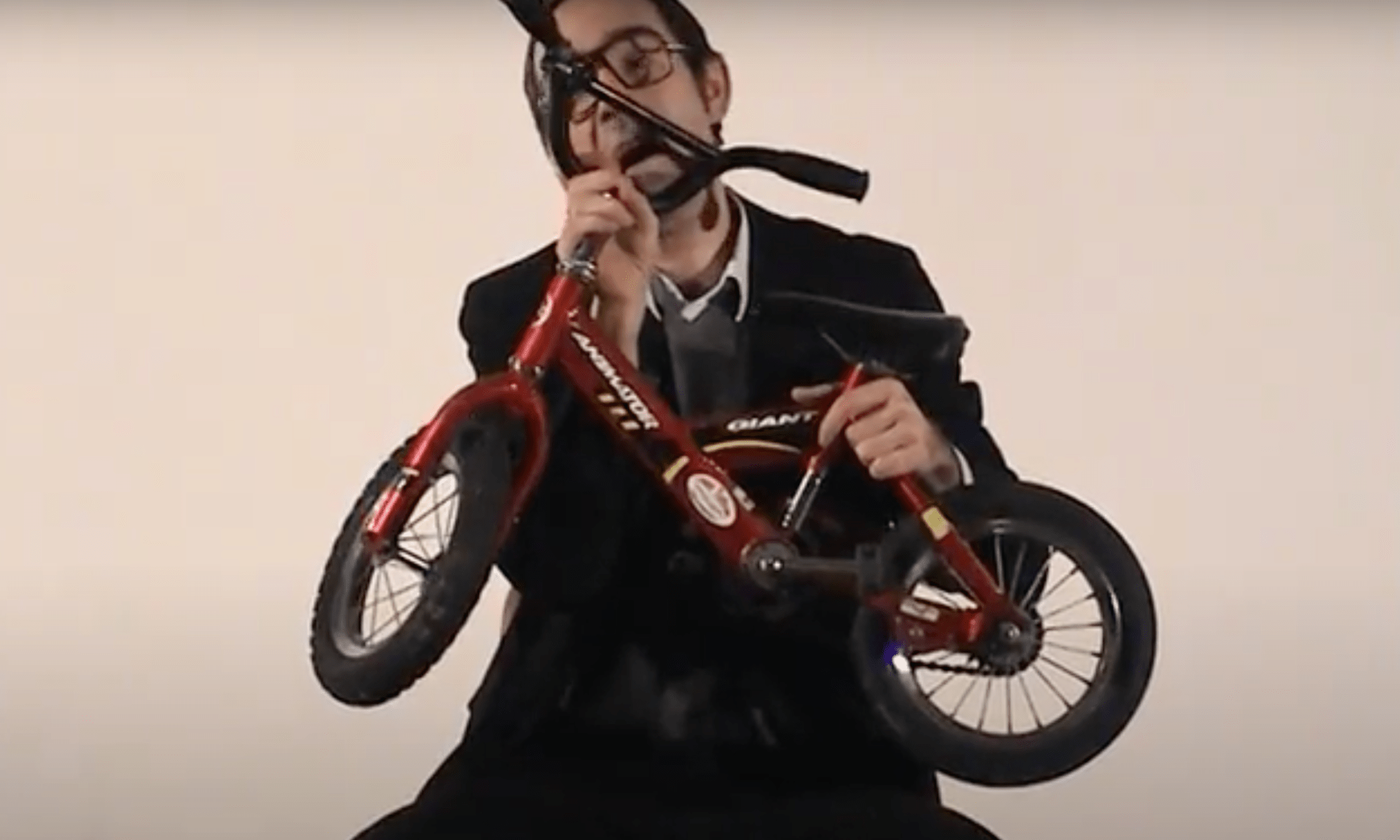
There is a time-based quality to Feigl’s work that extends beyond its limited duration. This temporality is, above all, a regulation—if not a regimentation—of time: an effort to contain otherwise loose or undefined actions within a strict temporal frame. The paradox of these frames lies in their seemingly short span—five minutes, a duration that, in theory, anyone or anything can endure while engaged in action. Yet when those five minutes become 300 seconds of continuously washing hands, licking a (very small) bicycle, or waiting for fogged glasses to clear, time slows down and begins to gnaw at us, transforming into an intense, almost visceral experience. Five minutes becomes the distilled experience of time—and of the self.
The question of conserving these performances also resonates on a temporal register. Feigl is committed to a fugitive art that leaves no trace. At first glance, the five-minute videos—neatly organized into categories such as “self-portraits,” “lick pieces,” and “sound pieces,” and made available on YouTube—seem to belie this claim. Yet a recording can only capture so much. What it presents is a fragment of the work and its world, a reminder that any document is inherently partial, fragmentary, and shaped by the subjectivities involved in its creation. Feigl refers to his video recordings as an “Art Diary” and makes them available for pedagogical use. When performance students remake a piece based on these videos, they produce their own interpretations and documentations of 300. Treated as visual instructions, the recordings function as educational tools, facilitating the transmission of skill, gesture, knowledge, and experience. Capturing this process of remaking situates the original realization within a broader chaîne opératoire—a chain of making or becoming—that is never fixed or complete. The mediality in Feigl’s work is always already a multimediality, in which the initial event is but one facet of the artwork. This facet converges with elements of live performance, filmmaking, pedagogical transmission, and potentially, remaking.
To hammer two hammers against each other is an ideal entry point into our contestation with performance—into the question of what performance is. The practice of hammering can be revealing: it compels attention not only to pitch but also to the intensity and texture of sound. If pursued long enough, this repetitive action may cultivate a form of embodied or tacit knowledge—knowledge that can be transmitted or held in secrecy. Over time, the hammer, once taken for granted, might break, exposing its internal mechanics and revealing what Heidegger calls its tool-being. Broadly speaking, using a tool diminishes our awareness of its qualities; as we become familiar with it, the tool recedes into transparency, withdrawn from conscious attention. When it fails—when it breaks or resists—it becomes unready-to-hand, its presence suddenly foregrounded. This breakdown, as Bruno Latour has argued, can shift our perspective and draw our attention to what was previously overlooked.
Conservation, at its core, presumes an understanding of its object before any measure or intervention takes place. Yet performance, which is all around us, seems to be many things at once. This multiplicity also inhabits the notion of conservation itself—not only as a broader cultural practice, but more specifically in the conservation of performance, which is often equated with archiving and documentation. While these practices offer essential ways to access aspects of a performance in the future, is that all that conservation can offer? Is it enough to claim that, in order to be conserved, performance—as supposedly ephemeral or vanishing—must be archived or documented? Perhaps we need to question the very principle of conservation as an apparatus: its practices, affordances, knowledge structures, mechanisms, and institutions. In other words, perhaps we must “break” the familiar tools of conservation—deconstruct and reconstruct them with renewed charisma and mentality—to open up new horizons of care.
Featured image: Florian Feigl, 300 – 006 (2009 – ongoing), from the series “Lick Pieces.” Artwork reproduced with kind permission of the artist. Copyright Florian Feigl.
 Performance: Conservation, Materiality, Knowledge