
In this short essay, Andrej Mirčev, a recently joined postdoctoral fellow, reflects on relics and icons and discusses how these concepts can shed new light on performance conservation. Can they also contribute to expanding our understanding of the field?
The performative turn of the 1980s-90s has set in motion a myriad of reflections about the expanded notion of performance and performativity that no longer concern only art, language and aesthetics but became a heuristic tool to examine other forms of anthropological, cultural activities and events such as rituals, festivals, or sport. Suppose it could be argued that theatre and religious practices were historically intertwined and that one of the origins of performance is its relation to rituals. In that case, we see that despite the process of secularisation, artists like Orlan, Pedro Lemebel, Gina Pane, Chris Burden, Marina Abramović, Hermann Nitsch, Joseph Beuys and Ron Athey, to name a few, deploy Christian iconographies in their works. The consequence is that the artistic event transforms into a communion and a ritual.
At the same time, an attempt to expand conservation paradigms has resulted in a shift to “performance and processual paradigms” (Dupré 2022: 1). Such an epistemic reorientation moves the focus from the materiality of objects to more performative conservation practice, one which foregrounds concepts such as care and ethics (Hölling, Magnin, Feldmann 2023; Muñoz Viñas 2020). Bringing conservation into a dialogue with ephemerality, loss, and contingency, Alexander Nagel argues for an expanded field of conservation that would acknowledge and consider acts of making and remaking. Furthermore, the last forty years of art production, Nagel observes, are determined by a “retrospective cast” linked to the “ubiquity of reliquary-like stagings in contemporary arts” (Nagel 2022: 10).
Relating relics and icons to remnants of performances, I argue that the intersections of performance and conservation can be illuminated by looking at practices of preserving body parts and objects/icons of deceased saints which is foundational to many religions like Christianity and Buddhism. Thsi short essay asks if performance (and) conservation can benefit from the discourse on relics and present in the specific image theory developed within the Byzantine philosophical tradition. In other words, it surveys whether it is plausible to assert that the research on relics and icons can multiply epistemic frameworks to challenge dualities such as body/mind, time/space, ephemerality/documentation, presence/absence, dynamism/stasis still troubling performance studies and the paradigms of conservation.
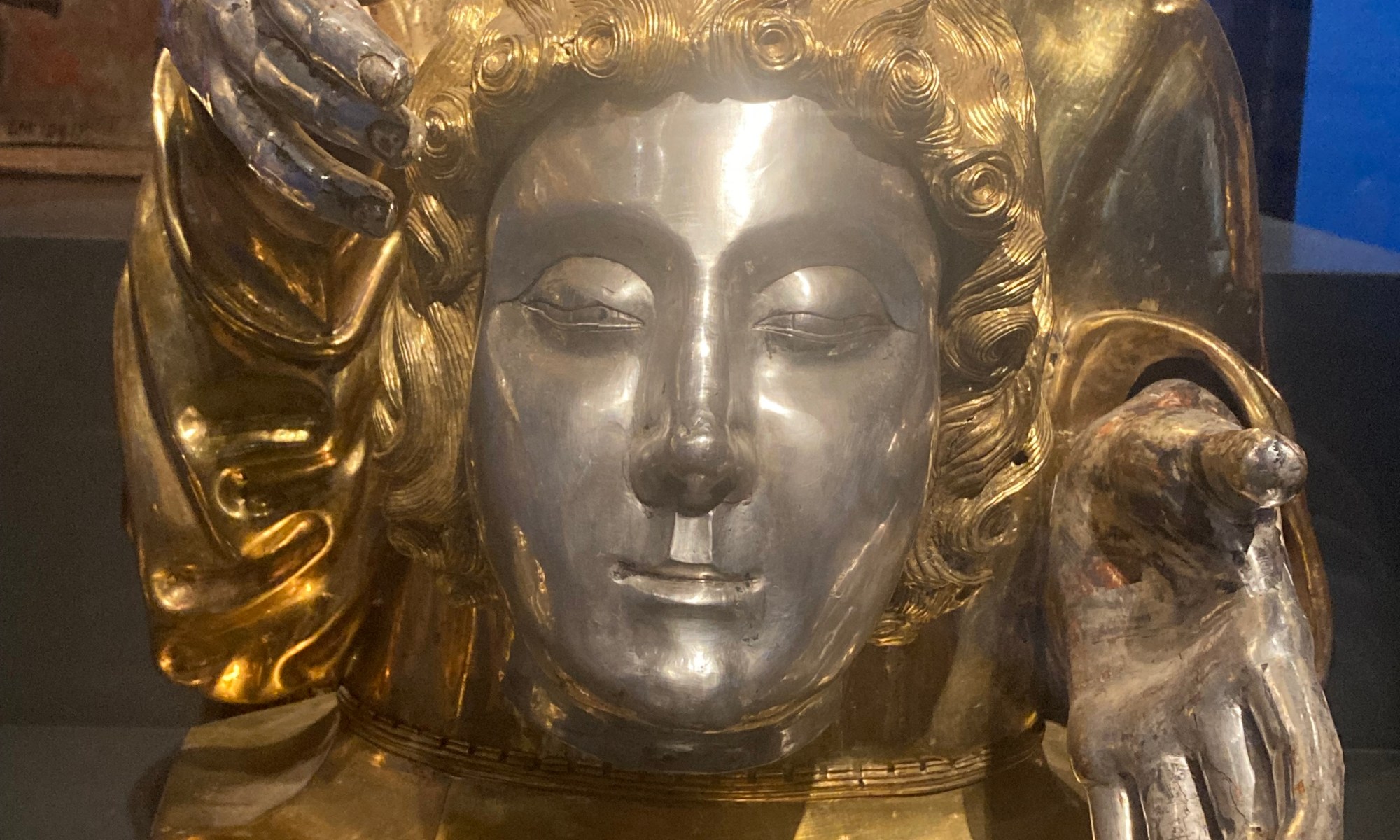
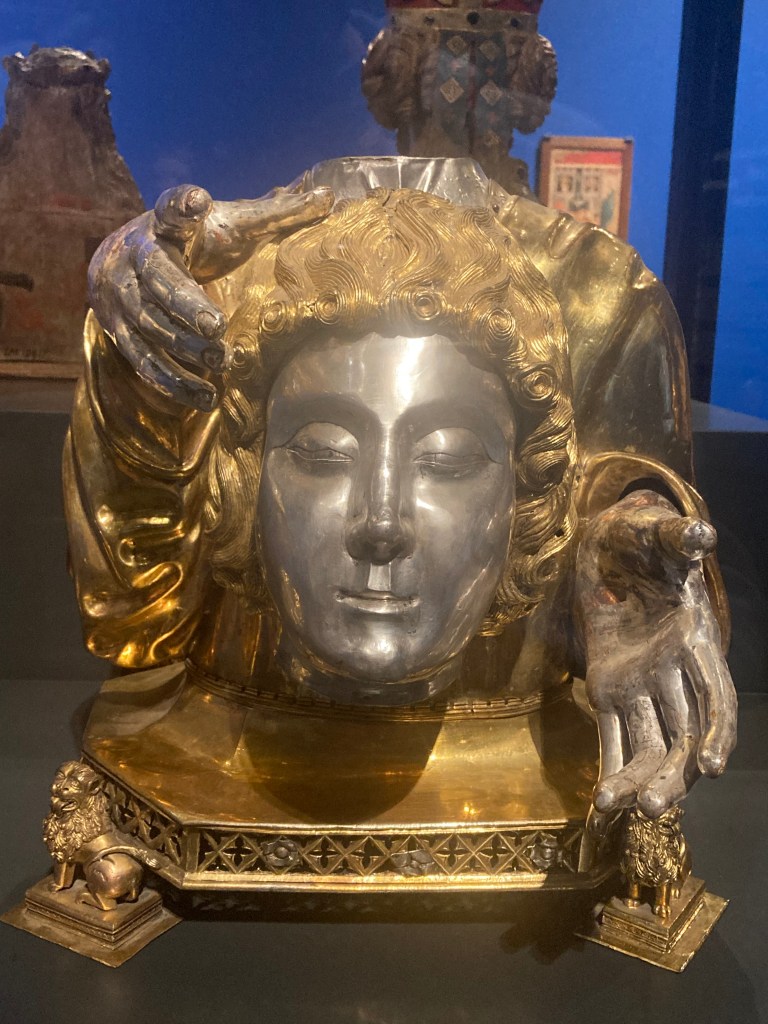
The Latin word reliquiae from which the concept of the relic derives designates material remains of dead people. As Charles Freeman shows, by the end of the sixth century, “it was used in this sense to include everything from the foreskin of Jesus discarded at his circumcision, the hair or milk of the Virgin Mary, the bodies of Apostles – but also anything that may have been associated with them; their clothes, for example, or even any object that had touched them (…)” (Freeman, 2011: 30). As such, relics functioned as symbols of spiritual and political power, and moreover, they had both monetary and ritualistic values. Wrapped in precious fabrics and often stored in lavishly decorated reliquaries made of gold or silver, relics soon became the focal point of pilgrims, thus ensuring the repetition and afterlife of the religious performance.
To draw a parallel between relics, icons and artifacts of performance-based artworks sets the stage to entangle questions about the conservation of performance remains with the theological discourse on incarnation, according to which holy images and veneration objects do not act as representations but enact the living presence of saints. While I do not aim to clarify the terminology, it is necessary to point out that when it comes to the discussions of what is left from performance, there is still a great deal of terminological confusion regarding the different signifiers such as “artifacts,” “remnants” and “traces.” While they all refer to objects, texts, images and sounds of bygone performances, it is not always clear what distinguishes them.
Reacting to the philosophical challenge posed by the iconoclasts, who considered images to be only material objects and, therefore, incapable of embodying divine presence, Byzantine theologians of the 8thcentury, such as Theodore the Studite and John Damascene, conceived of a subtle image theory. In many ways, it anticipated the iconic/visual turn as it is formulated by authors like W.J.T. Mitchell and Gottfried Boehm (Maar and Burda, 2005). What legitimizes the use of icons and relics, according to Damascene, is that Christ had acquired a corporeal and visible form. In short, the argument against iconoclasts is that icons and relics can be considered living images, which suggests “the ethereal and majestic presence of holy beings” (Tsakiridou 2013: 208).
This speculative and comparative framework in which my argument operates aims to relate religious practices to contemporary performance art. It is motivated by something dance scholar Susanne Foellmer has identified in the work of Orlan as the “religious vocabulary” of performance art (Foellemer 2020: 154). Showing how the idea of performance remnants operates on two levels – as a trace of the performance and as a temporal figure enabling repetition – Foellmer concludes that “the idea of the relic as a unique conservatory device of saintly energy” can be invested to articulate a “presenting rather than representing presence by way of an explicit absence of the bygone event” (Foellmer ibid: 157-158). What such a conceptual reorientation regarding relics can entail for performance conservation is the impulse to rethink not only the relation between presence and representation but also how concepts originating within the tradition of theology can productively be brought in dialogue with contemporary performance studies.
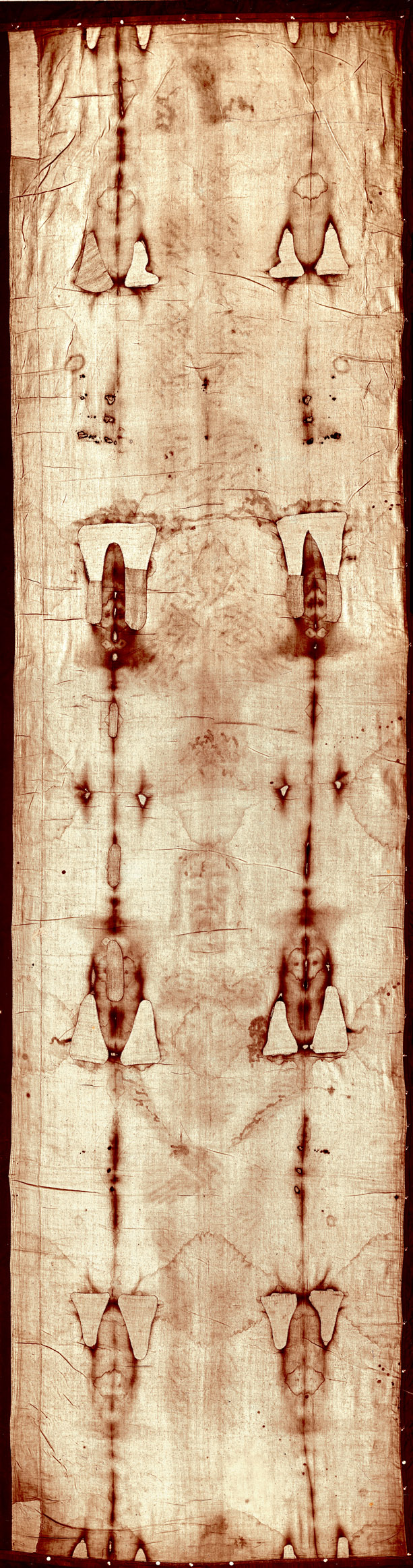
A specific notion that we can evoke to examine the intersections between performance, conservation and relics in more detail is the notion of acheiropoietic images. This refers to unpainted, “especially authentic images that were either of heavenly origin or produced by mechanical impressions during the lifetime of the model” (Belting, 1994: 49). Examples of these Christian icons are the Shroud of Turin, the Veil of Veronica and the Image of Edessa. Their common feature is that they are envisaged as relics of touch. Here, it is important to point out that these relics convey the visual archetype which had turned into an iconographical model that is consequently replicated and reactivated over the last thousand years.
If compared to relics of contemporary performance, it could be contended that acheiropoietic icons show a similar “capacity to be reiterated,” which signifies a condition when “it becomes possible to say not only that performance remains, but that performance conserves” (Schneider and Hölling, 2024: 62). For Schneider, the tendency to equate performance with disappearance needs to be challenged and she does it by insisting that both performance and object arts do not vanish but remain, even if this implies that they remain differently. At the same time, the conviction that performance remains and that it can be reiterated through the repetition of gestures leads her to the conclusion about its relation to ritual.
One example of an acheiropoietic image that became a relic of performance is the work Performing Light (2019) by Ulay. The artist transformed the Richard Saltoun Gallery in London into a dark room laboratory. On the floor, he spread out a sheet of photo-sensitive paper to which he attached his body together with the audience touching the paper. The result was a large photogram that conserved the haptic and luminous traces of his body as well as the bodies of the visitors. Hence, in close proximity to the concept of the acheiropoietic image such as the Shroud of Turin, Ulay´s “performative photographic event” (as he described it), sheds light on the relationship between performance, conservation and the icon/relic.

As one of the most important and precious relics of Christianity, the Shroud of Turin is believed to contain corporeal traces of Christ. According to the legend, the cloth was used to wrap his dead body. Yet, while it can be deemed as a “quintessential justification for the validity of Christian imagery,” Andrew R. Casper argues that it has been excluded from art history as its pictorial style, material composition and abstract configuration resisted traditional categorization (Casper 2021: 7). On the other hand, due to its indeterminate origin, the Shroud was subject to countless debates over its authenticity, especially regarding the materiality of the blood-stained traces. Drawing a comparison to performance documents such as photography, we could ask if it can be also considered a performance relic?
Writing about performance photography as an icon, Tracey Warr surveys its conflicting and contradictory role in documentation. In her words, “the icon makes the intangible and invisible accessible in portable form and therefore creates a market for the priceless and the immaterial” (Warr 2003: 35). In epistemic and ontological terms, once the live act is over, the performance photograph acquires the role of the icon which “is both indexical (like the Turin Shroud) and documentary” (Warr ibid: 36). In the case of Ulay´s performance, the photograph conveys precisely this double aspect of the icon. Due to the physical traces/residues that are imprinted on the paper, the photograph acts as an index and, at the same time, it can be assigned a documentary status.
According to the Byzantine theological doctrine, “incarnation and the icon are one and the same thing” (Mondzaine 2004: 15), which, if applied to the context of Ulay’s performance, signifies the relation between the performing body and the relic. In short, the image and the body become affectively intertwined, “making relic and image mutually dependent” (Casper, ibid. 17). By the time Ulay was performing the work, he was in the final stages of his terminal illness which becomes an additional frame for understanding the parallel to the Turin Shroud. A few months later in 2020, he passed away, and Performing Light would be his last work performed in public. Hence, the acheiropoietic photogram gains the form of a performative auto-eulogy. It extends its presence into a haunting temporality traversed by photographic traces and transforms the flesh into a fluid and fragile materiality composed of silver iodide.
As Bissera Pentcheva has shown in her essay on the performative dimension of icons, the icon is the imprint of the saint´s visible characteristics on matter. Having “a legacy of tactile visuality” that gave rise to “sensorially rich performance” in which all five senses are engaged, it oscillates between presence and absence (Pentcheva 2006: 632). Not confined to a mimetic regime of duplication and representation, icons heighten our awareness of the materiality and viscerality of the image. In doing so, they offer a speculative ground to reconsider performance conservation as a practice of interanimation. Echoing Schneider’s argument that interanimation articulates the “criss-cross temporality of ritual returns” and that it signifies the moment when the live and not live are not seen as oppositions, I assert that icons can heighten the idea of body-to-body transmission, which becomes central in the attempt to expand performance conservation (Schneider 2011: 147).
Returning to Ulay’s acheiropoietic photogram, it can be asserted that relics and icons delineate fresh epistemic and ontological perspectives to further articulate the question of how performance can be conserved. The answer perhaps is not in the auratic moment of the here and now but rather in what is absent and yet to arrive. In that sense, conservation becomes a practice of caring for the afterlife and the resurrection of performance. Thus, exploring expanded conservation through the optics of relics and icons allows us to comprehend the fluid materiality and corporeality of performance that resists representation. If, as Andrew R. Casper shows in his analysis of the Turin Shroud, the relic serves as a medium to embrace “authenticity and the material presence of Christ´s body,” could we assert that Ulay´s performative photography does something similar, that it conserves the haptic traces of the artist and his audience?
Diffracted through the prism of relics and icons, the connection between performance and conservation unveils a profound relationality between ephemerality and preservation which refuses to be reduced to binary simplifications. In other words, to epistemically constellate the relic, performance, and conservation aims at overcoming the dichotomy between presence and absence. In this way, the act of preserving performance is not only an assertion of permanence but a defiance against the inevitable decay and forgetting immanent to human temporality. Conversely, the engagement with relics and icons is an acknowledgment that acts of performance conservation are never static but ever-evolving, ever-changing, and dynamic. Thus, if seen against the backdrop of relics and icons, the relationship between performance and conservation becomes an invitation to engage with our memories, heritage and rituals in ways that are reverent, vibrant, and careful.
References
Andrew R. Casper, An Artfulf Relic: The Shroud of turin in Baroque Italy, State College: Penn State: University Press, 2021.
Alexander Nagel, “Introduction. Conservation as Performance”, Caroline Fowler and Alexander Nagel (ed.), The Expanded Field of Conservation, Williamstown, Massachusetts: Clark Art Institute, 2022, p. 8-18.
Bissera V. Pentcheva, “The Performative Icon”, The Art Bulletin, Vol. 88, No. 4 (Dec., 2006), p. 631-655.
Christa Maar/Hubert Burda (ed.), Iconic Turn-Die neue Macht der Bilder, DuMont, 2005
Charles Freeman, Holy Bones, Holy Dust. How Relics Shaped the History of Medieval Europe, New Haven: Yale University Press, 2011.
Cornelia A. Tsakiridou, Icons in Time, Persons in Eternity: Orthodox Theology and the Aestehtics of the Christian Image, Surrey: Ashgate, 2013.
Hans Belting, Likeness and Presence. A History of the Image before the Era of Art, Chicago: Chicago University Press, 1994.
José-Marie Mondzaine, Image, Icon, Economy. The Byzantine Origins of Contemporary Imaginary, Standford University Press, 2005.
Rebecca Schneider, Performance Remains. Art and War in Times of Theatrical Reenactment, London: Routledge, 2011
Rebecca Schneider and Hanna B. Hölling, “Not, yet: When our art is in our hands,” in: Hanna B. Hölling, Jules Pelta Feldman and Emilie Magnin (ed.), Performance. The Ethics and Politics of Conservation and Care, Volume I, London: Routledge, p. 50-70.
Susanne Foellmer, “Series and Relics: On the Presence of Remainders in Performance´s Museum”, in: Sarah Whatley (ed.), Art and Dance in Dialogue. Object, Space, Object, Palgrave Macmillan, 2020, p. 147-163.
Sven Dupré (ed.) Histories of Conservation and Art History in Modern Europe, London: Routledge, 2022
Tracey Warr, “Image as Icon: Recognizing the Enigma” in: Adrian George (ed.), Art, Lies and Videotapes: Exposing Performance, London: Tate Publications, 2003, p. 28-38.
 Performance: Conservation, Materiality, Knowledge
