
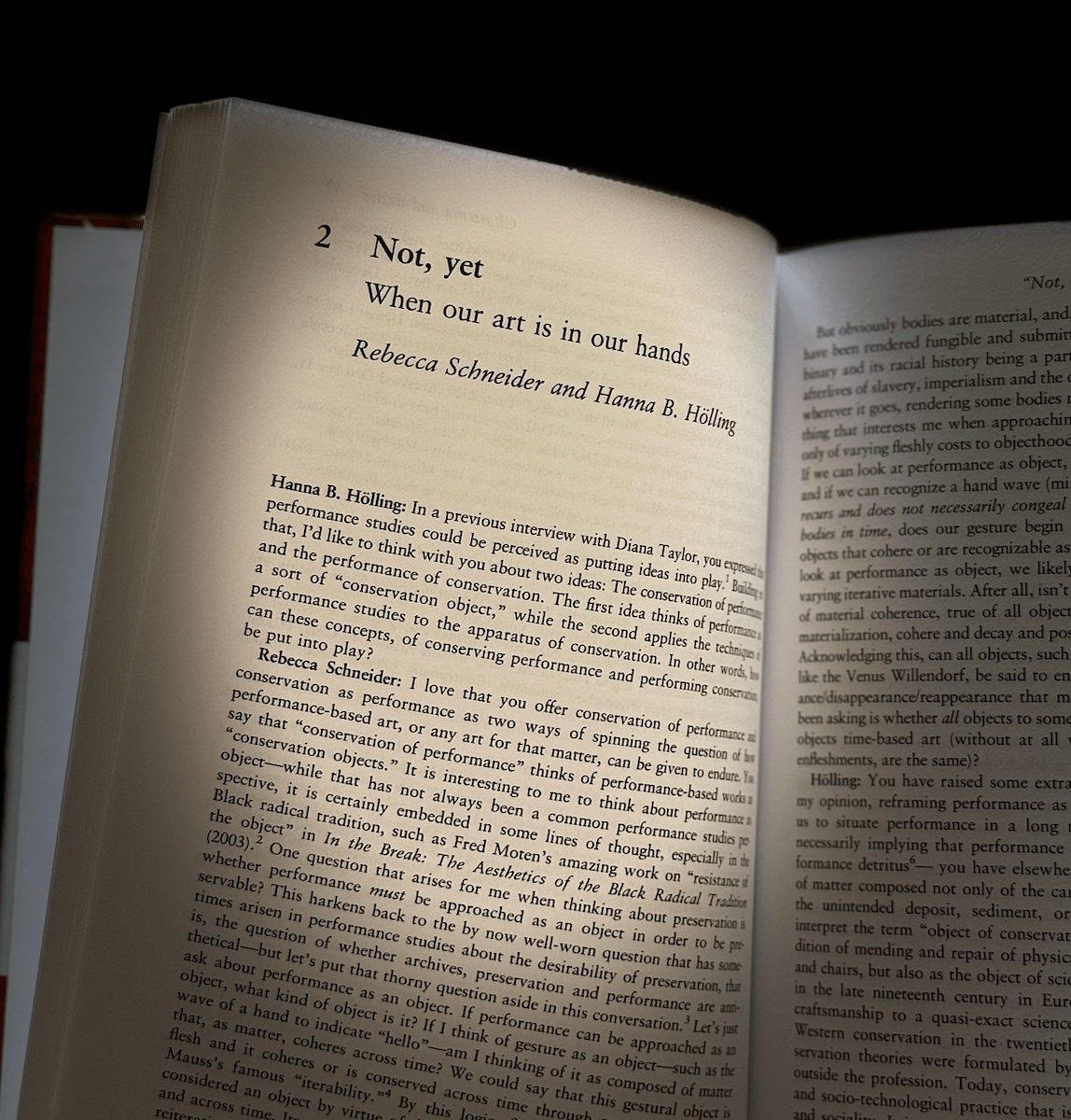
When we ask about how to conserve performance-based art, what are we asking? If we think of performance as itself a mode of conservation, what are we thinking? What is at stake in conserving changeability? Variability by design is as old as storytelling and the “changing same,” to quote Amiri Baraka, is a powerful mode of survivance. Thinking with hands, in this antiphonal call and response, a talking-with, Rebecca Schneider and Hanna Hölling consider what performance might teach us about endurance, duration, fungibility and the “not, yet.” What are the conditions in which the “not, yet” can thrive?
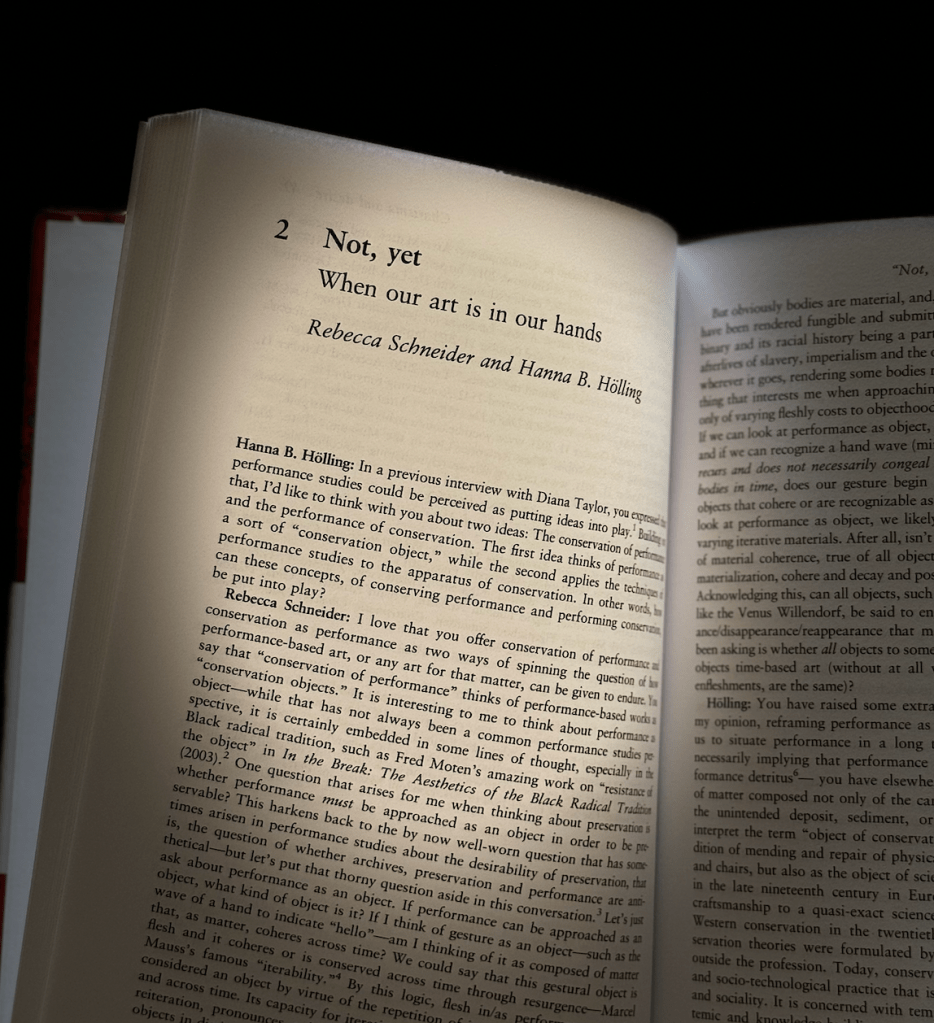
Hanna B. Hölling: In a previous interview with Diana Taylor, you expressed that performance studies could be perceived as putting ideas into play.1 Building on that, I’d like to think with you about two ideas: The conservation of performance and the performance of conservation. The first idea thinks of performance as a sort of “conservation object,” while the second applies the techniques of performance studies to the apparatus of conservation. In other words, how can these concepts, of conserving performance and performing conservation, be put into play?
Rebecca Schneider: I love that you offer conservation of performance and conservation as performance as two ways of spinning the question of how performance-based art, or any art for that matter, can be given to endure. You say that “conservation of performance” thinks of performance-based works as “conservation objects.” It is interesting to me to think about performance as object—while that has not always been a common performance studies perspective, it is certainly embedded in some lines of thought, especially in the Black radical tradition, such as Fred Moten’s amazing work on “resistance of the object” in In the Break: The Aesthetics of the Black Radical Tradition (2003).2 One question that arises for me when thinking about preservation is whether performance must be approached as an object in order to be preservable? This harkens back to the by now well-worn question that has sometimes arisen in performance studies about the desirability of preservation, that is, the question of whether archives, preservation and performance are antithetical—but let’s put that thorny question aside in this conversation.3 Let’s just ask about performance as an object. If performance can be approached as an object, what kind of object is it? If I think of gesture as an object—such as the wave of a hand to indicate “hello”—am I thinking of it as composed of matter that, as matter, coheres across time? We could say that this gestural object is flesh and it coheres or is conserved across time through resurgence—Marcel Mauss’s famous “iterability.”4 By this logic, flesh in/as performance can be considered an object by virtue of the repetition of its material instantiation in and across time. Its capacity for iteration, which is the same as its capacity for reiteration, pronounces a kind of endurance we generally have granted to objects in distinction to embodied live actions.
But obviously bodies are material, and, like other objects (such as commodities) have been rendered fungible and submitted to dehumanization (the human/thing binary and its racial history being a particularly noxious problem that drags the afterlives of slavery, imperialism and the ongoing capitalism of the Plantationocene wherever it goes, rendering some bodies more precarious than other bodies).5 One thing that interests me when approaching performance as object is the issue not only of varying fleshly costs to objecthood, but also the issue of varying time scales. If we can look at performance as object, granting iterability a kind of materiality, and if we can recognize a hand wave (mine, yours) as an object made of flesh that recurs and does not necessarily congeal into a sovereign body but jumps across bodies in time, does our gesture begin to share something with other material objects that cohere or are recognizable as objects in a world of objects in time? To look at performance as object, we likely have to employ varying time scales to varying iterative materials. After all, isn’t iterability, and endurance through a kind of material coherence, true of all objects in some respect? All objects, given to materialization, cohere and decay and possibly recohere at different temporal rates. Acknowledging this, can all objects, such as my gesture but also such as something like the Venus Willendorf, be said to engage in the dynamic playfield of appearance/disappearance/reappearance that marks performance? Perhaps what I have been asking is whether all objects to some degree cohere as performance? Aren’t all objects time-based art (without at all wanting to say that all objects, and all enfleshments, are the same)?
Hölling: You have raised some extraordinarily important questions here. In my opinion, reframing performance as “an object of conservation” could help us to situate performance in a long tradition of preserved objects, without necessarily implying that performance is an object or material entity, or performance detritus6 — you have elsewhere identified the latter as an amassment of matter composed not only of the carefully safeguarded fragment but also of the unintended deposit, sediment, or rubble. Conservation historians may interpret the term “object of conservation” as referring not only the long tradition of mending and repair of physical stuff such as statues, pictures, murals and chairs, but also as the object of scientific analysis and material studies that, in the late nineteenth century in Europe, helped elevate restoration from a craftsmanship to a quasi-exact science. Significant developments occurred in Western conservation in the twentieth century, during which the first conservation theories were formulated by humanities scholars, both within and outside the profession. Today, conservation is understood as both a discourse and socio-technological practice that is characterized by its plurality, diversity and sociality. It is concerned with temporal and relational matter. As an epistemic and knowledge-building activity, conservation positions the “object of conservation” as an “epistemic object” that arises from material and technological practices that ensure its continuity.7 For historians of science, epistemic objects are in a constant state of evolution; they are marked by an infinite potential. As an epistemic object, the conservation object has the capacity to continually acquire new properties and modify itself. Thus, these objects can never be fully themselves. Indeed, objects about which knowledge can never be fully attained are not objects but rather processes or performances that unfold and change over time.8
As you have mentioned, an object coheres or repeats on different time scales. We might then think of an object as a slow performance and performance as a quickly happening object that, as you have persuasively proposed, coheres and decays at different rates of resolution/dissolution. Gotthold Ephraim Lessing’s distinction between spatial art (e.g. painting) and temporal art (e.g. music)9 is once again challenged: Spatial art has similar qualities to temporal art and might be viewed as slow rather than fast. Moreover, this temporal perspective enables us to identify the artwork’s active and passive responses to time and the distinct ways in which various media undergo change. Artworks that actively engage with time, such as media installations, performance and events, experience faster change, while slower artworks like paintings and sculptures passively respond to time, as evidenced by the gradual yet steady degradation, decay and ageing of their physical materials. Objects and actions appear, again and again, as modulation and condensation of matter that radiates/moves at varying pace. But I would like to think more about the idea of gesture with you.
Schneider: To me, it is interesting that gesture is relational, even conceptually antiphonal, that is, iterable and open to the potential for response. If we apply the aesthetic of antiphony (or, better, call and response) to all objects and approach them as populating a reverberant world in which objects are “colleagues,” or in which objects, persons, and objects-as-persons “inter(in)animate” each other, then does a playing field for conservation widen?10 If gestures are objects and objects gestures—or are gestural—how does the scene of conservation amplify or extend its aims? Or, how does it change?
Hölling: Yes, to think about gesture is to imagine it being passed on through flesh and repetition. It involves recognizing its capacity to be reiterated as something always already citing, drawing from the past as always essentially reemergent, but also opening out toward something coming. However, does this reemergence qualify as a form of conservation? Does the ability to (re)iterate, which gestures towards both the past and the future as in the recursive “re-” and “pre-” enactment, pronounce a different kind of endurance, that, for us, functions as conservation, though it may not for others?
Perhaps exploring the notion of authenticity, or even better, identity, can shed light on the matter at hand. The debates surrounding authenticity delve into the manner in which an object, such as a chair or a mural, must meet specific identity criteria to be regarded as that particular chair or mural. (This raises the question of who determines these criteria.) In conservation, two theories of identity have recently come to the forefront. The first one asserts that an object—an artwork or an object of material culture—retains its identity only if all its constituent parts remain the same over time (with some physical alteration being acceptable). Examples of artworks that might adhere to this “mereological” theory are plenty: Leonardo’s Mona Lisa, Michelangelo’s David, and the majority of artworks that inhere in one individual manifestation and whose continuity is evident in their material structure linked to the artist’s autographic mark. The second theory of identity circumvents the issue of the numerical sameness of things over time. This theory is based on intuition and assumes that objects maintain their identity by tracing a continuous path through space-time. As long as an object sustains its form and shape, the gradual exchange of constituent components does not affect its identity, which is sustained through time.11 The wooden Shinto shrine in Ise, Japan, exemplifies spatio-temporal continuity. The shrine has been disassembled and rebuilt of new materials every twenty years for 1,300 years, thereby proving that its identity does not necessarily depend on the sameness of material components. This ritual of periodic reconstruction—shikinen sengu—preserves not the material aspect of a specific piece of architecture, but an ancient building tradition.12
In some instances, these two distinct perceptions of identity intersect in complex works such as multimedia installations, where an artwork’s sculptural element might remain physically unchanged while other elements, such as living plants or television monitors, are repeatedly replaced. Examples of such works can be found in Nam June Paik’s eco-electronic ensembles. More recently, the type-token distinction and the idea of multiple centers have been applied to further destabilize the perception of an authentic, original work.13 Despite these efforts, Western conservation still relies merely on the tacit agreement that the authentic work is a physical object that aligns with the material sameness and that this object is contingent on the involvement of the author-originator—an artistic genius guided by clearly definable intention. For works based on instruction, score or notation, and whose continuity is intermittent rather than physically continuous, the understanding of authenticity in relation to physical sameness is challenged.14 Conservators have coined the term “expressive authenticity”15 or “integrity” to refer to the preservation of an artwork. However, this still raises a similar question of who is entitled to decide about the aspects of sameness or difference and how these decisions are influenced by the prevailing cultural and knowledge systems in conservation— or what I refer to as the episteme of conservation.16 Today, we recognize that each conservation decision reinforces and upholds axiological systems that have historically favored Western values or what Ariella Aïsha Azoulay names the “imperial modality of art.”17 It is therefore crucial to acknowledge not only that the artwork/object undergoes changes and that the concept of authenticity is fluid, but also that the pluriversum of conservation—a vast range of conservation cultures—must incorporate principles different from those upheld by Western museums.
Returning to the notion of the object: What if we replaced “object” with “performance” in the phrase “the object of conservation”? Accordingly, rather than of “the object of conservation,” wouldn’t we speak of “the performance of conservation”? This experiment reintroduces, almost tautologically, the conservation action, the very act through which the work is conserved.
Schneider: Thank you for the reminder that performance, and the questions for conservation that it still raises, might continue to help us think deeply about the “imperial modality of art” that Azoulay unpacks. I think it is important to name that imperial modality as explicitly tied to white, liberal humanist Enlightenment traditions, in order to remember that the so-called West contains many otherwise modalities (and “genres of human”) upon which we might draw.18 But yes, as you suggest, let’s talk about the flip of your opening equation: conservation as performance. If one way to think about artwork is that all “objects,” whether composed of flesh or water or wood or stone (and you see that I am still working with what it can mean to consider performance an object, despite you saying that is not what you meant!), each cohere and decay according to different time scales, and if objects thus perform or in some way gesture by virtue of moving in and across time, then perhaps to conserve any object is to enter into a relationship with an ongoing in-time performance, no matter the materiality of composition. To conserve is to enter an ongoing or syncopated performance as a participant capable of and indeed engaged in “response-ability” (extending the call and response trope).19
Another way to say this, thinking with performance, is that working across time to conserve an object is entering into a relationship with that object— creating an object/conservator assemblage of multiple materialities in multiple time. If the conservator is (or the conservators are) live, and, we assume, flesh-based, then would the ongoing conservator/object assemblage be live art? If the object is performance and, say, composed of flesh-based dance (that is, bio bodies dancing in time), then the conservator dances as well, or sets the dance on other bodies, or otherwise decides about/enables flesh-to-flesh transmission. But if the object is stone? Well then, so too the conservator dances—or has an embodied and often highly choreographed intra-action with the stone-based object that is performing in geologic time.
Clearly what a conservator may achieve in a conservation-minded co-performance with an object may not only be an object’s material preservation for its on-stage and back-stage life as material, but the preservation of the conditions for engagement with said object as performance, as gesture, as sculpture, as painting, that is, as reverberant actant in a playfield that is always wider than the object itself, both in time and in space. A conservator’s performance is also participant in the broader preservation of the conditions for and the (ritualized) cultural investment in conservation itself. As is often noted, your performance, as conservator, takes place usually backstage in a theater designed for cross-temporal access, and your decisions concern the environmental theater of engagement by which the object’s gesture (say, the artwork that is my hand wave) can reverberate in an antiphonal relationship with the art object’s cross-temporal participants. Of course, it’s fascinating when preservation as performance is put center stage rather than backstage, as I recently witnessed in Ghent where the preservation of the Van Eyck Altarpiece was open to the public for certain hours of working days. Here “theater” takes its meaning as site for action, such as theater of surgery, theater of war. The theater of preservation is an operating theater, and the objects and conservators are the stage hands in tightly choreographed gestures of intra(in)animation.
Hölling: The “theater of preservation” as site for action implies the involvement of scripts, texts and actors-actants possibly (re)engaging in the acts of care. Theater of surgery connotes medical metaphors that frequently depict conservators as individuals responsible for sustaining the life of objects under their care, utilizing advanced technology for treatment and examination. This representation positions conservators as similar to doctors in terms of their attire (e.g. white gowns and scalpels at hand), the length of education, and approach to treating objects as if they were patients.20 Conservation narratives, which serve as connectors of the different temporalities of artworks and provide reasoning for decisions made, can support the textual dimension of the theater (my concept of the conservation narrative leans on Paul Ricoeur’s narrative theory).21 In addition, it is worthwhile to examine in greater depth the potential of the theater for restaging, that is, for a (ritualized?) repetition of a scripted play.
Let us delve further into the subject of time for another moment: Conservation with its sense of knowing (that is the way in which it metabolizes and creates different forms of knowledge) not only provides new perspectives on the work of art and its world, but also yields insights into its own formation of identity. Traditional conservation was thought to “return” a work of art to its past state, often seen as singular, originating from the artist—and even mythic—while making it available for the future. Although such views are rare amongst conservators today, the original past (including the artwork’s initial instantiations) still underpins the discourse, implicitly shaping decisions about the artwork’s future.
How can we challenge the temporal relationship that conservation has established between the present and the future, which assumes a linear and progressive notion of time? How can we introduce the idea of cross-temporal liveness and duration? Your brilliant proposal of understanding time as porous and having cross-temporal conversations shares commonalities with my own perspective on time as duration, inspired by the philosopher Henri Bergson. Performance is an excellent subject of study precisely because it defies the linear progression of time and embodies heterochrony.
Schneider: I agree with your insight that the degree to which we think of artworks as objects that undergo transformation and as objects with “many different pasts” requires us to “abandon” (your word again) the search for authenticity as existing in the past only. You invite us to question how authenticity might be a matter of change. That’s really a radical idea. It’s exciting to think about how an object’s authenticity might actually be in some deferred time, some future or other time. This point of view may be more comfortable for those who study theater than for those who study art history (“performance” is poised somewhat uncomfortably between the two, as the work of Shannon Jackson has long explicated22). Consider the deferral machine that is a script, for example. The “authenticity” of theater is always off of the script and into the queasy and always variable future of its (re)enactment. But isn’t that the same, at least to some degree, for other arts? Photography, for example, is constitutionally deferred in time both forward and back (and, some might want to say, to the side). You have written elsewhere that this cross-temporal dynamic “moves conservation away from its attempt to manage change (measured in an artwork’s former conditions) and toward a process intervening in the artwork’s temporality.”23 I’d love to hear more from you on that.
Hölling: I believe that artworks construct in the present a durational identity that “contains” many different pasts. This aligns with Bergson’s concept of duration, and I’m delighted that we share a passion for it. Duration refers to the survival of the past, in which the past exists alongside the present.24 According to Bergson, duration is an ever-accumulating ontological memory that is wholly, automatically and ceaselessly preserved. The duration of the current moment does not depose the moment that came before. Following this concept, in works that have the capacity to reoccur rather than endure, the present might be conceived of as the survival of the past. In other words, the past is actualized in the present—the only temporality to which we have unmediated access. Duration offers an alternative to traditional views of time (such as the Aristotelian inheritance, progressive linearity and chronology, including its figuration/diagrammatization, that historically governed conservation. The attachment of conservation to the authentic condition, the return of a work to its original intended state, and even the concept of restoration—conservation’s older sibling—demonstrate its adherence to the concept of time as a line (even if the timeline is “reversed,” as in restoration). If we replace this conventional understanding of time with durée, the works’ changeability will no longer be punctuated by singular conditions and states. Instead, they will exist unrestricted in a continuum, in which each instantiation of a work preserves the previous ones and simultaneously anticipates those that occur in the future.25 Shifting to Husserl, we can envision continuity as a state where each moment of protention becomes a retention of the next.26 And, in a similar vein, you suggest that that re-enactment is, in fact, a form of pre-enactment. Therefore, if artworks create a durational identity in the present that “contains” many different pasts, conservation can only be seen as an action that modifies and interprets objects by introducing ruptures, intervals and intermissions into what would otherwise be a continuum. Such a reorientation of conservation would move away from the attempts to “reclaim the past” or “restore the original” or “return the authentic object”—all of which rely on the concept of linear time that is explicitly or implicitly present even in contemporary conservation theories. However, we could also consider the possibility that conservation, instead of intervening in the work, can coexist with the artwork as a set of responsible practices that co-inhabit the time and space of these heterochronous works.
Schneider: The idea of “responsible practices” is resonant with antiphony. If we lift out the Latin root of responsible—“respondere” (answer in return)—to what degree is a conservator’s responsibility to “answer an object in return”? (And just a note in case it’s not overly obvious to our readers by now, we decided to create this chapter as a talking-with to formally engage a kind of call and response into our thought.) This of course implies that an object has also called. Or might call. Or might, in turn, respond. To think with antiphony might suggest that an object may have called and answered in a cross-hatch of historical encounters that reverberate. What part of an object is, in fact, the remains and returns of the flesh that has handled it? This question is not unrelated to the insights of paleoanthropologists that the human is an assemblage of hand and tool and that, with Leroi-Gourhan, the tool is not a tool without the hand just as the hand is not a hand without the tool.27 The “scriptive thing” that is the tool requires the component part, the hand, to be the object that it is.28 And so it is a flesh machine. But so too, flesh is an object machine. To conserve an object (and to conserve flesh) is to conserve a broader field of interinanimate component parts. This way of thinking again puts us in the realm of thinking with performance-based assemblage.
To acknowledge that an object’s very objecthood is punctuated by the intervals between and among its (re)appearances, and between and among itself and the bodies it interpellates or hails as co-participants, is to acknowledge changeability as a kind of core. To what degree does ritual keep that changeability at bay? Is encounter (and its repetitions) a kind of artifact that can be preserved as ritual or ceremony, thus bearing something that might be kin to what Amiri Baraka, writing about jazz, called the “changing same”?29 Can choreography regarding the object-flesh assemblage take a shape that preserves the artifact of/as encounter, even as changeability is the given condition where flesh time meets geologic time, paint time, clay time, wood time, etc.?
When we ask what it might mean to conserve change as essential to objecthood what are we asking? Conserving change can mean something as simple as preserving the conditions for engagement with an object given that engagement is always in time and variable over time. Here I am reminded of Robert Joseph’s discussion of the more-than-human masks of the Kwakwaka0wakw Nation of the Pacific Northwest. Chief Joseph is eloquent about the downtime of the wood and paint masks, which are acknowledged as having “a life of their own.”30 In fact, the masks dance the people, rather than the common settler-colonial assumption that it is humans who make masks dance. When they are not dancing the people, the masks are kept guarded and also hidden away. These are objects whose power moves in and out of performance-based engagements with the human beings who preserve the masks along with preserving the traditions of their animacy. In this, the humans, too, are preserved by the preservation of the masks. Many questions arise when thinking with this kind of performance-based object (and again, perhaps all objects are performance-based). I suspect we could here agree that all objects in human constellations have histories and traditions of use despite the fact that some objects, due to violence such as colonial plunder, have been robbed of those traditions and appropriated into other ritual traditions that preserve them differently (preserving them according to rituals of commodified Western art, say, rather than rituals of potlatch, etc.). We are likely more comfortable acknowledging the human history of an object’s use than we are acknowledging the coparticipation, or actancy, of an object or thing in its intra-action with humans. We usually assume that it is the humans who are responsible for the actions and conditions of objects and not the objects themselves or, better, the assemblage that is objects and persons. In the Kwakwaka0wakw ritual of the Potlatch, there are demands made by the “object” itself upon the other actants who engage with it, and as Chief Joseph relates, even while hidden when not on display an object can wield an incredible power. I am speaking of more than simply honoring an object as the object demands. I am suggesting in addition that what is preserved may also be a ritual assemblage. I am saying that part of what constitutes the object itself is its fleshly relations and the constellation of those relations is co-determined by the (ritual) object and the (ritual) participants that engage it, whether in a museum or a gallery, a temple, private dwelling, or a Kwakwaka0wakw big house. We are made by our objects just as much as we make our objects. Or said another way, we make our objects, but, simultaneously, the objects we make make us.
Hölling: To “conserve” the changeability of such objects—or objects in or as their changeability—might thus require decisions related to the cultivation of their actancy. If the new conservation is to rely on the expanded concepts of human and nonhuman agency, the crucial question must be, How is it being done? Does conservation of agential objects mean allowing them to fully dictate their conditions of care? Would conservation shift entirely into a performative paradigm, leaving aside the dead matter of fixity and authenticity? It couldn’t get more interesting.
Continue reading here.
DOI: 10.4324/9781003309987-4
This chapter has been made available under a CC-BY-NC-ND 4.0 license.
Notes
1 Rebecca Schneider and Diana Taylor, “What is Performance Studies?” Hemispheric Institute 2007, https://hemisphericinstitute.org/en/hidvl/hidvl-int-wips/item/1344-wipsrschneider. html.
2 Fred Moten, In the Break: The Aesthetics of the Black Radical Tradition (Minneapolis: University of Minnesota Press, 2003).
3 For a treatment of debates around that question see Rebecca Schneider, Performing Remains: Art and War in Times of Theatrical Reenactment (New York: Routledge, 2011).
4 Marcel Mauss, “Techniques of the Body” (1935), in Techniques, Technology, and Civilization, ed. Nathan Schlanger (New York: Durkheim Press, 2006), 77–96, esp. 81. See also Rebecca Schneider, “That the Past May Yet Have Another Future: Gesture in the Times of Hands Up,” Theatre Journal 70, no. 3 (Spring 2018): 285–306.
5 See the work of Sylvia Wynter in Sylvia Wynter: On Being Human as Praxis, ed. Katherine McKittrick (Durham, NC: Duke University Press, 2014). On “flesh” in distinction to the body as sovereign, and bearing on both materiality and history (in the afterlives of slavery’s capitalism), see Hortense Spillers, “Mama’s Baby, Papa’s Maybe: An American Grammar Book,” Diacritics 17, no. 2 (1987): 64–81. See an explication of Black Feminist thought that bears on my orientation here in Alexander Weheliye, Habeas Viscus: Racializing Assemblages, Biopolitics, and Black Feminist Theories of the Human (Durham, NC: Duke University Press, 2014). On the word “Plantationocene” to replace Anthropocene, see Greg Mittman, “Reflections on the Planationocene: A Conversation with Donna Haraway and Anna Tsing,” Edge Effects Magazine, June 18, 2019, https://edgeeffects.net/haraway-tsing-plantationocene.
6 Rebecca Schneider, “Slough Media,” in Remain, ed. Iona B. Jucan, Jussi Parikka, and Rebecca Schneider (Minneapolis: University of Minnesota Press, 2019), 68.
7 I pursued the topic of conservation as epistemic practice during my research project Conservation and Contingency: On Realms of Theory and Cultures of Practice at Max Planck institute for the History of Knowledge in Berlin in 2015. See Hanna B. Hölling, “The Technique of Conservation: On Realms of Theory and Cultures of Practice,” in “The Future of Conservation,” Special issue, Journal of the Institute of Conservation 40, no. 2 (2017): 87–96, https://doi.org/10.1080/19455224.2017.1322114.
8 The idea of unfolding objects was discussed by Pip Laurenson in her lecture “Can Artworks Live in a Museum Collection?,” Institute of Fine Arts, New York University,September 29, 2016, https://vimeo.com/184868009. Laurenson refers to Knorr Cetina’s notions of relational and creative practice and her concept of epistemic objects (things that we engage with during our knowledge-producing activities) and explores the possibility of conceptualizing unfinished, incomplete objects—in other words, unfolding works—as epistemic objects of both conservation and artistic practice.
9 Gotthold Ephraim Lessing, Laocoön: An Essay upon the Limits of Painting and Poetry, trans. E. C. Breasley (London: Longman, Brown, Green and Longmans, 1853).
10 On call and response see Thomas DeFrantz and Anita Gonzalez, “Introduction,” in Black Performance Theory, ed. DeFrantz and Gonzalez (Durham, NC: Duke University Press, 2014). On objects as colleagues, see Kim Tallbear, “Standing with and Speaking as Faith: A Feminist Indigenous Approach to Inquiry,” Journal of Research Practice 10, no. 2 (2014). On “inter(in)animation,” see Rebecca Schneider, “Intrainanimation,” in Animism in Art and Performance, ed. Christopher Braddock (New York: Springer, 2017), 253–175.
11 Spatio-temporal continuity is often claimed when objects follow an unbroken spatiotemporal path. I assume in this discussion that tracing such a continuous path permits some change of parts and thus partial intervals of discontinuity as long as the form of objects is preserved.
12 Cassana Adams, “Japan’s Ise Shrine and Its Thirteen-Hundred-Year-Old Reconstruction Tradition,” Journal of Architectural Education 52, no. 1 (September 1998): 49–60.
13 Brian Castriota, “Variants of Concern: Authenticity, Conservation, and the Type- Token Distinction,” Studies in Conservation 67, no. 1-2 (2022): 72–83; Brian Castriota, “Object Trouble: Constructing and Performing Artwork Identity in the Museum,” ArtMatters Special Issue 1 (2021).
14 For related concerns, see Hanna B. Hölling, “Unpacking the Score: Notes on the Material Legacy of Intermediality,” On Curating: Fluxus Special Issue 51 (2021), http://www.on-curating. org/issue-51-reader/unpacking-the-score-notes-on-the-material-legacy-of-intermediality. html.
15 For the notion of expressive authenticity as differing form nominal authenticity, see Jerold Levinson, see Denis Dutton, “Authenticity in Art,” in The Oxford Handbook of Aesthetics, ed. Jerold Levinson (New York: Oxford University Press, 2003); and Hanna B. Hölling, Paik’s Virtual Archive: Time, Change and Materiality in Media Art (Oakland: University of California Press, 2017), 49.
16 The word “episteme” stems from the old Greek “epistamai,” meaning to be acquainted with, to understand. The contemporary use of the word—and my meaning—is to signify a principled system of understanding.
17 Ariella Aïsha Azoulay, Potential History: Unlearning Imperialism (London, New York: Verso, 2019).
18 “Genre of the human” is Sylvia Wynter’s phrase. Human(ist) Man, and especially the modern variety of homo oeconomicus, is a genre of human whose imperial modality is essentially anti-Black. It is in the context of anti-Blackness that Fred Moten addressed the resistance of the object, cited at the opening of this conversation—one that he later engages as “(non)performance.” Preserving performance may be, as I begin to suggest later in this conversation though not in these terms, preserving the conditions for (non)performance. See Sylvia Wynter, “Unsettling the Coloniality of Being/Power/Truth/Freedom: Towards the Human, After Man, Its Overrepresentation— An Argument,” CR: The New Centennial Review 3, no. 3, (Fall 2003): 257–337. See Fred Moten, “Some Propositions on Blackness, Phenomenology, and (Non)Performance,” in Points of Convergence: Alternative Views on Performance, ed. Marta Dziewańska and André Lepecki (Warsaw: Museum of Modern Art in Warsaw, 2017), 101–107. See also “The Erotics of Fugitivity” in Fred Moten, Stolen Life (Durham: Duke University Press, 2018), 241–267.
19 On “response-ability” see D. Soyini Madison, Acts of Activism: Human Rights as Radical Performance (Cambridge: Cambridge University Press, 2010), 10–12.
20 On this topic, see Sarah Molina, “Sustaining the Lives of Art Objects,” AMA Journal of Ethics 21, no. 5 (May 2019), doi: 10.1001/amajethics.2019.450.
21 Paul Ricoeur, Time and Narrative, trans. Kathleen McLaughlin and David Pellauer (Chicago: University of Chicago Press, 1984).
22 Shannon Jackson, Professing Performance (Cambridge: Cambridge University Press, 2004).
23 Hanna B. Hölling, “Time and Conservation,” in ICOM-CC 18th Triennial Conference Preprints, Copenhagen, 4–8 September 2017, ed. J. Bridgland (Paris: International Council of Museums, 2017).
24 Henri Bergson, Time and Free Will, trans. F. L. Pogson (London: Elibron Classics, 2005 [1889]). See also Gilles Deleuze, Bergsonism, trans. Hugh Tomlinson and Barbara Habberjam (New York: Zone Books, 1991 [1966]).
25 For a temporal critique of conservation, see Hölling, “Time and Conservation.”
26 In his phenomenology of temporality, Husserl’s rejects an understanding of the experience of the world as a series of unconnected instances. Protention (an anticipation of the next moment), though distinct from immediate experience, is retained in consciousness; it relates to the perception of the moment that has yet to be perceived. Continuity rests on the idea that each moment of protention becomes a retention (a perceptual act retained in consciousness) of the next. For the temporal experience in Husserl’s phenomenology, see Christoph Hoerl, “Husserl, the Absolute Flow, and Temporal Experience,” Philosophy and Phenomenological Research 86, no. 2 (March 2013): 376–411.
27 See Carrie Noland’s reading of Leroi-Gourhan in Agency and Embodiment: Performing Gestures, Producing Culture (Cambridge, MA: Harvard University Press, 2010), 93–129.
28 Robin Bernstein, “Dances with Things: Material Culture and the Performance of
Race,” Social Text 27, no. 4 (2009): 67–94.
29 See Nathaniel Mackey, “The Changing Same: Black Music in the Poetry of Amiri
Baraka,” Boundary 2, 6, no. 2 (1978): 355–386.
30 Robert Joseph, “Behind the Mask,” in Down from the Shimmering Sky: Masks of
the Northwest Coast, ed. Peter MacNair, Robert Joseph, and Bruce Grenville, (Seattle: University of Washington Press, 1998), 20.
 Performance: Conservation, Materiality, Knowledge