
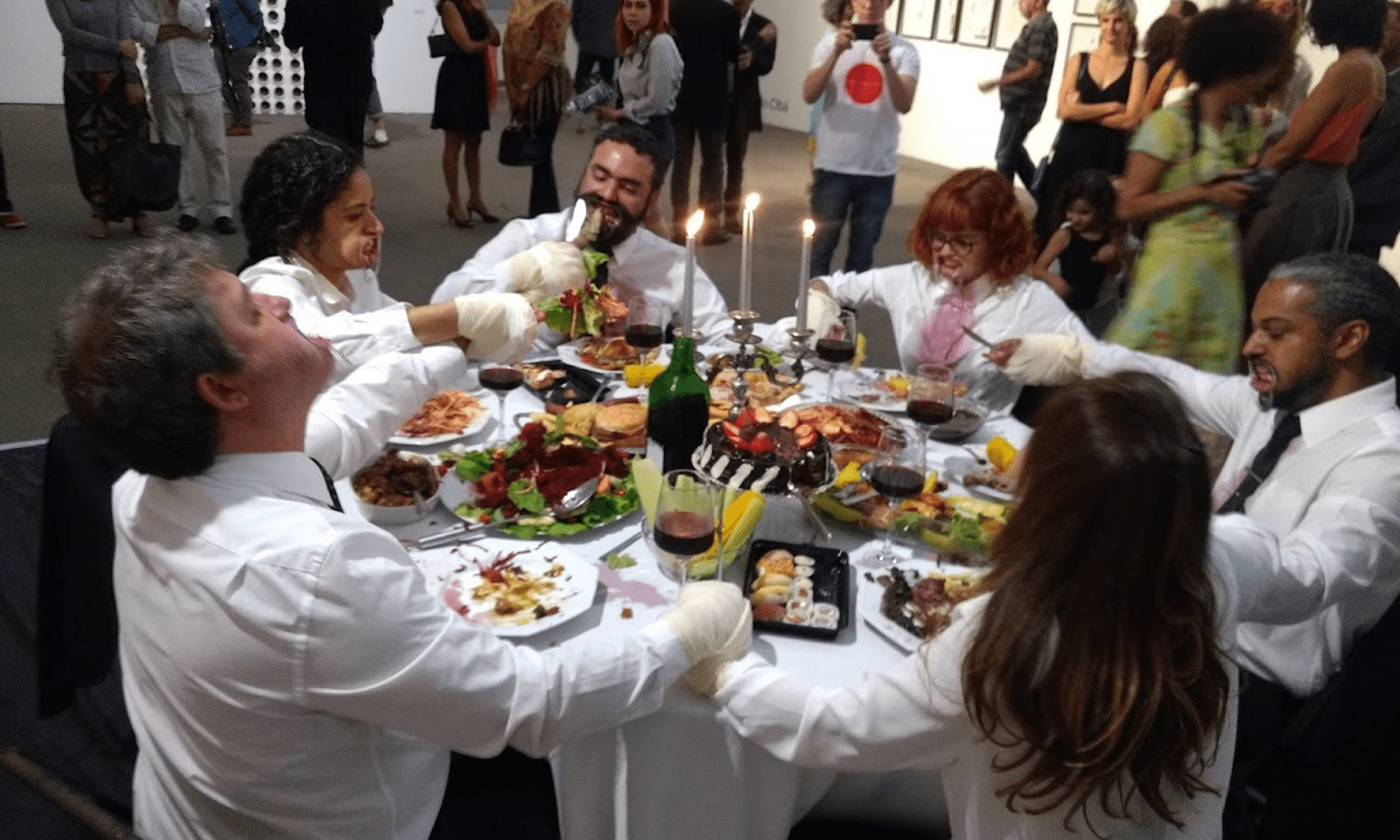
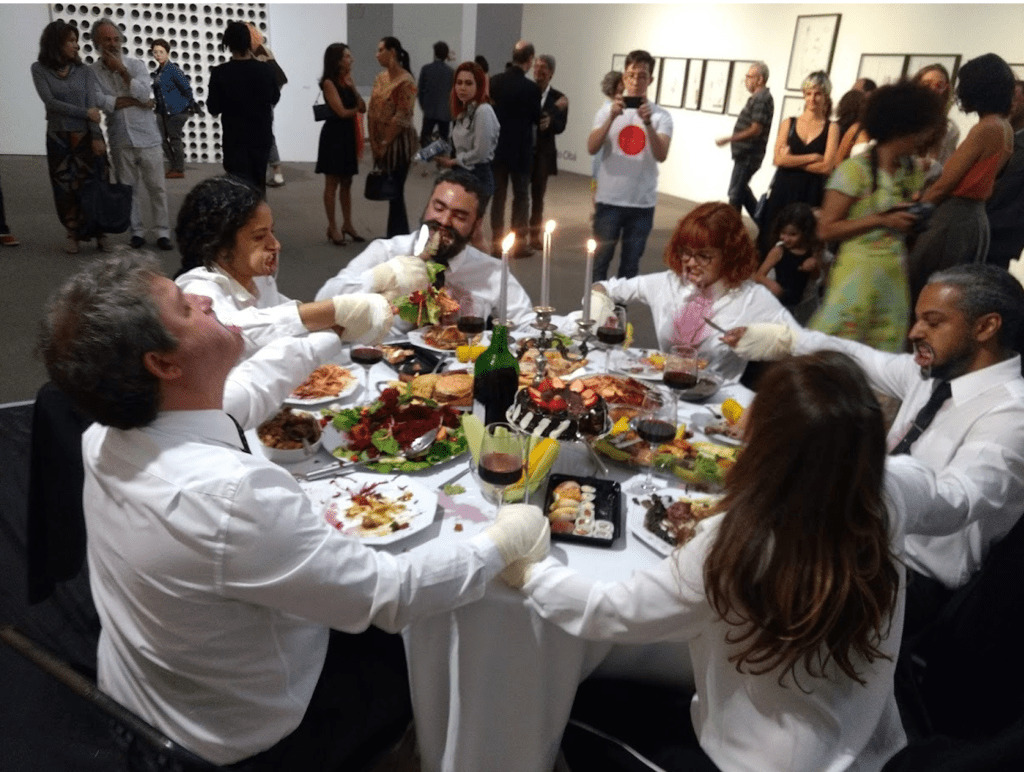
The acquisition of performance art by museums often faces resistance from directors and board members due to its ephemeral nature. Unlike other art forms, such as sculptures or paintings, performance art exists at a specific time and, sometimes, in a particular place. Additionally, a living body (or several) is typically required for the institution to exhibit the work. As a result, the museum must have the financial resources to support this and must gather and produce extensive documentation to activate a performance as intended by its creator. While we acknowledge that performance art has been present in museums since the 20th century, its acquisition by these institutions has been relatively rare.
Taking this into account, the Musealization of Art (mARTE) research group has started a four-year project named “Protocols for Musealization of Performance Art Conducted by Public Museums”, funded by the National Council for Scientific and Technological Development (CNPq) – a Brazilian government agency. The goal of the project — which started in 2022 and is therefore heading to its final phase — is to provide a guide with protocols to facilitate the collection of performance art in Brazilian public art museum collections. These preservation guidelines consider four topics: [1] artwork identification, that is, the cataloging process; [2] conservation plan; [3] activation plan, which includes contracts and other legal aspects; and [4] activation history. Eleven researchers — museologists, conservators, art historians, and sociologists — from several Brazilian academic institutions are contributing to the project.
The concept of “musealization” is central to this project. Brazilian scholars Bruno Brulon and Marília Xavier Cury define musealization as a process that encompasses a series of actions directed towards an object (Brulon, 2018; Cury, 2020). Therefore, merely acquiring an artwork is not enough to musealize it; the artwork must also be preserved, exhibited to the public, and generate knowledge. According to Silva, Oliveira, and Côrtes (2023: 9), the musealization process involves different times and spaces, encompassing both artistic production and institutional procedures related to the preservation, research, and communication of the artwork and its narratives. Similarly, Brulon (2018: 220) argues that the musealization process incorporates every aspect of an object’s life within a museum collection. In other words, the musealization process is a continuous cycle that occurs throughout the entire lifespan of an object or artwork as part of a museum collection.
It is not until very recently that Brazilian museums began to acknowledge how essential specialized staff is for the continuity of their collections. Notably, in public institutions, small, unequipped staff is still a reality. Particularly in the institutions holding contemporary art collections, the dissociation of information is a major conservation problem, with some artworks never being re-exhibited or activated after acquisition due to the lack of instructions. Consequently, some artworks remain dormant in storage. Regarding Performance Art in its various forms, some museums in Brazil do not even acknowledge they collect them, although some performances are already part of their collections.
This issue arises in part from inadequate documentation protocols, particularly concerning the terminology used during the cataloging process. The diverse forms and mediums in which performance art manifests—such as photos, videos, live actions, and their associated records, residues, and other physical materials—create challenges for museum staff in determining what exactly needs to be preserved. For those without a specialization in contemporary art, classifying and handling these artworks and objects can be especially difficult.
Language barriers can also play a role. The literature on performance art is mostly written in English, rather than in Latin languages. The only thesaurus for museum collections (Ferrez, 2016) in Brazilian Portuguese[1], which has been frequently used in museological institutions throughout Brazil, does not comprise some contemporary art forms, and the art of performance does not appear in its categories and subcategories. As a result, a performance that includes the medium of photography might be included in the museum collection as photography, and a performance that encompasses video, as video art, for example.
Moreover, while some English terms used by conservators and art historians in relation to performance art have direct equivalents in Brazilian Portuguese, these words are not commonly used in everyday language. Therefore, recognizing linguistic particularities is crucial when creating a guide tailored to museum staff.
Based on our experiences as researchers and museum professionals, we identified a gap in Brazilian documentation manuals concerning ephemeral, time-based art, such as performance. Although the conservation of contemporary artworks is a well-established field of academic discussion in Brazil, this knowledge has not yet fully permeated museum staff practices. As a result, the number of performances cataloged in public museum collections remains low (Caetano, 2019).
In the initial stage of our research, focused on a national scale, we observed a preference for acquiring delegate or delegable performances. We hypothesize that this preference is linked to concerns over copyright and patrimonial rights, with the separation of the performing body from the artist’s identity serving as a strategy to ensure the artwork’s continuity. However, if a museum intends to acquire delegate or delegable performances, this aspect must be clearly specified in the acquisition terms, including legal contracts and certificates of authenticity. Additionally, the identity report for the work should outline the characteristics of potential performers, the training process required for them to perform the work, and other relevant details.
Following the initial phase of the project, which involved bibliographical and documentary research, we conducted interviews with museum professionals from several Brazilian cities, including São Paulo, Recife, Belém, Salvador, and Rio de Janeiro.
Based on our conversations, we identified five main challenges faced by museum staff:
- Limited knowledge on how to acquire performance art, particularly concerning initial documentation.
- Insufficient information about objects already in the collection, specifically how performance materials or traces should be interpreted—are they documentation or artwork?
- Uncertainty about the artist’s role in this process: Is there a limit to the information and materials the artist should provide to ensure the integrity of the performance and its adaptations? This involves negotiating between the parties involved.
- Issues related to creative, intellectual property, and patrimonial rights under Brazilian law.
- Questions regarding which documents should be included in the artwork dossier—from materials created by artists and specialists to documentation and conservation records maintained by the institution.
Following the interviews, we decided to define the parameters of an artwork dossier is, to facilitate the creation of a structured guide:
A dossier is a collection of documents about a work of art, which can be composed of contracts, interviews, clippings, descriptive memorial, terms, technical specifications, photographs, and other materials to preserve the artistic work of an institution. In some cases, documents composing the dossier are linked to administrative or museum documents. Additionally, the artwork dossier represents the process of musealization of the piece, including previously created materials, as well as all technical procedures (collection management) conducted at the institution.
We used this definition to establish the steps and documents that compose the dossier, as well as the responsibilities of the institution and the artist or the work’s legal guardian at each stage and for each document throughout the acquisition, documentation updates, and artwork activation processes.
Some of the projects that inspired our own include The Live List: What to Consider When Collecting Live Works, Performance at Tate: Into the Space of Art, Performance at Tate: Collecting, Archiving and Sharing Performance and the Performative, and Performance Conservation, Materiality, Knowledge. The inquiries and materials produced by these projects helped us develop this work, which is based on Brazilian case studies and considers the challenges faced by Brazilian public museum management, particularly in light of the available financial and human resources.
We hope this guide will contribute to the future acquisition of performance art and the management of existing artworks in Brazilian collections, including installations, with appropriate adaptations. The guide also promotes a more thorough analysis of performance remnants found in museum depots, as it takes into account all the elements present before, during, and throughout the institutional life of an artwork in its musealization process. Additionally, most performance artworks in Brazilian museum collections have not yet been reactivated since their acquisition. In this regard, the guide could suggest actions to exhibit these works, emphasizing the possibility of change through conservation practices that allow for adaptation based on previously collected data.
The protocols we propose will open new avenues for the preservation of performance art and contribute to documenting the history of this art form in Brazil. We are aware that every publication has a limited lifespan, as artists continually create in new media and present fresh challenges to institutions. We also recognize that this guide may not address all realities, but it represents a valuable attempt to simplify the process and assist professionals working in Brazilian public museums.
Finally, we hope this guide will spark necessary conversations on the musealization of performance art in Brazil by proposing efficient and straightforward methods for acquiring this art form, which still appears to be a near impossibility for museum collections.
Contributors: The guide is being developed by Anna Paula da Silva, Bianca Tinoco, Daniela Félix, Emerson Dionisio de Oliveira, Fernanda Werneck Côrtes, Juliana Caetano, Magali Sehn, and Renata Padilha
To know more about mARTE group’s projects, visit: https://musealizacaodaarte.ufba.br/projetos.
UPDATE August 2025: The handbook Guide for the Preservation of Performance Art in Brazilian Public Museums has just been published. Launched during the group’s 5th Colloquium, held in Porto Alegre, Brazil, at the beginning of June 2025, the publication is the result of the research project Protocols for the Musealization of Performance Art Conducted by Public Art Museums, funded by Brazil’s National Council for Scientific and Technological Development (CNPq). It also received institutional support from the Brazilian Institute of Museums (Ibram). Access the guide here (Portuguese only):
https://musealizacaodaarte.ufba.br/wp-content/uploads/2025/05/Guia-para-Preservacao-da-Arte-da-Performance-em-Museus-Publicos-Brasileiros.pdf
References
Brulon, Bruno. “Passagens da Museologia: a musealização como caminho”. Museologia e Patrimônio 11, no. 2 (2018): 189-210.
http://revistamuseologiaepatrimonio.mast.br/index.php/ppgpmus/article/view/722/657.
Caetano, Juliana Pereira Sales. “Performances de arte em museus brasileiros: documentação, preservação e reapresentação”. MA diss., University of Brasília, 2019.
Cury, Marília Xavier. “Metamuseologia: reflexividade sobre a tríade museália, musealidade e musealização, museus etnográficos e participação indígena”. Museologia & Interdisciplinaridade 9 no. 17 (2020): 129-146.
https://doi.org/10.26512/museologia.v9i17.29480.
Ferrez, Helena Dodd. Tesauro de objetos do patrimônio cultural nos museus brasileiros. (Secretaria Municipal de Cultura do Rio de Janeiro, 2016).
https://tesauromuseus.com.br/download/tesauro.pdf.
Silva, Anna Paula; Oliveira, Emerson Dionisio Gomes de; Côrtes, Fernanda Werneck. “Introdução”. In Musealização da Arte, edited by Anna Paula da Silva, Emerson Dionisio Oliveira, and Fernanda Werneck Côrtes (Editora Appris, 2023).
Publications by mARTE researchers on performance musealization
Caetano, Juliana Pereira Sales; Oliveira, Emerson Dionisio Gomes de. “Séries e versões na documentação e preservação de performances em arte: Os Puxadores”. EM QUESTÃO 26 (2020): 186-209, https://doi.org/10.19132/1808-5245261.186-209.
Félix Martins, Daniela. “Before the Performance: contributions of speculative pragmatism to the sociology of art”. Revista Brasileira De Estudos Da Presença 13 no. 3 (2023): 1–29, https://doi.org/10.1590/2237-2660129256vs02.
Oliveira, Emerson Dionisio Gomes de; Silva, Anna Paula da; Côrtes, Fernanda Werneck; Caetano, Juliana Pereira Sales. Eds. “Musealização da Performatividade em coleções públicas e privadas”, dossier. Museologia & Interdisciplinaridade 9 no. 18 (2020), https://doi.org/10.26512/museologia.v9i18.
Silva, Anna Paula da; Oliveira, Emerson Dionisio Gomes de. “O Pipoqueiro da Festa: programas de performances em museus”. Revista da Fundarte 49 (2022): 1-23, https://doi.org/10.19179/rdf.v49i49.904.
Tinoco, Bianca Andrade; Albarrán Diego, Juan. “La institucionalización y el coleccionismo de performance en museos españoles”. MODOS: Revista de História da Arte 5 (2021): 100-117, https://doi.org/10.20396/modos.v5i2.8664764.
[1] Helena Dodd Ferrez and Maria Helena S. Bianchini first published the Thesaurus for Museological Collections (Thesaurus para Acervos Museológicos, in Brazilian Portuguese) in 1987. Then, in 2016, Ferrez published the Thesaurus for objects of cultural patrimony at Brazilian museums (Tesauro de objetos do patrimônio cultural nos museus brasileiros), an updated version of the 1987 thesaurus, more in synchronicity with conceptual changes experienced by the museological field.
 Performance: Conservation, Materiality, Knowledge
One Reply to “”