
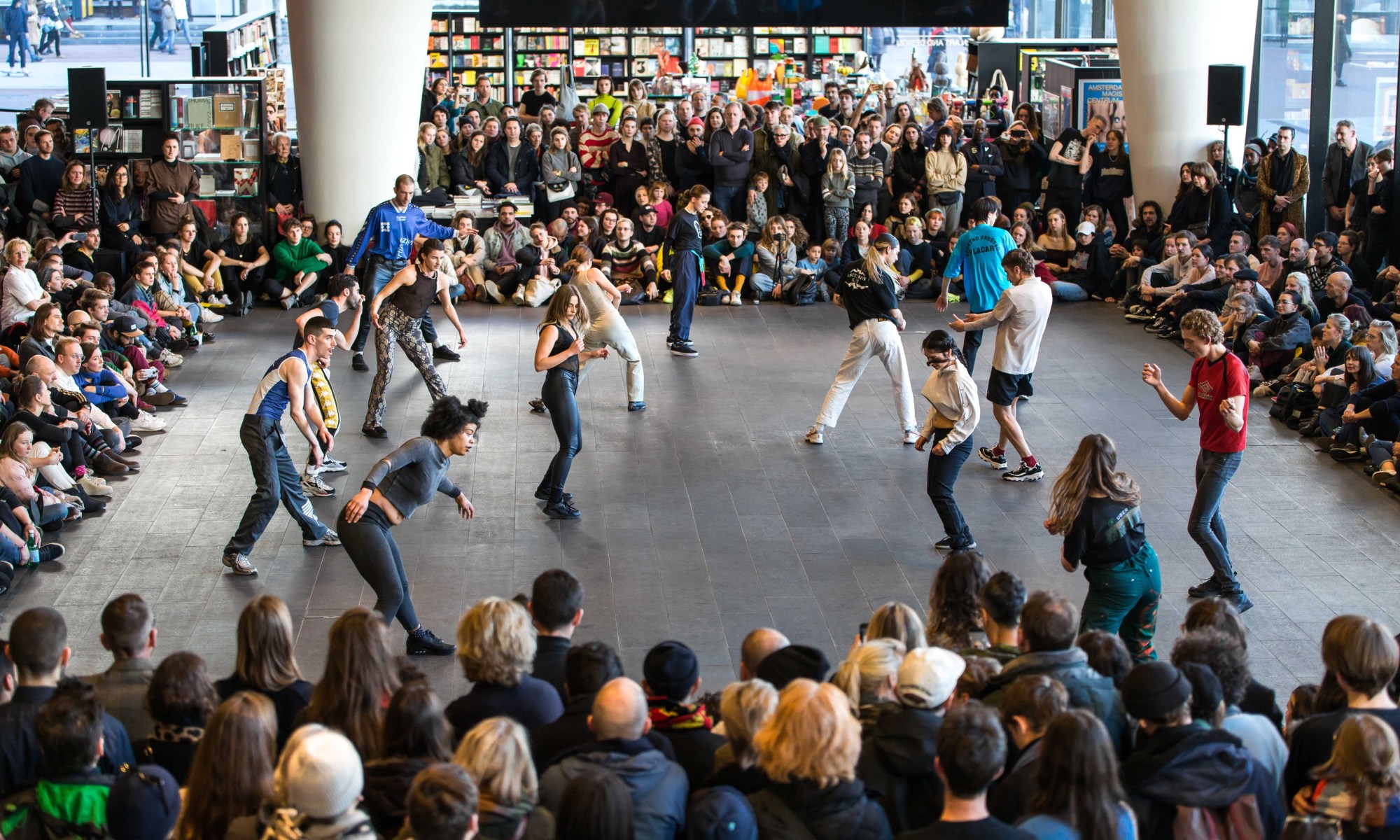
Emilie Magnin, a member of our research project and doctoral student at the University of Bern and Bern Academy of the Arts, has published an article that provides valuable insights into recent approaches to performance conservation. Below is an excerpt from the article, which is fully available as Open Access here.
As many disciplines are beginning to reckon with their contributions to historical injustices, so conservation must acknowledge and reflect on the number of its practices that continue to reinforce colonial and imperial legacies. Though such work is currently taking place in ethnographic museums, rethinking conservation and repairing its harms should be the aim of the entire museum community. Using case studies drawn from performance art, this paper demonstrates how performance challenges traditional paradigms of institutional collecting and conservation, and calls for a rethinking of certain museum procedures. It proposes the emerging scholarship on performance art conservation as a potential force for an expanded definition of conservation that puts people at its center. To this end, it presents performance as not only a conservation object to be cared for, but also a tool to care with, reframing the aim of conservation as preserving the vitality of relationships between objects and communities.
Introduction
As a product of Enlightenment ideology, the modern museum is inextricably bound up with Europe’s imperial history. Ariella Aïsha Azoulay describes how collecting institutions and museums were initially conceived to display goods and artifacts plundered by European colonial powers. Early museums were designed by wealthy, educated, white European men and followed their logic of classification, hierarchization, and interpretation. These inherited methodologies have only recently begun to be scrutinized and criticized.
These colonial legacies remain in institutions today, yet their violence often goes unacknowledged, residing in the most mundane tasks and procedures of museum operations such as wall labels, modes of categorization and display, and access policies. Even the vocabulary in use demonstrates the narrative of authority and control that such institutions continue to follow: national museums holding public collections “grant” or “allow” access to these collections for researchers – and often reluctantly. Conservation – which has long considered itself a scientific, objective, and neutral discipline – has begun to realize that many of its practices reinforce colonial and imperial legacies. Investigative vocabularies and methods of conservation, however, remain extractive and one-sided: conservators must “capture” all of the information available about an artwork in an “exhaustive” manner. Does this forensic treatment and examination of artworks with methods akin to those employed by the police not also imply a sense of violence?1
Although it is primarily in relation to ethnographic and historic collections that the process of recognizing museums’ colonial heritage, and conservation’s entanglement with colonial practices, has occurred, all fields of conservation must urgently examine their ties with their colonial past. I believe that the developing field of performance art conservation can both benefit from and contribute to these debates. Performance art, an ephemeral form with no enduring physical object, has long been thought to lie outside the bounds of conservation, with its traditional focus on material integrity. It is only following the recent interest shown by museums in performance that conservation has turned its attention to this art form. Like conservators of ethnographic collections and cultural heritage, performance conservators engage with both tangible and intangible resources, including documents, objects, places, people, and communities of practice that require complex care.2 Oral history, collective memory, body-to-body transmission, and reinterpretation all play a crucial role in perpetuating both cultural heritage and performance art, yet these practices have long been disregarded by traditional conservation. Indeed, these two fields have led to significant developments in the discourses and practices of conservation, expanding and sometimes fundamentally redefining it. Examples include accepting use and change as inherent features of the ongoing vitality of cultural objects, and understanding conservation as a collective activity that embraces cycles of activation and reinterpretation as important to the continuity of artistic and cultural practices.
However, as my analysis will show, broader institutional apparatuses still restrict these efforts, as museums struggle to relinquish their narratives of control. Conservation advances through the collective efforts of artists, conservators, curators, and communities to circumnavigate these failings, but museum structures nevertheless require a fundamental change of framework if they are to care for performance pieces (and their many other cultural belongings) more holistically. This then calls for further joint efforts from conservation communities to bring about change from within.
Conservation: a history of violence?
The history of Western conservation, in spite of its alleged neutrality, is closely tied to colonial history and the values that underpin it3 and many of its practices remain problematic. Although conservation often takes place “behind the scenes,” in laboratories and warehouses to which access is restricted, its direct and intimate contact with art objects carries a great potential for harm when it comes to mistreating, even unintentionally, the objects in its care.
Given the colonial provenance of many of these collections, the ties between conservation and colonialism were first problematized in the field of ethnographic collection care. This occurred largely in the context of repatriation claims, where the argument of proper conservation has often been used by museums to not restitute the objects in question, allegedly because the claimants would not be able to meet the conditions necessary for their preservation.4 However, many Indigenous communities have pointed to the inadequacy of Western conservation methods for cultural artifacts that are considered alive by their communities of origin. The conservator Miriam Clavir contends that preserving an object’s symbolic or spiritual value can take precedence over its physical integrity, and that reconnecting objects to their communities is an integral part of cultural preservation (p. 72). She therefore recognizes source communities as important stakeholders, who must be involved in the preservation of their own cultural heritage. Her writing went on to inspire the conservation theorist Salvador Muñoz Viñas, who states that interrogating “why, and for whom, the conservation process is done,” as well as “for whom the object is meaningful,” should influence the preservation of objects in all fields of conservation (p. 170). Noémie Étienne also suggests that gestures of care and repair within conservation can contribute to undoing colonial harm in museum collections by giving access to art and cultural heritage.
Recent theories of conservation thus mark a shift from a largely material-oriented approach toward an understanding of cultural objects as gaining significance through the relationships that actors weave with them. Following this turn, several resolutions and projects have emerged that promote the inclusion and participation of source communities in conservation decisions.5 In ethnographic museums – primarily in North America and Oceania, given the proximity to communities of origin in these regions – conservators are made aware of how to care for objects that need to be regularly fed, exposed to sunlight, or kept away from plastic containers. Indigenous communities can also access and use ritual objects on certain occasions. Yet these examples are still far from the norm, and Western conservation too often excludes other worldviews and methods as unscientific or unsuited for museum collections. This situation (in addition to other socio-economic factors) might also perpetuate the underrepresentation of Indigenous people in the conservation profession.
Indeed, conservation procedures more broadly still rely on antiquated – and unchallenged – value systems that are often synonymous with extraction and accumulation. Fowler in her analysis of the condition report (an institutional document detailing the state of an artwork or object at a given time), notes that the history of such reports is “inseparable from the early institutionalization of the museum” as well as the establishment of conservation as a purportedly objective and scientific method (p. 166). A central instrument for conservators, the condition report documents any changes in an artifact’s material condition, notably during transportation, exhibition, or a change of ownership. Today, condition reports regulate the entire system of artwork loans, exhibition, and commercialization. By focusing on loss – whether of an artifact’s physical matter, its properties, or indeed its monetary value – condition reports reinforce the logic of fixity in which museums maintain the objects in their collections.
More specific to contemporary art conservation, the widespread and codified method of the artist interview also contributes to the unbalance of power between museums and individuals. Domínguez Rubio describes how, through artist interviews, conservators and curators are “wittingly or unwittingly shaping the artist’s discourse through the questions they ask (or do not ask)” (p. 127), thereby reinforcing the beliefs and position according to which the museum operates. Similarly, the work of legal specialist Sandra Sykora investigates how institutions negotiate contracts with artists, and underlines that the institution almost always stands in a position of power. Sykora calls this “the power of the document,” meaning that the party who writes the contract (and benefits from the legal counselors able to do so) holds more power in the transaction – to the detriment of artists. By defining the “object of conservation” that conservators must preserve, such processes not only establish what constitutes the artwork but influence how it is conserved.
Turning now to the recent increase in performance art in museum collections, I will examine how these so-called intangible artworks come into conflict with the institutional apparatus and force museums to rethink their regimes of control and ownership. By drawing parallels between the preservation of performance art and ethnographic heritage, I will then suggest that strategies from both fields can mutually benefit each other, and help to counteract conservation’s inherited colonial values in favor of a more caring and people-oriented approach.
Continue reading here.
Magnin, E. (2024). Caring for the living: the conservation of performance art. Museums & Social Issues, 1–14. https://doi.org/10.1080/15596893.2024.2386348.
- Artifacts (including human remains) may be submitted to x-rays, and insurance companies will often request expert witnesses to open a loan crate after transportation, and so on. Domínguez Rubio (2020, p. 65) also draws a comparison with forensic examination when he discusses the inspection of Jackson Pollock’s One: Number 31, 1950 (1950) at MoMA. He goes as far as evoking a crime scene reconstruction when conservators reproduce Pollock’s technique to see whether certain traces on the canvas could be accidental or not. ↩︎
- On the “parallel paths” of ethnographic heritage and contemporary art conservation more broadly, see Peters (2016). ↩︎
- For the parallel development of conservation as a science following Enlightenment ideals, see Marçal and Gordon (2023, p. 167). See Étienne (2022, pp. 201–204) for an account of the links between conservation, museums, and spoliation under the Napoleonic regime. ↩︎
- The fallacy of this argument has been exposed by Sarr and Savoy (2018, p. 34). ↩︎
- Professional codes of ethics advocate the inclusion of source communities, but do not explicitly allow them agency in decision-making (AIC, 1994; ECCO, 2002; ICOMOS, 2010). For specific conservation projects, see Peters et al. (2008), Sully (2008), and Wharton (2008). ↩︎
 Performance: Conservation, Materiality, Knowledge