
In this newly published article, the performance scholar Philip Auslander and theorist Hanna B. Hölling argue that performance art cannot be conceived of or theorized apart from the object. An attempt to do so would strip a performance work of the larger context in which the action, whether bodily or machinic, is one element. Apart from ontological considerations, the history of the institutionalization of performance points to a rich material life of performance art, such as relics, residues and archival detritus. Beyond the factuality of collections, exhibitions and archives, in which the performance’s physical presence is manifest in a stratigraphy of scripts, scores, documentation, film, photography, and narratives – a substitute as it were for the “disappearance of the act” – recent research reframes performance as an object of conservation, situating performance in a long tradition of intentional upkeep of things. In this respect, performance, by its very nature, not only explicates the intricacies of transient art forms but also underscores that there is no way around the old, good traditional “art object”. Performance can therefore be seen alongside other transient and mutable art forms that arose in the same time frame, such as earthworks and process art, neither of which escapes the logic of the art object even as they test its limits. A key term here is repetition, for it is through repetition and repeatability that performance takes on the aura of a relatively stable object that can be encountered repeatedly at different times and in different places.
Below, we offer a glimpse into the article, which is otherwise available Open Access from Arabeschi Rivista di studi su letteratura e visualità, No. 24 (2025).
Allan Kaprow, in his 1966 book Assemblages, Environments, and Happenings, argued that “the most forward looking” art is transient, ephemeral and resists objectification and commodification. “There is no fundamental reason,” he wrote, “why it should be a fixed, enduring object to be placed in a locked case… If one cannot pass this work on to his children in the form of a piece of ‘property,’ the attitudes and values it embodies surely can be transmitted.”1 Kaprow’s stance toward the art object came to be seen as emblematic in the realm of performance art as evidenced by the continued insistence that ephemerality is a defining characteristic of performance.2 RoseLee Goldberg summarizes the essential points by saying of performance that “although [it was] visible, it was intangible, it left no traces and it could not be bought and sold.”3 Over time, and until the recent past, this perspective, which sets performance against the art object and all of the things that go along with objectification—including commodification and musealization—has become the dominant way of understanding the historical emplacement of performance art and the impulses behind it.4
But what if, rather than defining performance as a form that is ineluctably opposed to the object, we instead considered performance art as an artistic genre that necessarily includes and engages with objects and objecthood? What if we viewed performance, not from the perspective of the impossibility of its institutionalization and, specifically, musealization, but accepted it as just another form entering the institution of memory and becoming an “object” of collection, conservation and display? What if performance, by manifesting duration and materiality, cannot be divorced from the object or conceptualized apart from it? What if it is through duration, repetition and repeatability that performance takes on the aura of an object that can be encountered repeatedly at different times and in different places?
In this essay, combining the disciplinary perspectives of performance studies, art history and conservation, we draft, using selected examples of performance artworks, a larger cosmos of performance in which the action, whether body or object-based, will be seen as just one of its time-bound elements and not necessarily a privileged one. Our examples do not constitute a comprehensive overview of performance art. Rather, we selected them to illustrate the relationships between performance and objecthood we identify and to assert continuities and differences among performance art works from different historical moments. We begin by drawing parallels between performance and other process-based and mutable artworks, none of which escape the logic of the art object even as they test its limits. We argue that objects related to performances are not mere remnants of otherwise ephemeral processes: they exist in time and are performative in themselves. We further argue that duration and repetition make performance persist in ways akin to the perpetual availability of physical objects.5 Venturing into the mechanisms of the institutionalization of performance, we will observe a rich material history of this form that questions assumptions about its ephemerality and lack of endurance and object and asserts, above all, that the work of performance art is not limited to an “original” event. Performance persists in—and as—the objects that make it continuously available to experience and interpretation.
1. Process versus Product
One point of departure for reconceiving performance’s relationship to the object takes into account the ways the art object itself was reconceptualized at the time of performance art’s development in the West during the 1960s. Lucy Lippard’s characterization of this era as that of “the dematerialization of the art object” is perhaps not entirely accurate.6 Rather than being dematerialized, the art object was rematerialized through a new understanding of its materiality as a series of contingent and temporary conditions rather than a steady state. Far from the “enduring object . . . in a locked case” posited by Kaprow, the objects realized through art practices of the 1960s that emphasized process and temporality over stasis were neither lasting nor intrinsically precious. Richard Serra’s splashed lead pieces from 1968-9 are examples. Critic Jeffrey Weiss writes:
The production of a splash/cast work occurs in a series of basic steps. Tearing pieces of lead from industrial rolls, Serra heats them in a vessel that sits above an acetylene flame. He then transfers the molten lead from the pot and deposits it along the juncture of wall and floor. The artist has described the procedure as a largely methodical one that advances “ladleful by ladleful,” beginning at one end of the wall and finishing at the other. When the lead cools, it bonds to the site, converting the juncture into a kind of container, a mold for the lead. This interaction locks the work into a dependent relation to the space of the room.
Since Serra’s lead splashes were site-specific works made for temporary exhibitions, it is not surprising that they proved to be ephemeral.8 Indeed, the image most often used to illustrate these works is not of a lead splash itself but, rather, an iconic photograph by Gianfranco Gorgoni of Serra throwing lead with a gigantic ladle to make a piece at the Castelli Warehouse in 1969. Although Serra’s lead splashes are considered to be sculptural works, Serra’s emphasis of process over object redefined the nature of the sculptural object. This object is no longer fixed and singular – each iteration of Serra’s lead-splashing process is as much “the object” as any other, no matter what differences there may be among them. The object no longer aspires to permanence. As Serra himself observed, after the splash piece at the Castelli Warehouse was dismantled, “the lead went right back in the hopper,” presumably to be used again.9 The object is no longer self-sufficient but becomes primarily a record of Serra’s actions in making it. In some ways, the actual lead installations are secondary to the idea of making them and the fact of having done so.
In another example, Niki of de Saint Phalle staged “shooting” performances across cities from Paris to Stockholm, Amsterdam and Los Angeles in the early 1960s, using firearms to pierce assemblages of objects mounted on wood and coated in plaster. These often freestanding, pristine white compositions contained bags of liquid paint and spray cans that ruptured upon impact, causing colorful paint to splatter, drip and spill across the surfaces. Although these striking “paintings” marked by a sense of violence, disruption and psychological tension now adorn the white cubes of galleries, they are, in essence, the remnants of the performance-events that brought them to life. One could argue that de Saint Phalle’s works, like Serra’s lead splashes, stand as the outcomes of performative actions. Moreover, they are not mere static objects but assert their intimate relationship to the actions that brought them into being. Their objecthood is far from static or fixed. Rather, along the axis of material instability and fragility, cast against the sterile walls of exhibition spaces, these works persist through and in a slow performance. Noticing pays off. This intricate performance of objects highlights the failure of exclusively holding onto—or even the inevitable forgetting of—the originating event.
The understanding of objecthood that informs de Saint Phalle’s shoot paintings and Serra’s sculptural interventions is thus very similar to the objecthood of performances, which are also temporary stagings derived from processes that exist prior to them. These stagings, like the dramatic photographs of Serra throwing lead or of de Saint Phalle’s elegant positioning on a ladder in a white uniform and aiming a firearm at a tableau, both serve as records of the underlying process and throw off other objects that either were involved in the process, resulted from it, or document it. From this perspective, it is more accurate to say that performance art, rather than rejecting or resisting objectification, participated in an ongoing redefinition of the art object as it developed across artforms in the late 1960s and early 1970s, giving rise to a mutually defining, dialectical relationship between performance and object.
2. The Musealization of Performance art
Although the inclusion of work by Serra, de Saint Phalle and other visual artists who emphasized process over product cracked open the museum door to art informed by a performative sensibility in exhibitions as early as the late 1960s, museums did not consider performance art to be a category congruent to traditional art forms until well into the 21st century. Tate Modern in London began collecting performance art works in 2005. The Museum of Modern Art in New York founded its Department of Media in 2006; it became the Department of Media and Performance in 2012. The Whitney Museum of American Art appointed its first curator of performance also in 2012, with the Guggenheim Museum in New York following suit soon thereafter. It is noteworthy that commentaries on The Artist Is Present, Marina Abramović’s exhibition at the Museum of Modern Art in 2010, both at the time and retrospectively, often treat Abramović’s exhibition as a watershed moment in performance art’s entry into the museum.10
The International Council of Museums (ICOM) defines musealization as “the operation of… giving [something] a museal status, transforming it into a musealium or ‘museum object,’ that is to say, bringing it into the museal field.” This definition goes on to say that musealization, “as a scientific process, necessarily includes the essential museum activities: preservation (selection, acquisition, collection management, conservation), research (including cataloguing) and communication (via exhibition, publications, etc.).”11 Virtually all these activities are problematic with respect to performance: how is performance, a form celebrated for its ostensible immateriality and ephemerality, to be acquired, collected, conserved and presented?
It is unsurprising that recent approaches to acquisition, exhibition and conservation address these questions, which have become central to the conservation of process—and performance—based artworks as well as the conservation of so-called “time-based media” more generally.12 Suffice it to say that while conservation has made great efforts to address the event-based aspects of performance art, its focus on the object dimension has long been integral to the conservation of paintings, sculptures and other object-based forms of cultural expression.
In an article on performance cataloging and archiving, Christine Manzella and Alex Watkins define three categories of objects through which a performance may become a musealium: documentation (records of the performance as an event), artifacts (objects used in the performance that continue to exist after and apart from it) and ephemera (“announcement, press releases, reviews, photographs and correspondence”).13 The traditional view of performance art as resistant to objectification usually leads to a dismissive attitude toward all three kinds of performance remnants as things that are ultimately separate from and secondary to the “real thing,” the event itself. One of our objectives here is to challenge this supposition. In the next sections, we present case studies that focus on the exhibition of performance through its artifacts and documentation, followed by a discussion of how performance has become a musealium in the form of an event.
3. Object in and as Performance – Abramović’s Rhythm 0
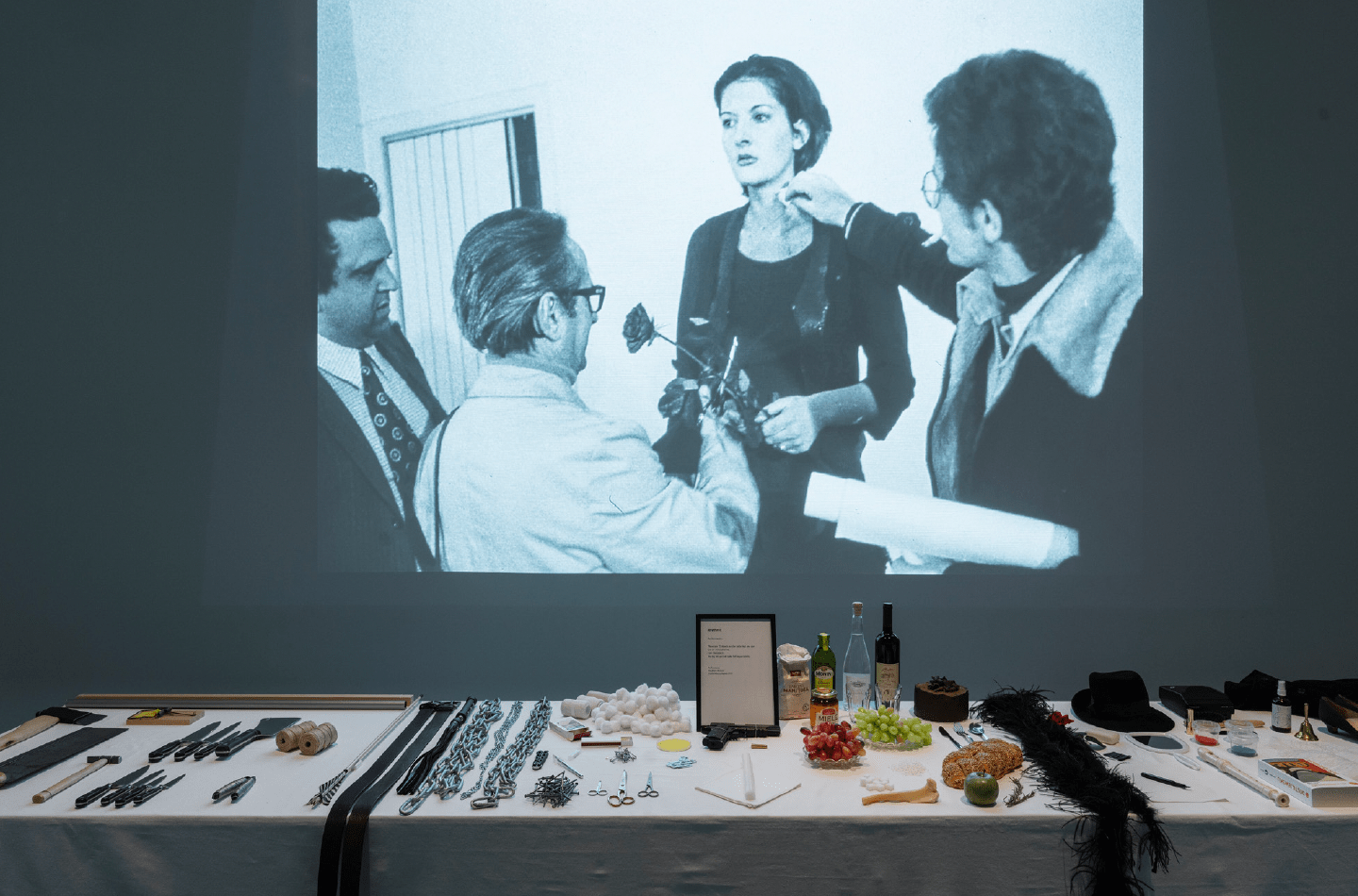
Marina Abramović’s Rhythm 0 (1974), displayed over the course of several years at the Tate’s Performer and Participant, and recently prominently present as a room installation in her traveling retrospective making a stopover at the Kunsthaus Zurich (October 2024, 25-February 16, 2025), exemplifies the intricate relationship between performance, documentation and artifact – being not solely a product or a record of the event, but an amalgamation of these aspects, alongside reinterpretation and reperformance.
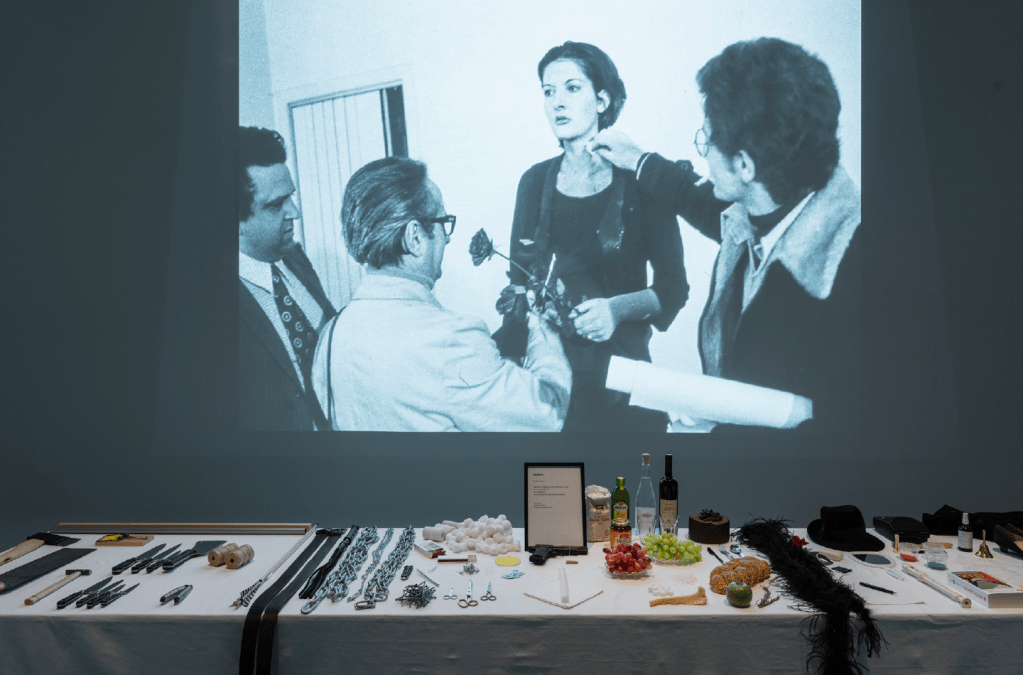
Installation views of Rhythm 0 at the exhibition Marina Abramović – Retrospective, Kunsthaus Zürich, 2024/2025. Courtesy of the Marina Abramović Archives/DACS 2025. © Marina Abramović/ Photos: Kunsthaus Zürich, Franca Candrian.
A longish table covered in white cloth presents to the viewer a set of neatly arranged artifacts, such as a hammer, a saw, a fork, a bowler hat, a lipstick, a shawl, a blade, a Polaroid camera, a pistol, among many others.14 Above this table, a series of documentary images is displayed from a digital projector; on the right-hand side of the table, we see an empty chair. The originating performance took place at Studio Morra, Naples. The instructions for Rhythm 0 read as follows: “There are 72 objects on the table that one can use on me as desired. Performance. I am the object. During this period I take responsibility. Duration: 6 hours (8pm-2am).”15 Like her other works in the series Rhythm, such as Rhythm 2 and Rhythm 5 from 1974, Rhythm 0 performed an extreme act pushing the artist to her limits, providing Abramović with an insight into what Peggy Phelan sees as “the line between strength and vulnerability.”16A part of a non-sequential series, the work resulted from Abramović’s strict upbringing in postwar Yugoslavia, where control, discipline and violence coalesced.17 The objectification of the performer’s body echoed, if only to an extent, Yoko Ono’s earlier Cut Piece that premiered in 1964 at Yamaichi Concert Hall, Kyoto. While Ono’s work encourages the participant to cut away pieces of her attire in the spirit of taking and giving (at least in its initial iteration and pre-feminist readings), in Rhythm 0, Abramović permitted the audience to freely manipulate her body with a set of tools offered on a table while she remained determinedly passive. The event reached a dangerous point when a loaded gun was moved to her neck18 – one of the reasons why Abramović refuses to allow the piece to be reperformed (while otherwise performing “reconstructions” as one of the strategies of performance survival, see, e.g., Seven Easy Pieces, 2005).19
None of these emotions seem to inhere in current viewers’ interactions with the static display of the table accompanied by a projection. Moreover, and despite various authors’ claim that these are in fact the relics of the 1974 performance, not all table objects formally coincide with their historical precedents, and none of them is materially identical with the 1974 objects. The objects had been replaced by newer objects or added in later years. In fact, as Mareike Herbstreit has noted, and the artist confirmed to
these authors, several tables exist in collections from London to New York equipped with a varying assemblage of objects.20 This seems even more curious since at least several of the “originals” from the 1974 event were saved. Although Abramović explicitly advised Studio Mora to dispose of the artifacts after her 1974 performance of Rhythm 0—she insisted “there are no original objects”—the owner decided to keep them. No doubt, and somewhat against this essay’s claim, Abramović capitalizes on the exclusive meaning of performance as an event. In contrast to artists like Joseph Beuys or Chris Burden, who, each in their own way, selectively enshrined performance artifacts in vitrines, Marina Abramović is known for not retaining these artifacts but instead repurchasing them for subsequent performances, such as the knives used in Rhythm 10 (1973) or the brushes for Art Must Be Beautiful/Artist Must Be Beautiful (1975). Devin Zuber notes that artifacts began to appear in Abramović’s oeuvre following her separation from Ulay (Frank Uwe Laysiepen, a long term companion of Abramović), a pivotal moment in which she established herself as a solo artist. Although they are crafted from wood or crystal, Abramović has collected and exhibited these objects not as sculptures but as tools, referring to them as “Transitional Objects.”21
Continue reading here.
 Performance: Conservation, Materiality, Knowledge