
May 16, 2023
Each speaker’s talk can be found at the links below.
Dorota Gawęda and Eglė Kulbokaitė
Can performance art be conserved – and if so, how? At this colloquium, Performance Conservation: Artists Speak, artists engaged with performance will discuss the afterlives and legacies of their work, even considering performance’s potential to serve as a form of conservation itself.
Once considered incompatible with mainstream institutions, live performance is no longer on the fringes of the art world. Today, it is presented, commissioned, and even collected by major museums around the world. But what does it mean to commit to maintaining a work of performance into the future – or reanimating one long buried in the past? The modern discipline of conservation has grown more sophisticated in recent decades, but it still struggles to approach artworks that transcend objecthood, frequently reducing them to documentation or mere relics.
Featuring presentations by a variety of performance artists, this colloquium seeks to investigate how they approach the longevity and afterlives of their own work as well as the ways in which performance itself serves to conserve, revisit, and reinterpret the past. Some artists see any kind of conservation as antithetical to their conception of the live, whereas others embrace reenactment, reperformance, or documentary mediums such as video, photography, or oral history. Meanwhile, modern conservation practice involves both science and artistry, precision as well as interpretation. If conservators may sometimes behave like artists, it follows that artists might sometimes perform the work of conservators – either in transforming their own work or bringing events and artworks of the past into the present through artistic research and creative reinterpretation. Despite a great variety of approaches, each of the artists presenting will be invited and challenged to discuss their own relationship to conservation.
“Conserving Performance: Artists Speak” is the third annual colloquium organized by the members of Performance: Conservation, Materiality, Knowledge (Hanna B. Hölling, Jules Pelta Feldman, and Emilie Magnin), a research project sponsored by the Swiss National Science Foundation and located at Bern Academy of the Arts. Questions may be directed to performanceconservation@gmail.com.
This event will be held in person at Bern Academy of the Arts (HKB), Fellerstr. 11 in Bern, and on Zoom. The event is free, but you need to register in order to attend. Please make sure that you register either for the online or the in-person event. A Zoom link will be circulated to registrants shortly before the event. At the HKB, refreshments will be provided during breaks.
SCHEDULE
Note: The schedule is subject to change, but its general outline (from 12:00 to 7:45 p.m.) is confirmed. All times in CEST.
12:00–12:30 Introduction: Hanna Hölling, Jules Pelta Feldman and Emilie Magnin
12:30–01:15 Christian Falsnaes DK
01:15–02:00 Davide-Christelle Sanvee CH
02:00–02:30 Refreshment break (HKB)
02:30–03:15 Pascale Grau CH
03:15–04:00 Ido Feder ISR
04:00–04:45 Dorota Gawęda and Eglė Kulbokaitė PL & LT
04:45– 5:15 Refreshment break (HKB)
05:15–06:00 Rosanna Raymond NZ
06:00–07:00 Final Discussion
7:00 – 7:45 Apéro (HKB)
Information about our speakers
Davide-Christelle Sanvee crafts rigorous, demanding performances that bring audiences’ attention to the spaces and bodies occupied by performer and viewer alike. Born in Togo in 1993, Sanvee has lived in Geneva since childhood. She graduated from the Geneva School of Art (HEAD—Haute école d’art et de design) and received a master’s degree from the Sandberg Instituut in Amsterdam, where her studies focused on architecture. In 2019 she won the Swiss Performance Prize. Sanvee uses performance to investigate architectural space, history, memory, personal identity, and relationships between people. Through archival research, architectural thinking, and physical movement, Sanvee embodies histories and ideologies latent in charged cultural spaces, such as the Centre Pompidou in Paris (Je suis pompidou.e.x, 2020), the Aargauer Kunsthaus (Le ich dans nicht, 2019), which houses Switzerland’s national art collection, or Geneva’s Pavillon ADC (À notre place, 2022). Her work has also archived, historicized, and discoursed upon the recent history of performance art in Switzerland (La performance des performances, 2022).
For Christian Falsnaes, art is an arena for staging social experiments. Born in Denmark in 1980, he studied at the Academy of Fine Arts Vienna and is currently based in Berlin. He has had several solo exhibitions in Denmark and Germany, including 2018’s “Force” at the Kaiser Wilhelm Museum in Krefeld, and his work is featured in many public and private collections. Falsnaes’s performance works pose hard questions about the complex relationships between artist, performer, and viewer, while also implicating the political and institutional structures in which all three are enmeshed. Audiences may be invited, provoked, or dared to enter into the situations he stages. Past performances have led audiences to descend into debauched revelry (Feast, 2021); trash copies of problematic masterworks (Icon, 2018); or follow instructions that lead to uncomfortable or charged encounters with others (Justified Beliefs, 2014). “The audience is my material,” Falsnaes says.
Pascale Grau understands performance as a practice of remembering, and sees the body as a storehouse of cultural memories. Born in Switzerland in 1960, she has made a powerful mark on the Swiss art scene and beyond through her performances, curation, scholarship, and teaching. She received a degree in modern dance at Heiner Carling’s HC Studio in Bern before studying art at the Hamburg University of Fine Arts and art theory at Zurich University of the Arts ZHdK. As a performer, Grau uses her own body to skewer the history of art, such as in 2019’s me as a fountain, which playfully subverts male artists’ claim to embody creativity: “From me spurts life, never-ending inspiration.” In Ovation (2005), which exists as both a live performance and a video, Grau performs a series of operatic bows towards the audience, only concluding the performance once they have begun to applaud her. In addition to various teaching and curatorial engagements, Grau has also championed the cause of performance documentation, working to ensure that performance art lives on through video, photography, interviews, and other means. From 2010–2012, she led the groundbreaking research project archiv performativ at Zurich University of the Arts.
Ido Feder, born in 1985, is an Israeli choreographer, performance curator, and artistic director, whose work explores extended choreography, gang formation and dance and performance ceremonies. He is the artistic director of Tel Aviv-Jaffa’s Diver Festival, as well as a founder of the dance platform Tights: Dance and Thought and of the La Collectiz! group of progressive Israeli dancers. Feder has presented his works on all major stages in Israel, as well as internationally. Feder, who has also studied philosophy, investigates how dance’s heritage might be transformed in the present as well as in the future. In 2019’s At Hand! (Hebrew hicon, meaning “get ready” or “on your mark”), a group of dancers learned, reproduced, and reimagined iconic, sometimes demanding movements and gestures from performance works of the 1960s and ‘70s. For Feder, this return to performance’s past, in which dancers attempt to turn their bodies into “artistic objects,” also represents preparation for a world yet to come.
Dorota Gawęda and Eglė Kulbokaitė work collaboratively across a range of media, extending from painting and sculpture to performance and video, and even into fragrance, reaching the point “where language breaks down and one genre morphs into many.” Their artistic research weaves together ecology and technology, science and magic. Gawęda, born in Poland in 1986, and Kulbokaitė, born in Lithuania in 1987, both graduated from the Royal College of Art in London in 2012; today, they live and work in Basel. Gawęda and Kulbokaitė have had recent solo exhibitions at Palermo’s Istituto Svizzero, Palermo, Sofia’s Swimming Pool Projects, the Julia Stoschek Collection in Düsseldorf, Fri Art – Centre d’Art de Fribourg, Futura in Prague, and London’s Cell Project Space, among several galleries and art centers. In 2022, they received the Allegro Prize as well as CERN’s Collide Residency Award. They are also the founders of YOUNG GIRL READING GROUP (2013– 2021). Gawęda and Kulbokaitė’s multifaceted approach to performance is exemplified by their creation and use of RYXPER1126AE, a fragrance that synthesizes odor compounds captured during their 2018 performance YGRG159 : SULK. The artists subsequently incorporated this fragrance into new, sculptural works, thus concretizing the ephemeral into a stable molecular structure while dissipating the performing body into an invisible, amorphous cloud.
Rosanna Raymond, born in Aotearoa (New Zealand) in 1967, has a multifaceted practice that encompasses performance, institutional critique, fashion, writing, curation, and pedagogy. Her work mediates Pacific Islander culture between museum and living tradition, academy and nightclub. Raymond received the Arts Pasifika’s 2018 Senior Pacific Artist Award, and is a member of the New Zealand Order of Merit. She has exhibited and presented her work in many institutions and communities around the world. Raymond’s performances—interventions into museum storerooms and crowded sidewalks—not only expose and critique the colonialism of traditional Western museum practices of conservation, collecting, and display, but also propose other methods for keeping culture alive, through inherited tradition, personal innovation, and embodiment. Her work, both independently and as a member of the collective Pacific Sisters, honors and extends the traditions she has inherited from her ancestors—Raymond has Sāmoan,Tuvaluan, Irish and French heritage—while insisting on Pacific Islander culture as modern, dynamic, hybrid, and individual. A formative early work is G’nang G’near (1993), a pair of Levi’s jeans embellished with scraps of traditional, decorative tapa barkcloth that Raymond wore in art, fashion, and social settings before the garment was accessioned into a museum collection. For Raymond, all heritage, whether tangible or intangible, is alive, and thus requires living performance and reembodiment for its continued flourishing. Her 2021 master’s thesis, “C o n s e r . V Ā . t i o n | A c t i . V Ā . t i o n: Museums, the body and Indigenous Moana art practice,” addresses both practical and theoretical models for conserving Pacific Islander heritage in museums through performance.
You may learn more about our previous colloquia and watch video recordings here:
First annual colloquium – Performance: The Ethics and the Politics of Care
Second annual colloquium – Performance conservation: Interdisciplinary Perspectives
To stay informed, sign up below for our mailing list below. Newsletters are usually sent out once every 6 weeks or so, and of course you can unsubscribe at any time.


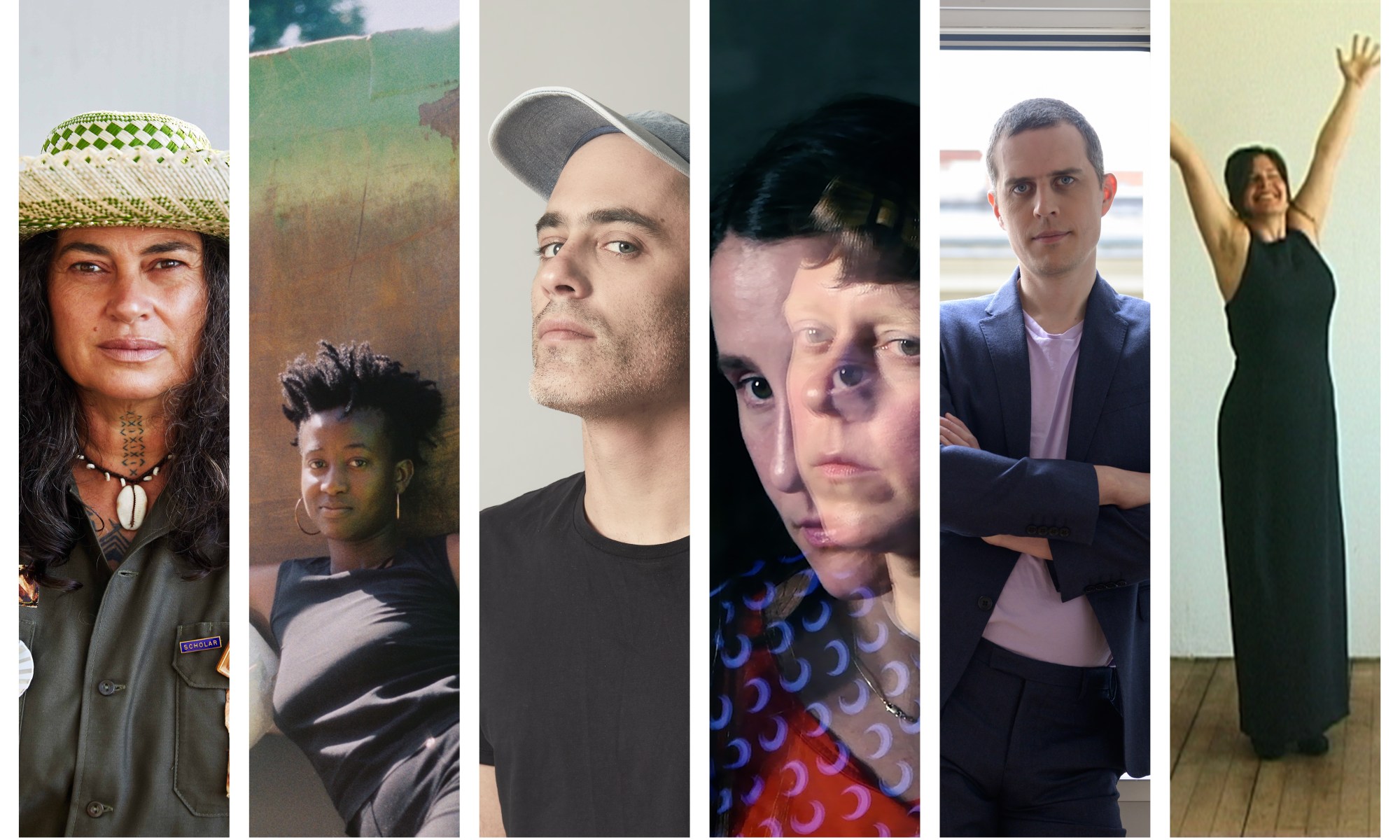
Featured images: Rosanna Raymond (photo by Rebecca Zephyr Thomas), Davide-Christelle Sanvee (photo by Francesca Lucchitta), Ido Feder (photo by Liron Weisman), Dorota Gawęda and Eglė Kulbokaitė (photo by Ortelli/Bantone), Christian Falsnaes (photo by Estefanía Landesmann), and Pascale Grau (video still from Ovation, 2002)
 Performance: Conservation, Materiality, Knowledge