
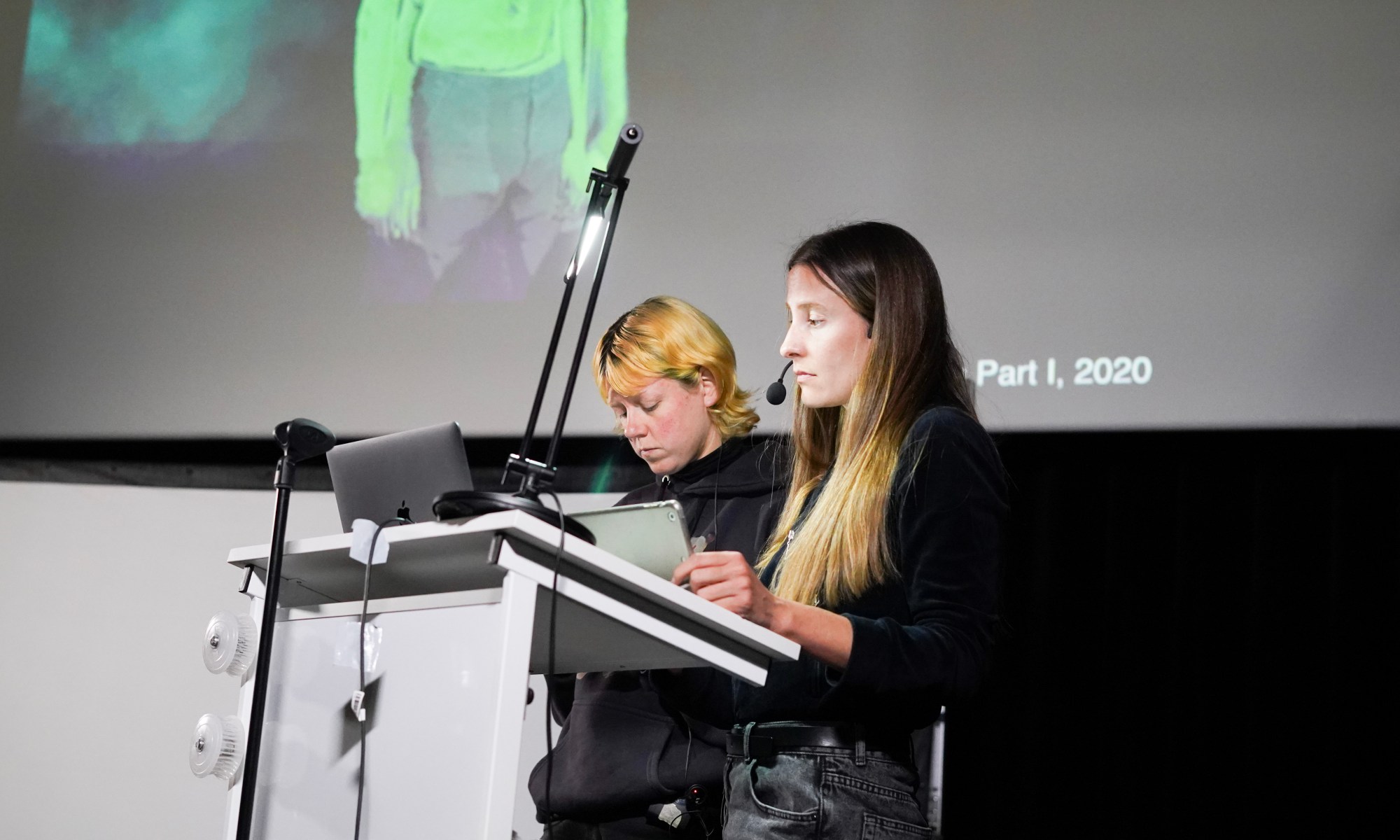
In advance of our third annual colloquium, Performance Conservation: Artists Speak, which took place at the Bern Academy of the Arts on May 16, 2023, we collected responses from artists engaged with performance about their own thoughts and feelings on conservation and performance’s afterlives. We are grateful to everyone who took part! (If you would like to participate in the survey, you are still welcome to do so.)
These are the questions we asked:
Do you think about the longevity or afterlives of your performance works?
How would you like them to be conserved – recorded, presented, recreated, known – in the future?
Are your works safer in collecting institutions (like museums) or outside of them?
Do you see performance as a method or technique for conserving the past – revisiting or reinterpreting past artworks or events in the present? How so?
And here are artists’ responses:
Charlotte Triebus:
Although I do believe that the artistic moment is strongly connected to liveness and the moment when the piece is performed, I like to think of impacts and tiny imprints that the performance leaves.
In the past years I have started to think of each project more as a collage experience, and each show as a demonstration of the current state that draws from all the artistic research around it.
I feel like my works would be safer with institutions as they tend to make the effort of creating rules to understand what the piece is about and make it possible that this understanding will be passed on to show the piece again in other setups. Unfortunately there are not too many collecting institutions interested in performative art—yet.
Performance is a very touching form of art, abstract but very relatable to the audience. In my opinion it is a very good method to channel past or present discourse.
Abraham Poincheval:
j’aime a m’imaginé le spectateur comme le colporteur d’une oeuvre. Une fois qu’ille la vue Illes en sont le porteur et celui qui raconte, la propage et la fait perdurer.
en effet c’est [Performance] une façon de ré-intéroger le passé, l’histoire de l’art et la conception des espaces d’exposition (le rapport a la monstration, a la durée, au publiques) et aussi au mythologie au récit qui nous construise
Philippe Wicht:
I like to think about my works as traces, lost spirits, found footage, costumes and masks in a treasure box, memories of audiences or archives of institutions or places that presented them.
I’m not affiliated to any specific institution and I don’t believe into placing my work in a safe space. I don’t understand what it means. My work is something intangible somebody could grab and feel. It should be linked with apparition and disappearance.
I think of performance as a human technology operating with, within and through the presence of a collective and affective body.
I don’t think that my work is something out of me that can be conserved. I’m not saying I am my work, just that I work with my work, hand to hand. We share a relationship of equality and independence, if it lasts somehow and can help or inspire people, great, if it dies with me, it’s also great.
Anonymous:
Do they [my works] need to be safe? I would rather have them discussed, activated, extrapolated, exhausted.
Crichton Atkinson:
When I make a performance I’m not thinking of the future. That’s why I work a lot in video, in video I am absolutely thinking of the future, I like that the art stays. Performance feels like a sand mandala. You create the form and then blow it away. I became interested in creating video after I put my life into performances that were only seen for the brief encounter of the work. Reperformance would be such a luxury and seems like it is allocated to those at the top of the field.
The works in museums and collecting institutions are given authority by the stability and name of the institution. One of my friends once said that you are only as powerful as the institutions you are associated with. And institutions are a shorthand, I have shown at MoMA is a shorthand for those who won’t experience the fullness of the work. But community is a living entity. The works are vulnerable inside the community and alive in the breathing of of the work, the inhalation and exhalation of viewership and viewed. There is a power to the support of institutions, the establishing nature of them. And there is a wild, virile abandon, a fire and energy to what is underground or for peers.
Samuel Lang Budin:
At this point in my career, I am mostly concerned with getting people to let me perform the fucking things at all. If I can’t, what will it matter where they are or what condition they’re in 50 years from now?
Walter Siegfried:
performance is permanently moving communication.
Pascale Grau:
[Performance is] not about preserving the past, but about putting artistic ideas and concepts into circulation, because performance art illuminates and deals with socio-political and relevant issues and sometimes answers can be derived from them. Therefore it is absolutely necessary to document and archive the works in an adequate form, so that they can be performed and reinterpreted by interested people.
Dorothea Rust:
I think I don’t want this kind of special attention, that my ‘Werk’ that I don’t see as a ‘Werk’ is longlasting.
It’s for me a never-ending learning and experiencing process…
I come from dance and my practice is influenced by a somatic view and practice of perceiving … And I try to be active as long as I can, in exchange with people and attentive to what is around me, that’s important … and some days I will disappear … I think it’s important to disappear, what’s left I won’t have really control over it …
Rhoda Davids Abel:
My work is fundamentally more about the research aspect of it and since it is linked to the community work that I do it is important that the information that I have unearthed or learned during the research process is shared.
Essentially I am more concerned about the fact that so much is not accessible or that only few people have access to information/archives/research. It is difficult to unpack this since there is no real separation between my artistic practice and the research that I do and the purpose of my artistic work.
These questions are only leading to more questions that I do not yet have answers for.
My work speaks to a certain demographic, but is also for everyone. I do not want any of my work be reserved only for a select few. I have such a hard time accessing archives, because of my skin colour, because of where I come from, because of my class status, financial status and gender. I am passionate about archives having digitised versions of their collections that is open to the public. Why is there so much gatekeeping of information?
Jonathan Kemp:
”Conserving the past” can be only understood as being necessarily a recursive-only approach to past works; those recursions are also necessarily ontologically generative.
Featured image: Dorota Gawęda and Eglė Kulbokaitė present their work at the colloquium.
 Performance: Conservation, Materiality, Knowledge