
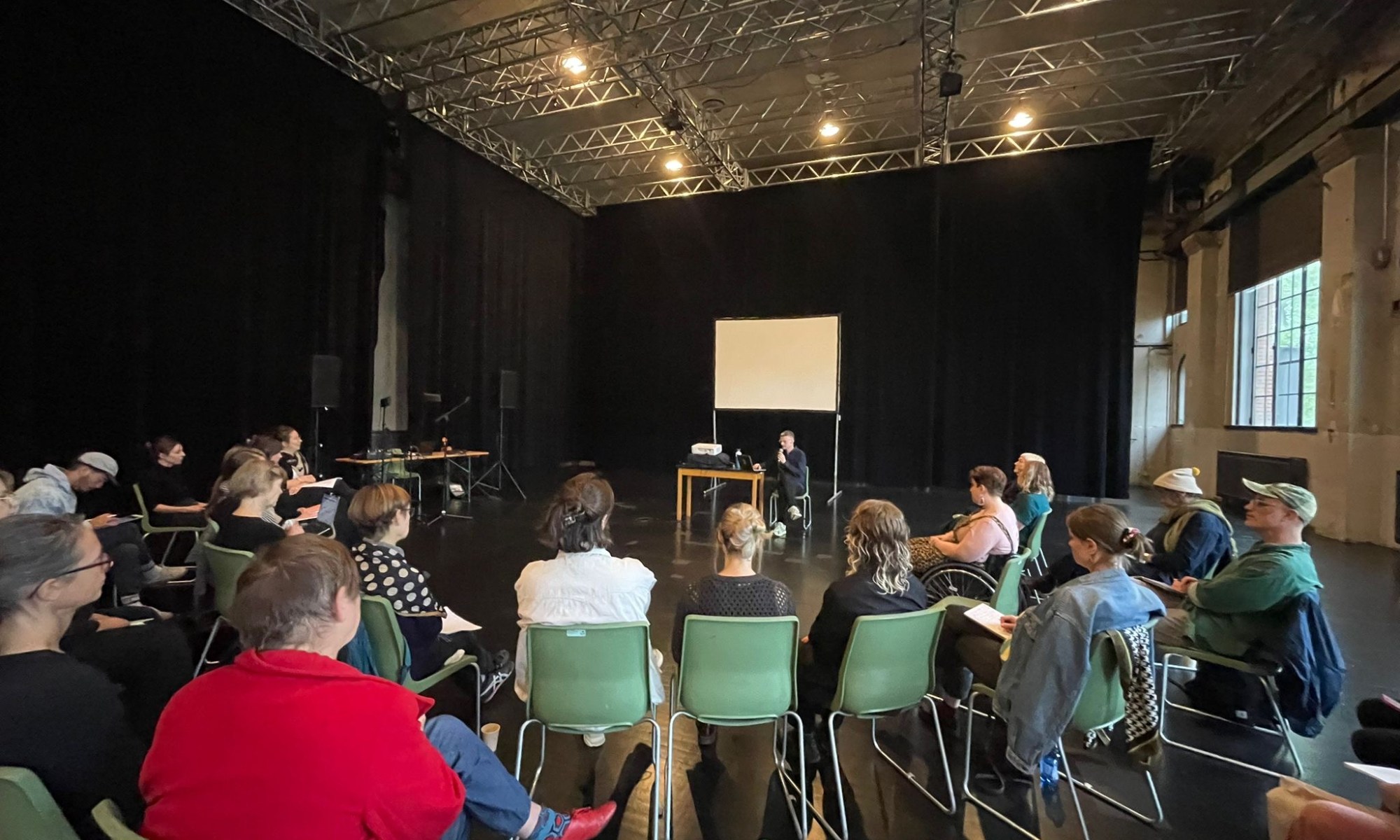
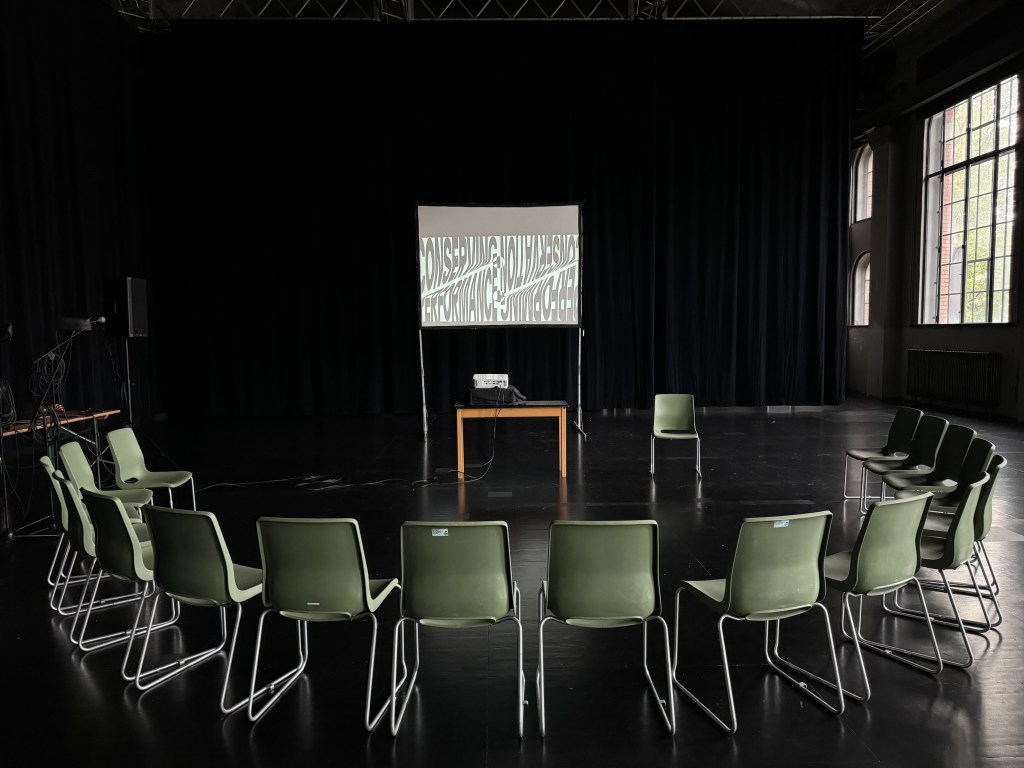
Art historian and postdoctoral researcher Friederike Schäfer reflects on the fifth day of our research festival and exhibition, Conserving Performance, Performing Conservation (September 14–29, 2024). This event invited discussions among artists, activists, conservators, and cultural workers across sectors, with the thematic focus “Collecting and Preserving as an Act of Care.”
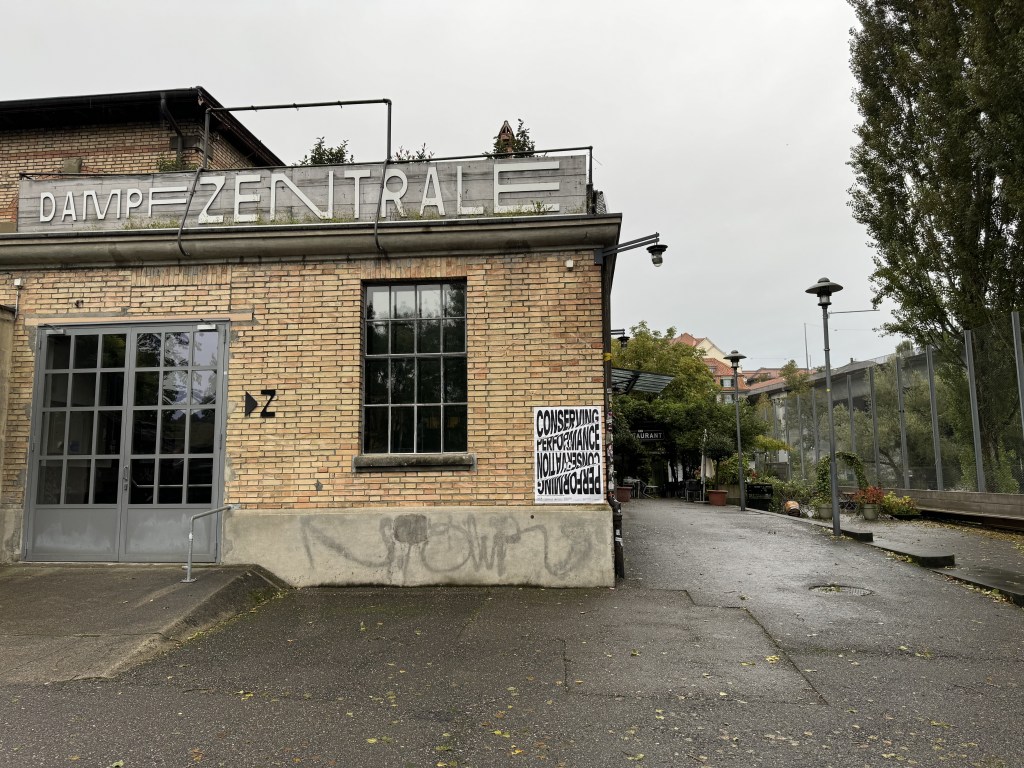
The final day of the two-week research festival Conserving Performance, Performing Conservation (September 14–29, 2024), held at the Dampfzentrale Bern, was dedicated to the notion of care. Writing this essay from the perspective of an art historian working on ephemeral artistic practices, I find that Maria Puig de la Bellacasa’s 2017 book Matters of Care: Speculative Ethics in More-than-Human Worlds (University of Minnesota Press) has emerged as a key reference in advocating for the consideration of “care” practices in the arts in recent years. While this posthumanist focus provides a broader framework for the current debate, contributions from various actors in the fields of performance art and dance revisit the question of how the concept of care, as performed by individual human actors, needs to be reconsidered within the context of both institutional and non-institutional performance conservation practices.
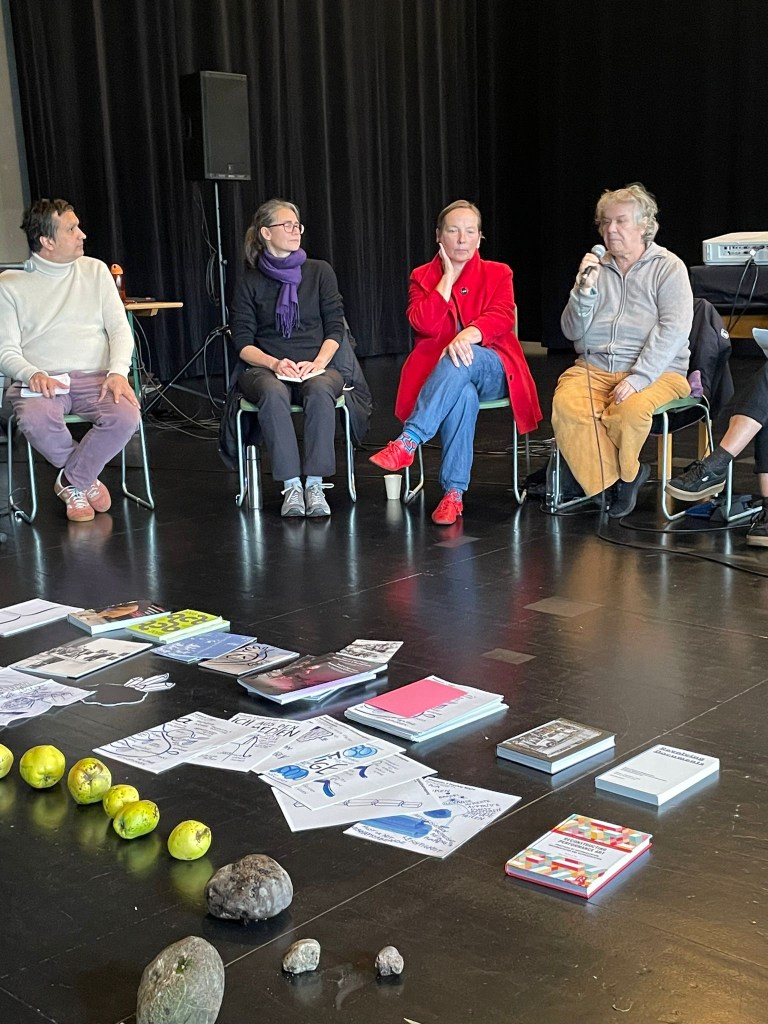
The group of Swiss performance artists—Muda Mathis, Andrea Saemann, Dorothea Rust, Chris Regn, and Gisela Hochuli representing the Performance Art Network CH (PANCH)—brought along not only their various publications but also some quinces and stones as co-actors for a performance reenactment. In their discussion with art historian Sabine Gebhardt Fink, the long-term initiative explored some of their strategies for preserving performance work and how the perseverance of the artists’ joint efforts has built a network of care over the past decades. Their expansive undertakings range from incorporating acts of conservation into their artistic practices (such as various forms of reenactments) to organizing exhibitions and establishing the structural conditions of a network, both in terms of their long-term friendship and in the digital realm. This continuous engagement has resulted in the creation of a digital resource, Collections Performance Art Switzerland, developed with Tabea Lurk (head of the Media Library of the Academy of Art and Design Basel FHNW). Their presence as individual artists and as a close-knit group opened the discussion towards considering acts of care in terms of a network. The expansive, multilingual archive was one concrete example discussed in relation to the model of a “network of care,” as conceived by Annet Dekker. As a media studies scholar focused on archival and information studies, Dekker developed the notion of a “network of care” within the realm of digital heritage, specifically regarding practices of collecting and conserving net art based on network cultures
On the black dance floor of the Dampfzentrale, however, the focus was on the human subjects involved in acts of caretaking, sometimes with their entire bodies. In fact, the circular setup of chairs transformed the venue into a shared space, where everyone present during the one-day event—regardless of their role as presenter or visitor—at one point became an engaged participant.
Saša Asentić, a founder of the Per.Art organization and a scholar, along with Nina Mühlemann, a Zürich-based artist, scholar, and activist, not only discussed how the aesthetics of access in a live performance can be communicated and preserved but also emphasized the importance of addressing structural issues of accessibility. They raised critical questions such as: Who can participate, and under what conditions? What factors of inclusion and exclusion enable or prevent participation in the creation of a network, particularly for people with disabilities? How do current conservation practices account for companies or groups of performers in the realm of contemporary dance and theater, as well as disability-led artistic practices? These reflections underscored that one of the foundational conditions for a network of care is solidarity—by considering those who are not, or cannot be, present.
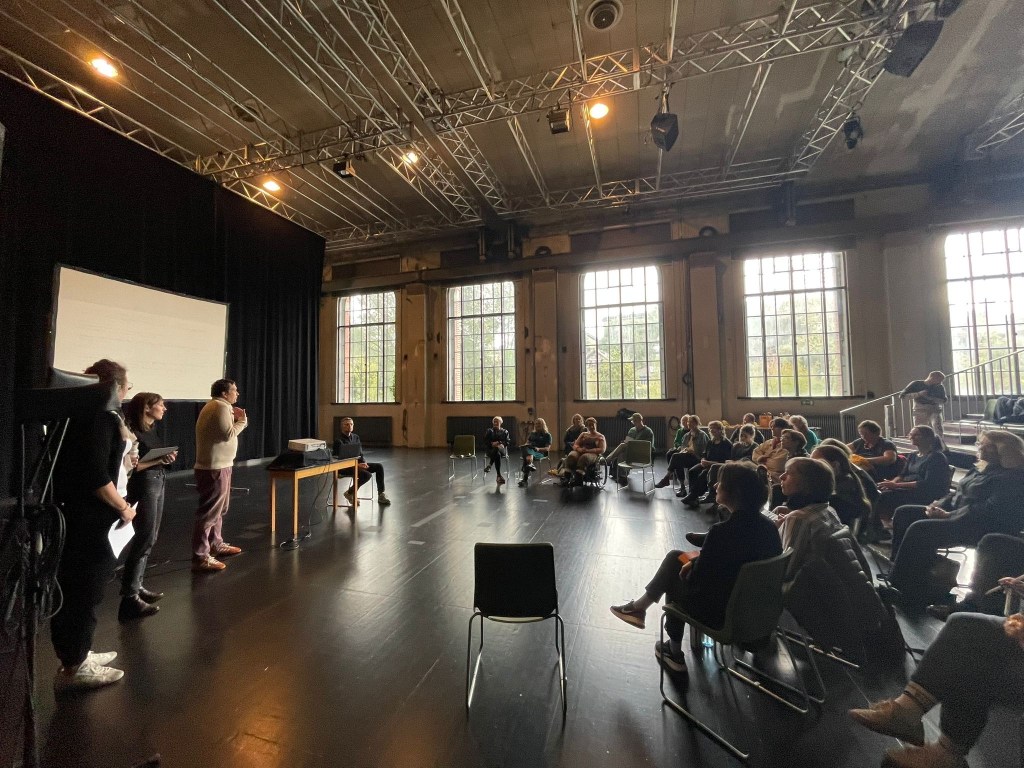
Drawing on their experiences of giving and receiving care during times of need, collaborators Rebecca Gordon, a Scotland-based scholar, and Sally Labern, a London-based artist and activist, emphasized that every collaboration inherently involves forms of shared labor. They called for consideration of how solidarity plays a key role in the creation of community projects.
In their performance lecture, during which they fostered a shared space of mutual exchange and attentiveness, they elaborated on the relationship between care and solidarity. They introduced political scientist Joan Tronto’s feminist Ethics of Care, developed with Berenice Fisher in 1993. Initially based on the aspects of 1. caring about (attentiveness), 2. caring for (responsibility), 3. caregiving (competence), and 4. care receiving (responsiveness), Tronto added the solidarity of caring with as a fifth quality in 2013. Gordon and Labern stressed how these qualities form the necessary foundation for people to take on collective responsibility, and that it is this notion of caring as a “highly relational act” that helps further our understanding of how networks of care can function in the preservation of performance.
The presentation by Julia Asperska, who introduced the challenges of “installing” the model of a performance art collection, further highlighted how a network of care, as a distributed model of responsibility, functions differently than a traditional model of collection.
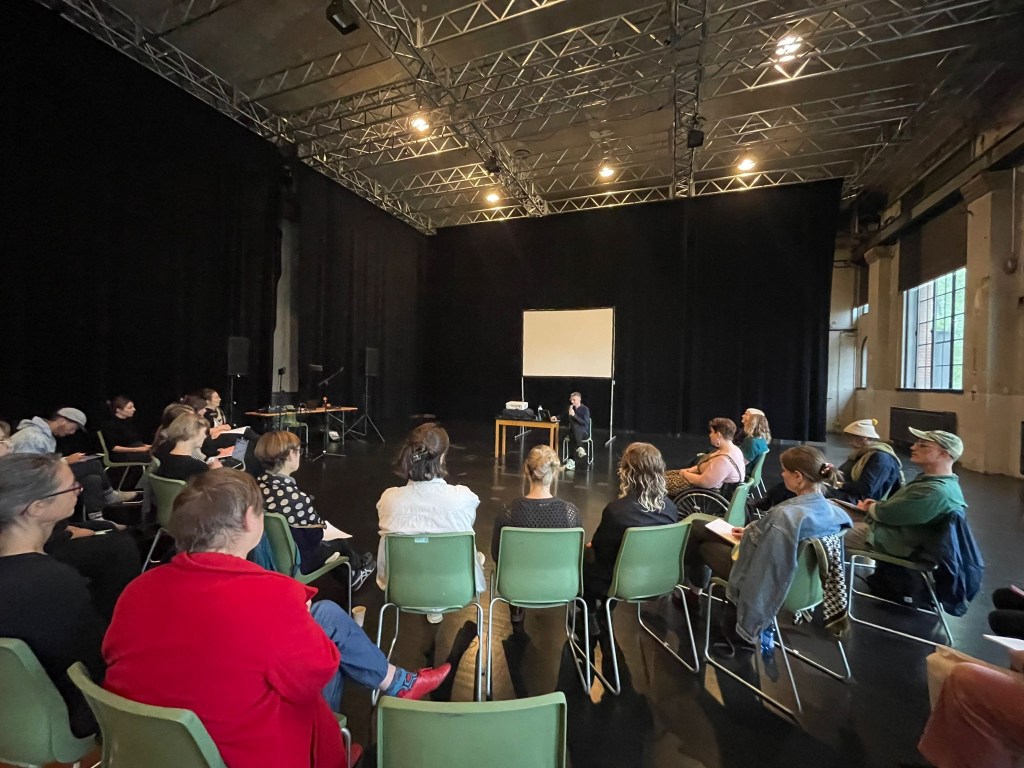
After roughly eight hours of presentations and exchanges, the final round of discussion, which included all participants, highlighted that, as a living practice, the set of issues surrounding how to perform conservation in order to conserve performances is constantly expanding. This continuous evolution must be addressed. Put differently, how do we conceive of the preservation of change, or preservation as change? This question is crucial because networks of care can only be understood as ongoing practices. These acts of care both constitute and reshape the network. A network cannot be established by a single generative act; it must be sustained through continuity. In other words, it only exists in-the-making through the ongoing performance of acts of care.
Dr. Friederike Schäfer is an art historian and a postdoctoral researcher in the Cluster of Excellence Temporal Communities: Doing Literature in a Global Perspective at Freie Universität Berlin. She currently works on her new project “Earth(ly) Matters: How Exhibition Spaces Capture Natural Environments.” From 2017 to 2021, she was an academic associate in the Media Arts department at the Karlsruhe University of Arts and Design (HfG). She pursued her doctorate An Anarchitectural Body of Work. Suzanne Harris and the Downtown New York Artists’ Community in the 1970s (De Gruyter, 2023) as part of the Cluster of Excellence Bild Wissen Gestaltung. Ein interdisziplinäres Labor (Image Knowledge Gestaltung. An Interdisciplinary Laboratory”) at Humboldt-University of Berlin. Schäfer has worked on international exhibitions including dOCUMENTA (13), the KW Institute for Contemporary Art Berlin, and the traveling project “re.act.feminism 2—a performing archive,” occasionally pursues curatorial projects, and has also conceived interdisciplinary, collaborative research and exhibition projects, for instance at the nGbK Berlin; Kunstverein Harburger Bahnhof, Hamburg; Badischer Kunstverein, Karlsruhe; Kunsthalle Mannheim; and Museum für Naturkunde, Berlin. In 2021, she co-conceived the project Networks of Care at nGbK, Berlin, which resulted in the bilingual publication Networks of Care. Politiken des (Er)haltens und (Ent)sorgens, nGbK Berlin, Berlin 2022. (Ed. with Anna Schäffler; Nanne Buurman). https://www.temporal-communities.de/people/schaefer.
Image credits: Day 5 of the Research Festival and exhibition, Conserving Performance, Performing Conservation, September 28, 2024, organized by the SNSF Performance: Conservation, Materiality, Knowledge team—Charles Wrapner, Emilie Magnin, Andrej Mircev, Joanna Lesnierowska and Hanna Hölling at the Dampfzentrale Bern.
 Performance: Conservation, Materiality, Knowledge