
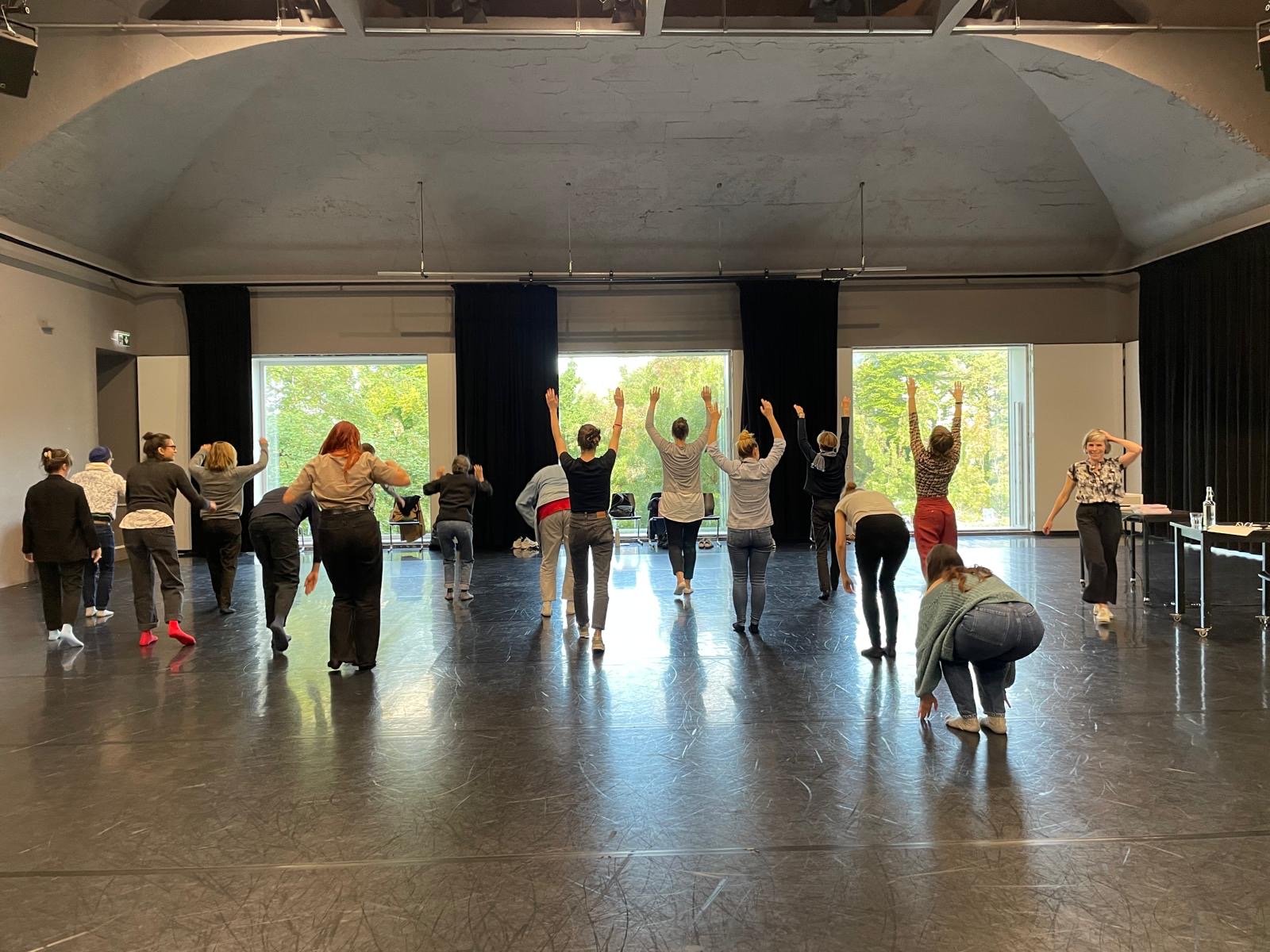
Once again, we invited Nicole Savoy, an alumna of the Hochschule der Künste Bern, Conservation of Modern Materials and Media, to report on our research festival. Nicole offers a conservator’s perspective on the performance conservation methods explored during the event, both traditional and radical. See also Nicole’s previous reports on our third and second colloquium as well as her earlier review of our conversation with Claire Bishop.
The research festival Conserving Performance, Performing Conservation (September 14-29, 2024), consisting of five thematic events and an exhibition, spanning over the course of two weeks and in five cities across Switzerland was the culmination of the four year long Performance: Conservation, Materiality, Knowledge (PCMK) research project (SNSF 2020-2024). Through a series of talks, performances, and workshops, a multidisciplinary group of researchers, artists, and museum practitioners explored the questions at the core of the project: Can performance be conserved, and if so, how? Also, what does it mean to conserve performance? Considering the multiverse of performance art and the evolving field of contemporary art conservation, it is no surprise that these queries catalyzed a broad range of discussions and many more questions.
The thought of preserving something intangible like performance seems antithetical to our general understanding of how things are conserved, and it elicits a reassessment of the meaning of conservation itself. Hanna B. Hölling and her research team, including Joanna Lesnierowska, Emilie Magnin, Andrej Mircev, and Charles Wrapner invite us to question what it means to apply traditional conservation practices–which aim to preserve or capture an original or authentic state of an object–to performance. Traditionally, through physical and chemical analysis, conservators identify the material nature of works of art and the causes of damage, degradation, or aging, and then apply treatments to restore, repair, or prevent further changes. However, these notions begin to break down when addressing immaterial, iterative, and performative time-based works that play out and transform on a timeline far more immediate than objects like paintings.
If, however, we extend the identifying properties of works, like paintings, beyond their material, environmental, and historical contexts, to include temporality as a performative feature–is it even possible to capture any artwork in its entirety? The aim to capture and encapsulate can be viewed as an extension of a colonialist mentality that isolates people and objects from their environments and contexts for the purpose of objectification and display. The work by the native American artist James Luna comes to mind. In his performance, The Artifact Piece (1987–1990), Luna revealed the absurdity of encapsulating and displaying only the relics of people’s rituals and lives. By displaying his living body in a museum case, he pointedly revealed the problematic role museums have had in perpetuating colonialism, exploitation, and appropriation of Indigenous cultures.1
The inclusion of performance art in museum collections over the past couple decades has exposed the western ideologies embedded in established institutional practices, which it, as a practice, inherently challenges. Performance art’s existence in the conservative space of a museum has acted as what Ido Feder, in conversation at the festival event at Dampfzentrale Bern, likened to a trojan horse–breaking up the system from within.
Hanna challenges us further to imagine conservation as performance, or the conservator as performer, and what then is the performance of conservation? Rebecca Schneider describes the act of conserving as entering “an ongoing or syncopated performance as a participant capable of and indeed engaged in “response-ability”” with any object regardless of its materiality.2 Resituating the conservator’s relationship to artworks as continuous engagements with their development over time—and accepting change as part of their identity—provides opportunities to discover new ways to form and transmit knowledge of these works and their cultural, socio-political, environmental, and temporal contexts affecting those changes. Joanna Leśnierowska, choreographer, curator, and visual dramaturge, suggests replacing the term conservation with cultivation. To cultivate performance is to care for, keep alive, and foster its growth.
The Conserving Performance, Performing Conservation festival demonstrated several methods of applying this theoretical approach practically—by conserving embodied knowledge through bodily transmission and reactivation, bridging gaps between conservation and performance practices, and by facilitating inclusivity and networks of care.
On the first day of the research festival, titled “The Bodily Transmission of Knowledge” (Sunday, September 15, 2024, at the Tanzhaus Zürich), dance practitioners, scholars, choreographers, and the research team explored the theme, “transmission, living legacy, and reactivation”. The workshops and talks by Sara Wookey, Megan Metcalf, Peter Pleyer, Anna Huber, Catja Loepfe, and Declan Whitaker showed how conservation is already built into many performance artworks through artists’ own practices.

The art historian and former dancer Megan Metcalf discussed how the artist Simone Forti developed several models for the continuation and preservation of her performances. Depending on the work, methods for their continuation involve teachers, or qualified transmitters, who pass choreographed movements down through bodily transmission; sets of instructions to be followed by performers; and the use of props in combination with movements, like in Forti’s “Dance Construction” Seesaw (1960). In the earliest version of Seesaw Yvonne Rainer and Robert Morris balanced their bodies in relation to each other while moving along a balancing wood board. The evolution of the work has led to contemporary iterations where a seesaw is built anew by a different artist given creative license to design the structure on which a new set of performers “play”. These various models highlight the numerous modes of continuing a work of performance and its infinitely possible iterations.
In her workshop, at the same event, the scholar and dance practitioner Sara Wookey shared her experience as an authorized transmitter of Yvonne Rainer’s choreographed dance performance Trio A (1966). Rainer maintains the integrity of Trio A by teaching its specific sequence of movements to selected performers who are then qualified to transmit the work to others. Leading the group of participants through part of the sequence, Wookey demonstrated how, to fully understand and conserve a work like Trio A, one has to perform it. The performance conserves itself through its own regular activation. Each iteration preserves the work’s lineage of those that came before it and prefigures those to come.
Returning to the idea of capture, one video recording from 1978 of Yvonne Rainer performing Trio A exists, which the artist maintains is not an accurate representation of the work. Rainer claims that she made many mistakes in the recording, however, without her input, this rendition could be taken as proof. Also, coming back to the concept of authenticity or an original state, statistically, wouldn’t multiple iterations of a performance give a more expansive understanding of it? The true nature of a population is more accurately reflected through a larger sample size since it can encompass a broader spectrum of possible variations.
During the final panel of the day, artistic director of the Tanzhaus Zürich, Catja Loepfe discussed how the concept of reenactment is at the core of the Tanzhaus Zürich’s company, The Field. Dancer and choreographer Declan Whitaker of The Field, shared his professional experiences of re/performing Simone Aughterlony’s work–opening a broader conversation with Joanna Leśnierowska about the craft of reactivating, reenacting, and re/performing.
Change through iterative reactivation was a central topic regarding choreographer, filmmaker and performer Eszter Salamon’s performance on day four of the festival, “Revisitation: Eszter Salamon, Dance for Nothing (Revisited, 2024)” (September 22, 2024 at Musée cantonal des Beaux-Arts Lausanne | Plateforme 10, Lausanne). The discussion followed Salamon’s revisitation of her work Dance for Nothing (2010, revisited in 2024), in which she choreographically reworks John Cage’s Lecture on Nothing (1949). In the 2010 iteration, Salamon combines Cage’s words with her own movements. In the 2024 rendition, the artist reinterprets the previous iteration by adding an exploration of auditory transmission and transformation.
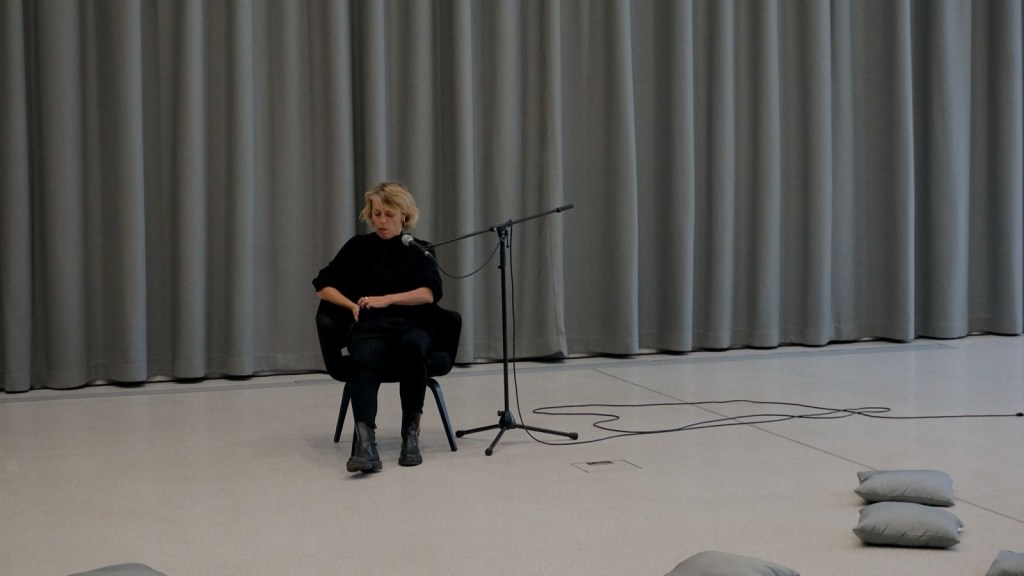
Florence Jung’s instruction-based performances, presented by the artist on day two of the festival, “Conserving Absence: Florence Jung in conversation” (September 19, 2024 at the Aargauer Kunsthaus, Aarau), are performed not by the artist but by individuals found through advertisements. She does not monitor the execution of the performances and prohibits collecting institutions from recording or documenting them. Jung challenges the officiality of institutional documentation, as it can impose a definitive portrayal and memory of the piece. At the same time, she welcomes amateur images and recordings made by viewers, even when resulting in misunderstandings or false rumors which, from a traditional conservation perspective, could be classified as damage. In this case, the perceived “damage” would take away from the original or authentic state of the work. However, it is difficult to apply this concept of loss without a fixed idea of how the work should appear and be understood.
Jung’s choice to embrace these unpredictable outcomes allows the piece to evolve into its own wabi-sabi-esque entity, where, with each iteration, viewers’ subjective experiences are integrated into the cumulative growth of the work. In this way, documentation becomes performative, bridging the gap between the artwork and its objective representation in an archive.
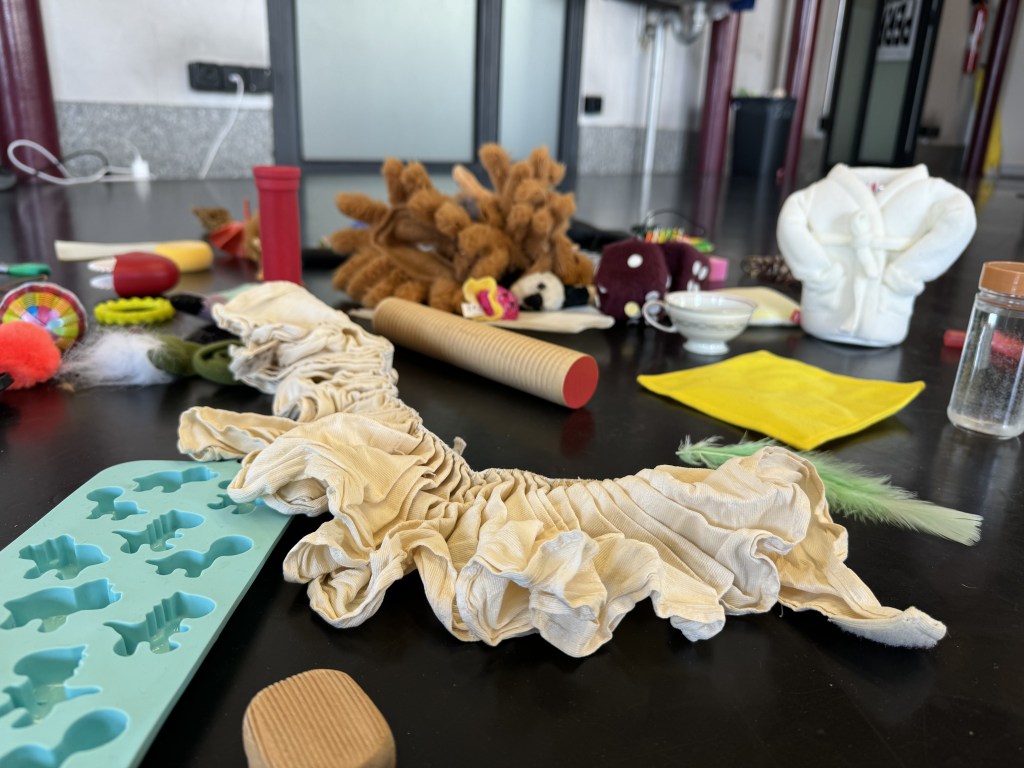
Day three of the festival, “Archiving and Documentation” (September 21, 2024, at ADC Geneva, Grütli studios) with workshops by Cori Olinghouse and Thomas Plischke, a film screening by Eszter Salamon, and responses by Rachel Mader and Joanna Leśnierowska explored several methods of documentation and how the multi-sensory dimensions of performance can inform how it is documented. Bringing the senses into the archive, the research-based artist Cori Olinghouse walked participants through her living archives methodology. Approaching documentation—as somatic practitioners—through movement, creative writing, and performative subjective sensory perspectives, like haptic visuality and touch, can provide more multifaceted interpretations of performative works in archives.
In practice, documenting such dynamic artworks can be challenging with conventional museum database systems designed for object-based artworks. Current research is pointing towards Wiki-based models that support the documentation of evolving iterative works with immaterial and multimedia components.3 Wiki-based platforms can democratize information by facilitating collaboration inter-institutionally and with outside experts. Depending on the equality of access to their knowledge and use, these tools have the potential to aid under-represented artists and communities in stewarding the documentation and preservation of their own cultural heritage.
The fifth and final day of the research festival, “Collecting and Preserving as an Act of Care” (September 28, 2024 at the Dampfzentrale Bern), included an exchange between the non-disabled artist and cultural activist Saša Asentić and scholar and activist Nina Mühlemann about the aesthetics of access, its effects on memories, and how overlooked or forgotten artist’s perspectives can be revived through reenactment.
The event also featured a performance by researcher and lecturer Rebecca Gordon and multidisciplinary artist Sally Labern, “Communities of Caring with: Thinking-through-making and Slowing the Flow”. Additionally, in a roundtable discussion, “Networks of Care”, performance artists Muda Mathis, Andrea Saemann, Dorothea Rust, Chris Regn, and Gisela Hochuli, art historian Sabine Gebhardt Fink, and archivist Tabea Lurk shared their roles in the artist led initiative, Performance Art Network Switzerland (PANCH).

In the last presentation of the day, art manager, organizer, networker, and context curator, Julia Asperska spoke about her role in the foundation of the Something Great Collection based in Berlin, where she served as the Collection Manager (2020-2022). The goal of the independent organization is to recontextualize the contemporary art canon by supporting performance artists from diverse international backgrounds and shadowed areas that may be overlooked by larger arts institutions. The Collection’s focus on collecting and regular reactivation over archiving allows works that would otherwise be lost to be conserved.
The festival events also raised questions about the role of the body in conservation. What does it mean to conserve the body as an essential part of a performance? In time-based media and digital art conservation, the preservation of the technical environment that an artwork depends on to perform is necessary to conserve the work. Thinking about the body as the environment that a work requires for its performance, then conserving or caring for the body seems equally as important as the knowledge of the performance.
This notion could be extended beyond the (human) body, since it is a living entity that also requires a certain environment to exist. To conserve, or cultivate, the bodies of performers, the communities, environments, and ecosystems they are connected to that influence their performances also need to be considered. A holistic approach cares for the people embodying cultural heritage arts practices, the natural ecosystems sustaining those communities, as well as, the other (non-human) bodies that are dependent on those ecosystems.
Although it defies conventional methods, performance art can be conserved, and there are no simple strategies that can be applied to this complex field. Nevertheless, initiatives like the PCMK research project, Tate’s Reshaping the Collectible: When Artworks Live in the Museum (2018–2022), and the University New South Wales’ Precarious Movements: Choreography & the Museum (2021–2024) have ambitiously addressed the challenges posed by collecting and caring for performance, thereby expanding the scope of contemporary art conservation.4
Thanks to projects like these, influences from ethnographic collection studies, music, dance, choreography, theater, and the growing diversity of artistic mediums, contemporary art conservation has expanded its scope beyond the materiality of the object to encompass the cultural and socio-political contexts, as well as the temporal and sensory dimensions of works rooted in artistic, ritualistic, and other performative cultural heritage practices. This paradigm shift has opened up new possibilities for conservation methods that extend beyond time-based media, offering fresh perspectives that can be applied across various forms of art.
These developments will hopefully continue to coax the field of conservation out of the institution and into more inclusive and unconventional spaces. With increased experience and knowledge drawn from the heterogeneous world of performance art—and through greater collaboration between institutions, practitioners, and experts from diverse disciplines and underrepresented communities—this evolving framework promises to inspire further innovative research, shaping the future of conservation in dynamic and unexpected ways.
Nicole Christiane Savoy is an independent contemporary art conservator specializing in time-based media and digital art. She holds an MFA from Cranbrook Academy of Art (MI, USA) and an MA in the conservation of modern materials and media from Bern Academy of the Arts (Bern, CH). Her main area of focus has been on conserving the performative features of works of net art. Nicole was a finalist for the Digital Preservation Coalition’s CLOCKSS award for the most outstanding student work in digital preservation 2024 with her MA thesis proposing a method for evaluating the condition of net art.
- Joyce M. Szabo, “Native American Art History: Questions of the Canon”, in Essays on Native Modernism: Complexity and Contradiction in American Indian Art, ed. E. Kennedy Gische (Smithsonian’s National Museum of the American Indian, 2006), https://www.jstor.org/stable/j.ctv37wprn3.8. ↩︎
- Rebecca Schneider and Hanna B. Hölling, “Not, yet: When our art is in our hands,” in Performance: The Ethics and the Politics of Conservation and Care, Vol I, ed. H. B. Hölling, J. P. Feldman and E. Magnin (Routledge, 2023), https://doi.org/10.4324/9781003309987. ↩︎
- Dušan Barok, Julie Boschat Thorez, Annet Dekker, David Gauthier and Claudia Röck, “Archiving complex digital artworks,” Journal of the Institute of Conservation 42, no. 2 (2019): 94-113, https://www.tandfonline.com/doi/full/10.1080/19455224.2019.1604398.
Beat Estermann, “Creating a Linked Open Data Ecosystem for the Performing Arts (LODEPA),” Arti dello Spettacolo / Performing Arts 6 (2020): 31-49, https://doi.org/10.24451/ARBOR.11958.
Lozana Rossenova and Karen Di Franco, “Iterative Pasts and Linked Futures: A Feminist Approach to Modeling Data in Archives and Collections of Artists’ Publishing,” in Perspectives on Data, ed. Emily Lew Fry and Erin Canning (Art Institute of Chicago, 2022), https://doi.org/10.53269/9780865593152/05. ↩︎ - Louise Lawson, Duncan Harvey, Ana Ribeiro and Hélia Marçal, “The Living Process of Conserving Performance: Theory and Practice in the Conservation of Performance-Based Artworks at Tate,” in Conservation of Contemporary Art, Vol. 9, ed. R. van de Vall and V. van Saaze (Springer International Publishing, 2024), https://doi.org/10.1007/978-3-031-42357-4_16. ↩︎
Top page image: Sara Wookey instructs workshop participants to perform a warm-up ahead of a demonstration of Trio A at Tanzhaus Zürich. Photo Charles Wrapner.
 Performance: Conservation, Materiality, Knowledge