
In this newly published article, art historian Jules Pelta Feldman challenges one of the most persistent assumptions in the history and theory of performance art: that performance is inherently ephemeral and therefore resistant to conservation. Focusing on artists who understood their actions as rituals rather than performances—notably Charles Simonds—Pelta Feldman argues that ritual offers an alternative genealogy for performance, one that situates it within much longer histories of embodied practice, repetition, and cultural continuity.
Rather than treating ritual as merely a metaphor or aesthetic reference, the article proposes it as a conceptual and practical framework for understanding how performance endures. Drawing on ritual studies, anthropology, Indigenous heritage conservation, and the UNESCO concept of Intangible Cultural Heritage, Pelta Feldman suggests that conservation should not be understood as preserving the traces of past performances alone, but as sustaining the practices that allow performances to continue through repetition, transformation, and reenactment.
In doing so, the article repositions performance not as an art form defined by disappearance, but as one whose future depends on living practices of care. It offers a new perspective on the relationship between performance, ritual, and conservation, with implications for art history, museum practice, and the stewardship of performance in collections.
Below, we offer a glimpse into the article, which is available Open Access in Liminalities: A Journal of Performance Studies, Vol. 22, No. 1 (2026).
Burckhardt.
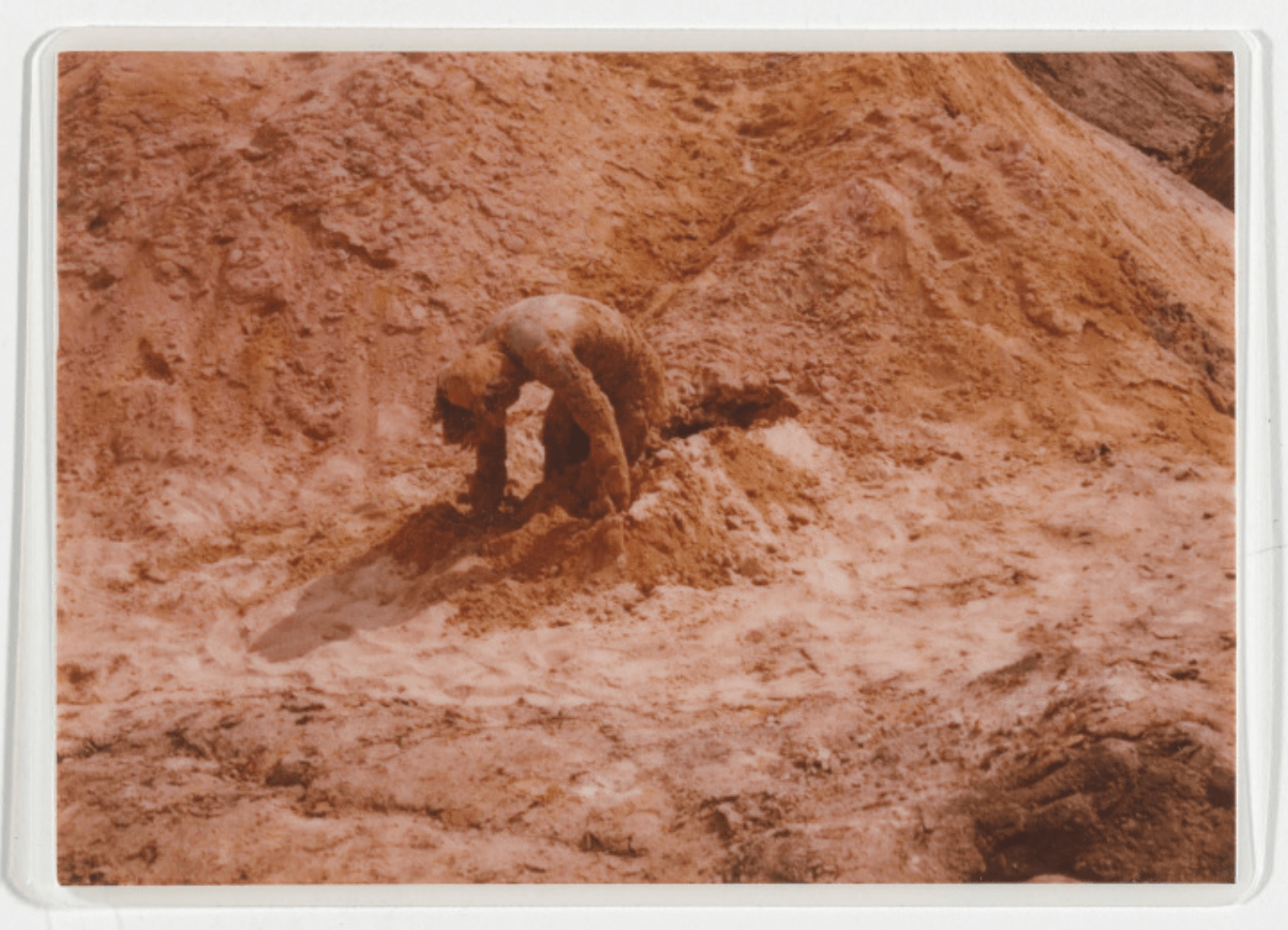
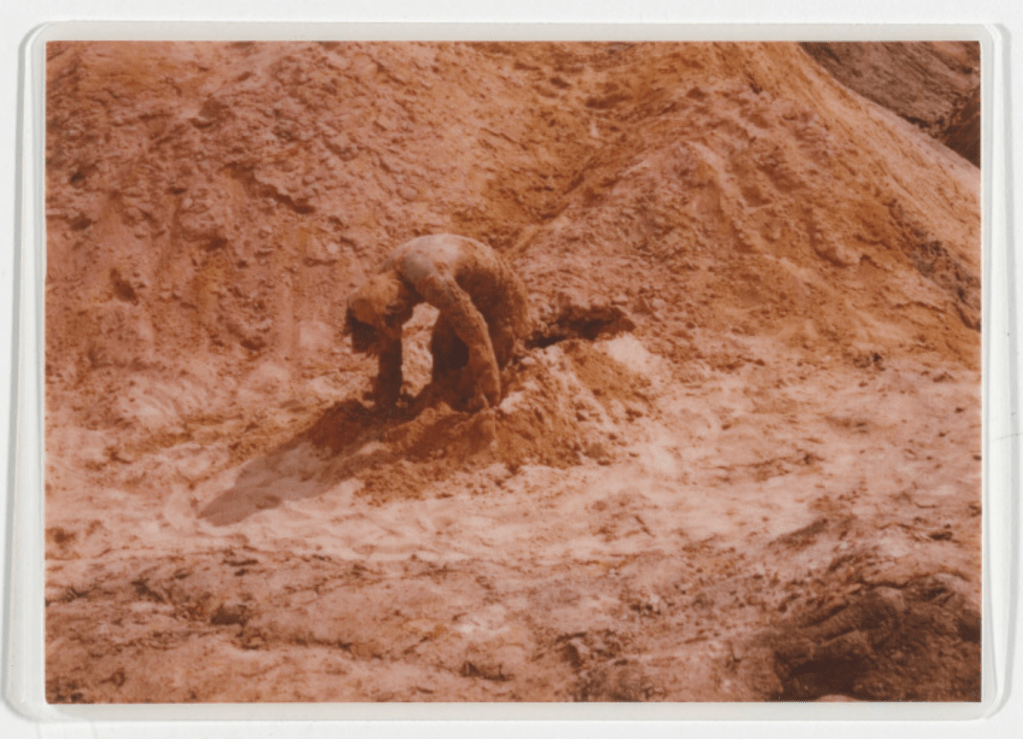
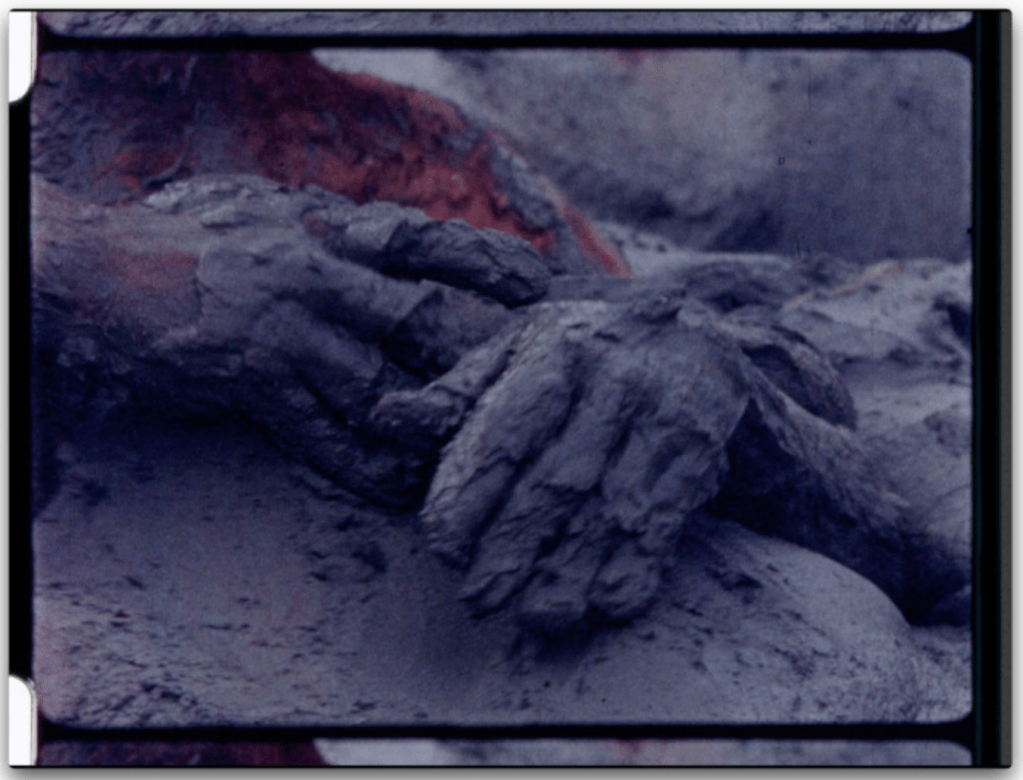
Beginning in 1970, but repeated throughout the decade, artist Charles Simonds used the abandoned clay pits of Sayreville, New Jersey as a staging ground for three actions that he considered fundamental to his practice. The clay pits had formerly served the region’s brick-making industry; in the 1970s, they provided Simonds with the clay that he used for his sculptures – and that served as both stage and substance for what he called his “Mythologies” (figs. 1-3). For Birth, the first action, Simonds immersed himself in the heavy, wet clay of the pit and then slowly, painfully reemerged from within it, his skin and long hair caked gray. In Body ↔ Earth, the artist, having been thus born from the earth, returned to it and pressed his body into the clay. Finally, for Landscape ↔ Body ↔ Dwelling, Simonds, having been created, became a creator in turn: lying on the ground, he covered his body in clay so that it resembled the terrain around him. Then, forming tiny bricks, he constructed a miniature building on the landscape he had become.
Though Simonds’s “Mythologies” have left only light footprints in the art historical record, it is not difficult to place them within it. The 1970s – particularly in downtown New York City, where Simonds lived and worked – are well-established as a period of explosive experimentation in the still fresh and unstable medium of performance. Though such art historical contextualization is not wrong for Simonds’s work, it nonetheless presents a problem: Simonds adamantly denies that his “Mythologies” are performance art. Instead, he claims, these symbolically charged, repeated actions should be considered rituals. He insists that “It’s not a performance. It’s just a kind of ritual.”1
Simonds is not the only performance artist of the 1970s to refer to his works as ritualistic, or whose work was described that way by critics attempting to make sense of the diversity of early performance practices. A wide array of performance pioneers have invoked ritual in their work. But is this simply a question of terminology? As is well-known, “performance” is just one of many terms that were used in the 1960s and ’70s to denote artists’ diverse experiments with artworks that were adequately described neither by the traditional visual arts genres of painting and sculpture nor by the performing arts genres of theater, dance, or music. Perhaps, in describing his performances as rituals, Simonds was simply expressing a preference – as other artists might have preferred to call their work “body art,” “actions,” “happenings,” or “living sculpture.”
Yet there is particular significance both in Simonds’s rejection of the term “performance” and in his insistence on “ritual.” What began as a catch-all term for diverse experiments that defied artistic categorization gradually congealed into yet another category – that of performance art. Simonds rejected the cultural and historical specificity of that category, instead linking his activities with ritual, which is transcultural, transtemporal, and transformative – thus defying definitions of art that depart from a stable, finished object, or perhaps even transgressing the concept of art itself. While performance art designates the activities of a few individuals working within the particular framework of late twentieth-century western art, the study of ritual assumes fundamental importance across human societies. And whereas this concept of art had become, by the ‘70s, so abstruse as to be unintelligible to all who were not its direct initiates, ritual is believed to have accompanied human beings from their earliest days into the present. Therefore, to understand Simonds’s “Mythologies” as rituals is to embed them into a historical, critical, and even praxis-based lineage that not only changes how we understand their meanings today but also suggests methods for preserving them for the future.
To ignore ritual’s role – or reduce it to a mere reference – in works by Simonds and other artists like him would be not only to misunderstand the nature of their work, but also to miss something fundamental about the history of performance art in this crucial, open, early moment of its development, prior to its ascendance and eventual canonization: that performance was, at least for some, not a new way of making art, but an escape from the very concept of art, an effort to seek its lineages outside of art history. Understanding performance as ritual also opens new pathways for approaching the endurance of historical performance today and in days to come: I propose that ritual and its histories imply a method for the conservation of performance art, often considered to be beyond the conservator’s grasp. In short, I believe that the notion of ritual might not only radically reconfigure performance’s past, but also its present and future.
In what follows, I delineate a provisional framework for approaching certain works of performance art as rituals, addressing the implications of this perspective for both art history and conservation. In its present state, the project should be understood as an experimental treatment – both theoretical and practical – of performance works that hopes to catch and hold onto central aspects of these that are otherwise missed and, ultimately, lost. I introduce three interrelated concepts of ritual’s relationship to performance that I propose as both productive and necessary for understanding performance’s past and for ensuring its future. First, I summarize relevant positions from the anthropological and religious study of ritual. I then show that the notion of ritual allowed performance artists to see their work in an expanded time scale, undermining the common understanding of performance as an invention of the 1960s (or, at the earliest, the first decades of the twentieth century). For this reason, as will be made clear, performance was seen by some artists not simply as a new kind of art, but as an alternative to art itself, a rebellion against the increasingly well-defined systems of the art world and its emphasis on dematerialized and conceptual practices – an emphasis that continues to influence or even define the interpretation of performance today.
Finally, I propose that ritual can be used as a conservation methodology, by shifting our understanding of performance as a fragile, vanishing medium to that of a powerful and enduring one. This discussion borrows abundantly from conservation theories and practices in the field of Indigenous heritage preservation, which has for several decades accepted the validity and even necessity of ritual within and around institutional contexts. I argue that, in learning to care for the works of performance art that have begun to enter museum collections, conservators of contemporary art may need to embrace an understanding of performance – or at least certain performances – derived from ritual.2 Against many prevailing interpretations, this understanding refuses to see performance as either a faulty object or an embodied work of conceptual art, instead locating the mechanisms for performance’s continuation within the practice of performance itself.
Performance artworks as rituals
The term “ritual” has appeared frequently in discourses about performance art, but its meaning is often unclear within art history or art criticism (more on this below). I first turn, then, to the discipline of ritual studies. Rooted in late nineteenth-century efforts to ascertain the essence and origins of humanity, ritual studies is a hybrid field encompassing aspects of history, religious studies, classical studies, anthropology, psychoanalysis, and – beginning in the 1960s and ’70s, the period at issue here – performance studies, as well as other fields of scientific and social inquiry. My concern here is not whether the performances I discuss here truly – according to any given schema, and there are many from which to choose – constitute rituals. Rather, my interest is in exploring how frameworks of ritual change the meaning of these works, their place in (art) history, and ultimately, the way they are conserved for the future, opposing the still common conception of performance art as inherently ephemeral. For these purposes, rather than any illfated attempt to define ritual itself, it is enough to understand how ritual has been understood, particularly in the period in question, which was an especially rich one in ritual studies.
Ritual scholars have used diverse methodologies – linguistic, textual, biological, sociological, ethnographic, and beyond – to try to define ritual activities and to explain their significance for the origins and the subsequent development of human culture, as well as to make sense of other, for them related phenomena, notably art. If ritual is understood, as some scholars have argued, to be a or even the fundamental human activity, uniquely tasked with and capable of bridging culture and nature, then other spheres of human activity are seen to descend from or revolve upon it in some way.
As Erika Fischer-Lichte points out in her study of the relationship between theater and sacrificial ritual in the early twentieth century, Nietzsche had already theorized ritual as the source of ancient Greek theater in the nineteenth century, a lineage that was rejected by his contemporaries as demeaning to the transcendence, sophistication, and beauty of Greek drama.3 Yet by the early twentieth century, Jane Harrison advanced a notion of “primitive” (meaning elemental) ritual as a source not only for drama, but indeed of all art.4 For Harrison, as for James Frazer and others inspired by their work, such theories had clear and meaningful implications for modern western culture and its concepts of art: art was in some way superior to (more advanced and intellectual than) ritual, but also profoundly dependent on it.5 Harrison’s “ritualism” thesis is no longer current in ritual studies, but artists have taken inspiration from ritual practices as well as from their theorization in scholarship.
Ritual is notoriously difficult to define, but certain generalizations from its study will allow us to understand its potential for a reconsideration of performance art. Rituals are apparently common to all human societies and may even be practiced by animals.6 Though they are usually goal-oriented, a ritual’s goal is not to create an object, but to bring about a state or situation. In this way, they are inherently transformative, and inherently performative – meaning that they must be enacted to be effective. While some religions, notably many forms of Protestantism, may focus on an individual’s inner belief over exterior action, the logic of ritual stresses the sometimes painstakingly precise performance of particular actions, usually within a communal context. In this way, the ritual moves performance away from conceptuality and towards a form of practice that can only be expressed through the body. Indeed, the notion that performance should be seen as fundamentally embodied and experiential, rather than dematerialized and conceptual, parallels early debates in ritual studies about the primacy of ritual versus myth.
Continue reading here.
1 Oral history interview with Charles Simonds, 2012 July 31-August 14. Archives of American Art, Smithsonian Institution.
2 For the present, it is sufficient to concern ourselves with performance works that clearly use ritual as a structuring concept, as Simonds does. But it may be that very different works of art also benefit from the attention I propose to give the examples presented here.
3 Erika Fischer-Lichte, Theatre, Sacrifice, Ritual: Exploring Forms of Political Theatre (London: Routledge, 2005), 17–19.
4 Jane Ellen Harrison, Ancient Art and Ritual(New York: Henry Holt and Company, 1913).
5 James George Frazer, The Golden Bough: A Study in Comparative Religion (London: MacMillan and Co., 1890).
Jules Pelta Feldman is an art historian, curator, critic, and salonnière. They received their doctorate in art history from the Institute of Fine Arts, New York University. They teach in the department of History of Art and Visual Culture at California College of the Arts in San Francisco. They were previously postdoctoral research fellow for the project Performance: Conservation, Materiality, Knowledge, sponsored by the Swiss National Science Foundation and hosted by Bern Academy of the Arts. Pelta Feldman has also worked at New York’s Museum of Modern Art, Whitney Museum of American Art, and Grey Art Museum, and written criticism for publications in the US, Germany, and Switzerland. Additionally, they were director and curator of Room & Board, an artist’s residency and salon in Brooklyn. Their forthcoming monograph, Charles Simonds and the Seventies, will be published by Hatje Cantz in 2027.

