
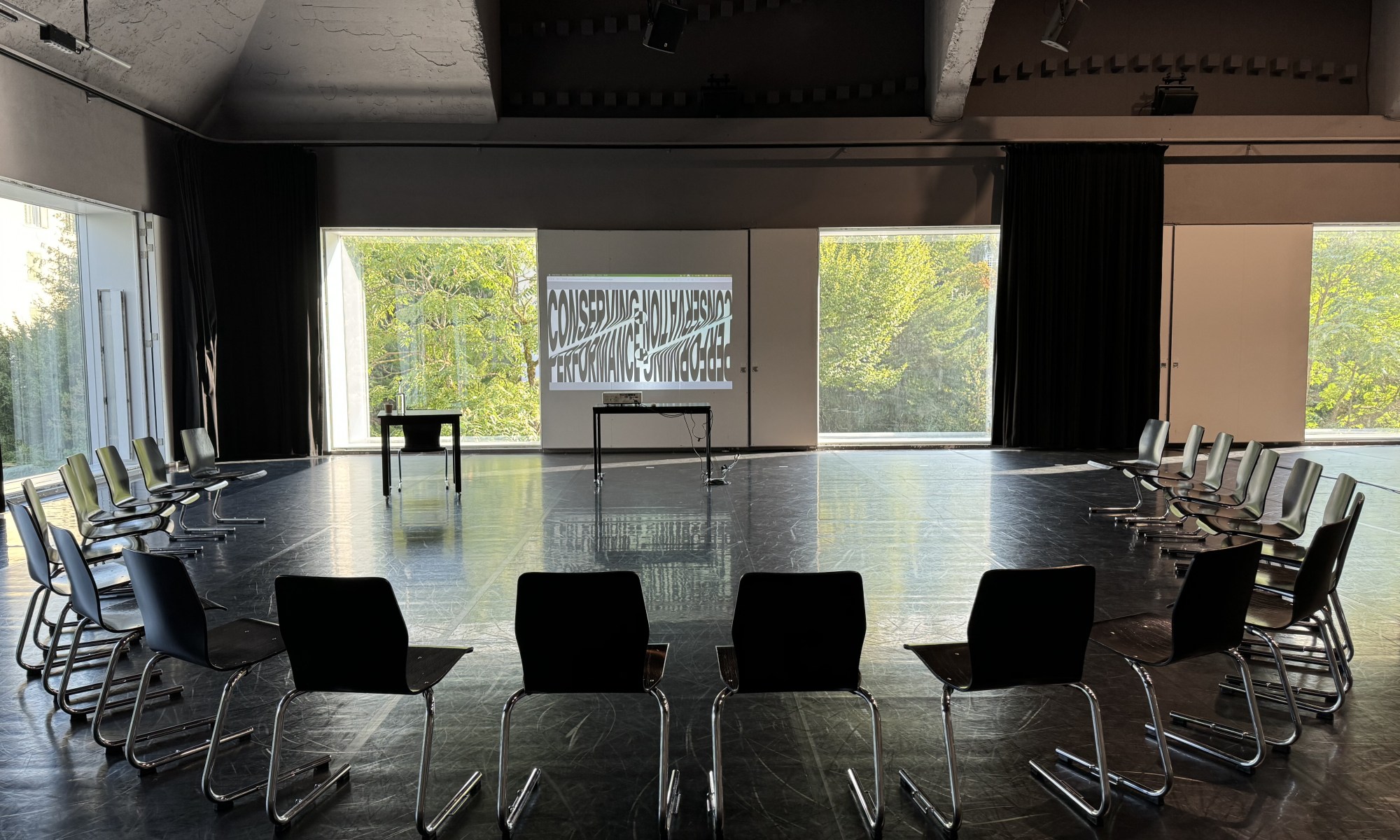
T H E · C O M P L E T E · F E S T I V A L · P R O G R A M
Can performance be conserved, and if so, how? What does it mean to conserve performance? The research festival and exhibition Conserving Performance, Performing Conservation—taking place from September 14 to 29, 2024, across Zurich, Geneva, Lausanne, Aarau, and Bern—explores these questions by examining performance through the lens of conservation. This event marks the conclusion of the research project Performance: Conservation, Materiality, Knowledge (2020-2024). It celebrates performance in its social, material, and epistemic networks by bringing together practitioners from performance, dance, museums, and conservation, alongside researchers from various disciplines.
Find short biographies of the speakers here.
For a selected media coverage, refer to HKB Zeitung “Rückblick.”
Several video recordings of lectures, demonstrations, and discussions are being made available on this website.
Saturday, September 14 – Sunday, September 29, 2024
YET TO COME: EXPERIMENTS IN REVERSE-ENGINEERING AND CONSERVING PERFORMANCE – AN EXHIBITION
Directors Hall, HKB Bern Academy of the Arts, Fellerstrasse 11, 3027 Bern.
Opened daily from 10 AM to 5 PM Monday through Friday. On weekends, 13-5 PM.
A walk-through of the exhibition with curators will take place on Tuesday, September 17, and Wednesday, September 25, from 5 PM to 6 PM. Please meet at the HKB’s main entrance next to Buffet Nord. Admission is free.
Access here the exhibition website.
Organized with the generous support of the HKB Bern Academy of the Arts Research Division, HKB Events, HKB Kunst and Gestaltung Werkstatt and the Swiss National Science Foundation.
Sunday, September 15, 2024, 10:00 – 19:00
DAY 1: THE BODILY TRANSMISSION OF KNOWLEDGE, TANZHAUS ZURICH
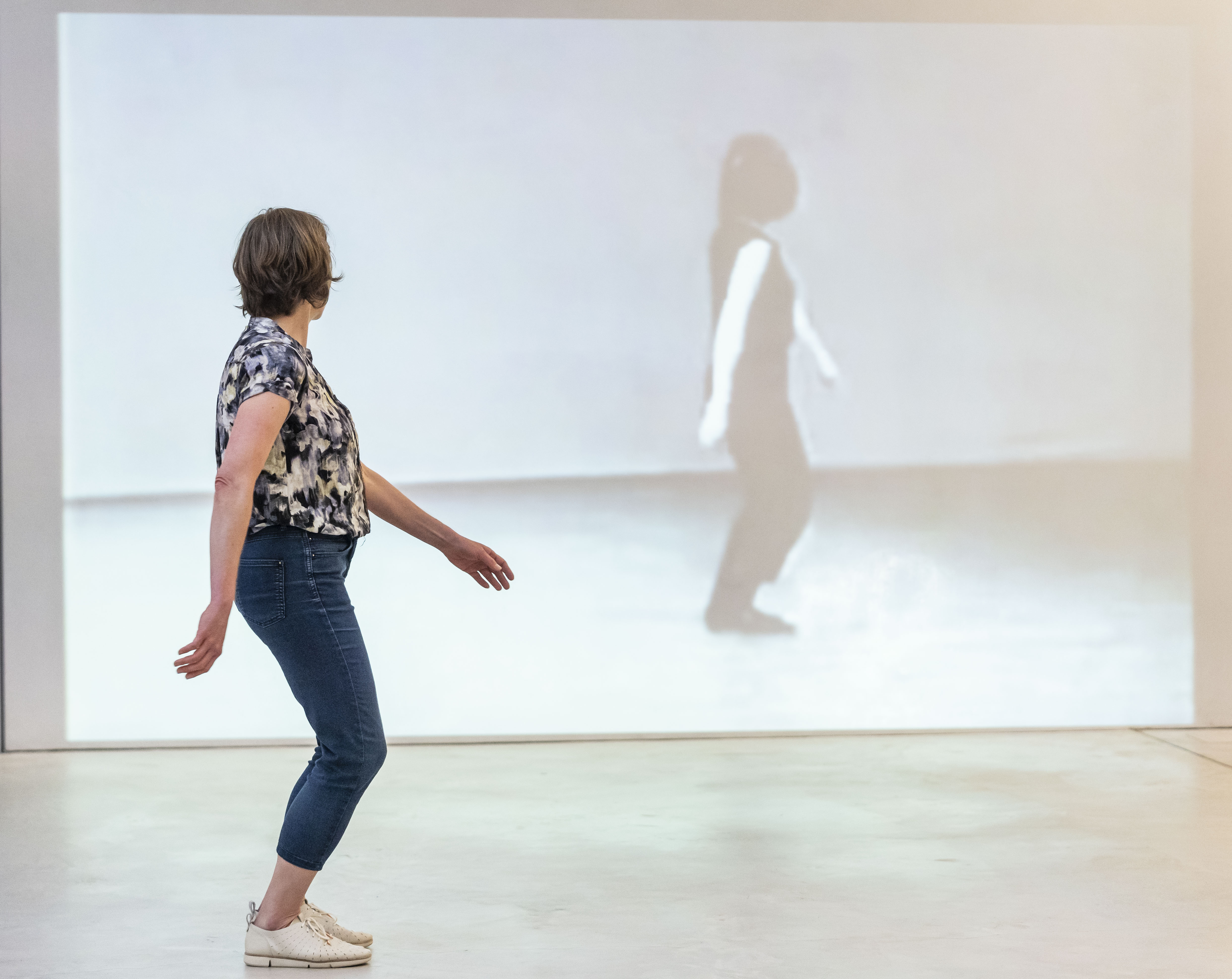
Focused on the bodily transmission of knowledge and aspects of reenactment, reperformance and reinterpretation, the first day of our research festival will consist of two interactive workshops led by prominent leaders in the field followed by individual interventions, responses and group discussions with practitioners and scholars in performance, conservation and the museums. The thematic focus of this day is “transmission,” “living legacy” and “reactivation.” With Sara Wookey, Megan Metcalf, Peter Pleyer, Anna Huber, Catja Loepfe, Declan Whitaker, Hanna Hölling, Joanna Leśnierowska, Andrej Mirčev and others. Link to the announcement on the Tanzhaus Zurich’s website.
10 a.m. – 12:30 p.m.
Sara Wookey: Dance is Hard to See: The Body, Language and Material in Acts of Transmission and Influence
Yvonne Rainer’s work Trio A (1966) will be presented, discussed and experienced through bodily and verbal transmission, methods of remembering and material pedagogical tools. Scholar and dance practitioner Sara Wookey will trace lines of influence from Rainer’s work to her own practice and research on dance in the museum, examining dance as an experience to be collected, archived, conserved, and used as a tool for institutional change. A performance of Rainer’s iconic piece will be followed by Trio A (Unplugged 1966/2015), a rendition reflecting the evolution of the piece.
Megan Metcalf: Museums and Dance Legacies: Simone Forti’s Dance Constructions (1960-61) at the Museum of Modern Art in New York
In this talk, art historian and former dancer Megan Metcalf will present the models devised for the continuation of Simone Forti’s Dance Constructions (1960-61), which were acquired by the Museum of Modern Art New York in 2015. These models both draw upon curatorial and conservation procedures already common in museums and introduce dance-specific tools to the stewardship of visual art, pressuring the artworks and the institution in the process.
12:30 a.m. – 1:30 p.m. Lunch break

1:30 p.m.-4:00 p.m
Peter Pleyer, of Cranky Bodies: Scores: History and Practice since Judson Dance Theater
Scores are crucial transmitters of performance. Since the Judson Dance Theater, where scores for music and sound were adapted and used for performance-based works, many dancers and choreographers have developed and utilized various scores to preserve and convey their creations. In this lecture-demonstration, dancer and choreographer Peter Pleyer will share several examples of scores, ranging from written instructions to photographs and drawn images, and discuss their relevance in his choreographic practice. There will also be opportunities to engage with some of these scores, both collectively and individually.
Anna Huber: In conversation with Andrej Mirčev
Dance artist Anna Huber will share insights from her ongoing artistic inquiry focused on movement research and site-specific performances beyond the traditional theatrical stage. These performances are created in art spaces or construction sites, where the body serves as both an instrument and an object of research. In conversation with Andrej Mirčev, Huber will explore themes of age, aging, and transgenerational exchange and care, embracing the potential of aging bodies in dance and performance and empowering their visibility.
4:00 p.m.-4:30 p.m. Short break
4:30 p.m.-7:00 p.m.
Hanna B. Hölling: Towards the Ethics of Repair
Repair signifies that things are broken down, eroded or decayed. Often, in traditional art such as painting and sculpture, this status quo sets in motion various restorative measures aimed at returning the object to its former status. But can the notion of repair be applied to performance? And can, by extension, notions such as “treatment,” “restoration,” “patina” and “aging”? In this short provocation, conservator and conservation scholar Hanna Hölling will test the application of several traditional paradigms and tools of conservation to performance-based forms as to spawn productive discussions on the intersection of performance practice, practical conservation and experimental care.
Catja Loepfe, of Tanzhaus Zürich, and Declan Whitaker, of The Field: In Discussion with Joanna Leśnierowska
The discussion will begin by exploring the concept of reenactment as a foundational choice for starting Tanzhaus Zürich’s own company, The Field (since 2019). The director of Tanzhaus Zürich, Catja Loepfe, will speak about the motivations behind establishing the company, sharing her vision and the driving forces that led to its creation. Following this, artist Declan Whitaker of The Field will share his experiences of re/performing Simone Aughterlony’s work, offering valuable insights into the nuances and challenges of reenactment in a professional context. A broader conversation with Joanna Leśnierowska, choreographer, curator and visual dramaturge, will focus on reactivating, restating, transmitting and drawing inspiration.
Language of the venue: English. We will facilitate discussions in German if required.
Moderation and coordination: Hanna B. Hölling, Joanna Leśnierowska, Andrej Mirčev, Emilie Magnin and Charles Wrapner.
Location: Tanzhaus Zürich, Bühne 2, Wasserwerkstrasse 129.
Accessibility: Contact us for wheelchair access and further access needs.
Organized with the generous support of Tanzhaus Zürich, the HKB Bern Academy of the Arts Research Division and the Swiss National Science Foundation.
Thursday, September 19, 2024, 6 p.m. – 7.30 p.m.
DAY 2: CONSERVING ABSENCE: FLORENCE JUNG IN CONVERSATION, Aargauer Kunsthaus, Aarau
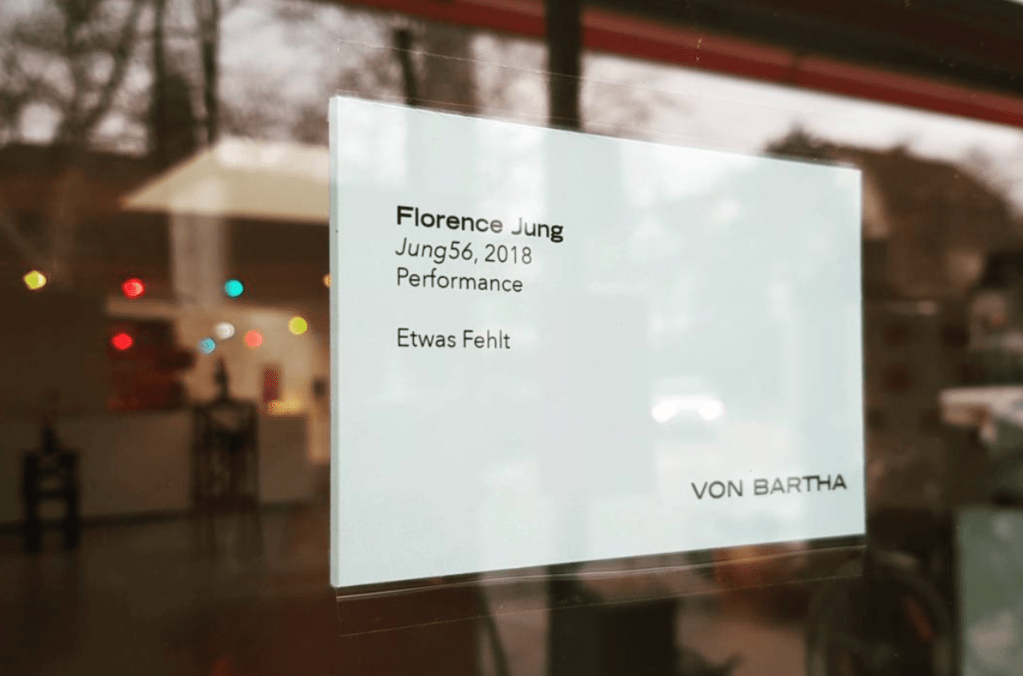
Florence Jung’s identity as an artist is notably elusive. She actively avoids personal presence, instead cultivating situations that embody qualities of uncertainty and instability. This event will focus on Jung’s performative ultra-conceptualism and her prevalent choice of avoiding the visual documentation of her work, addressing how her artworks, despite intricate challenges, live in collections and are preserved. What should be done about a work that consists of a thought not to be thought about? How do we handle an artwork that occurs through changed circumstances and shifting mental conditions? What about works for which the only evidence is conveyed through oral transmission, occasionally documented by a critic or curator? How can we avoid despair when contemplating the conservation and afterlife of these works? Jung will discuss these questions with Hanna B. Hölling, Emilie Magnin, Simona Ciuccio and the curatorial team of Aargauer Kunsthaus. Followed by an Apéro. Link to the announcement on the Aargauer Kunsthaus website.
Language: English. We will facilitate discussions in German or French if required.
Location: Aargauer Kunsthaus, Aargauerplatz, 5001 Aarau, CH.
Accessibility: Aargauer Kunsthaus is wheelchair accessible, and the event space with assistance. Please contact us if you have further access needs.
Organized with the generous support of Aargauer Kunsthaus, the HKB Bern Academy of the Arts Research Division and the Swiss National Science Foundation.
Saturday, September 21, 2024, 10:00 a.m. – 7:00 p.m.
DAY 3: ARCHIVING AND DOCUMENTATION, ADC | Association pour la Danse Contemporaine, Geneva
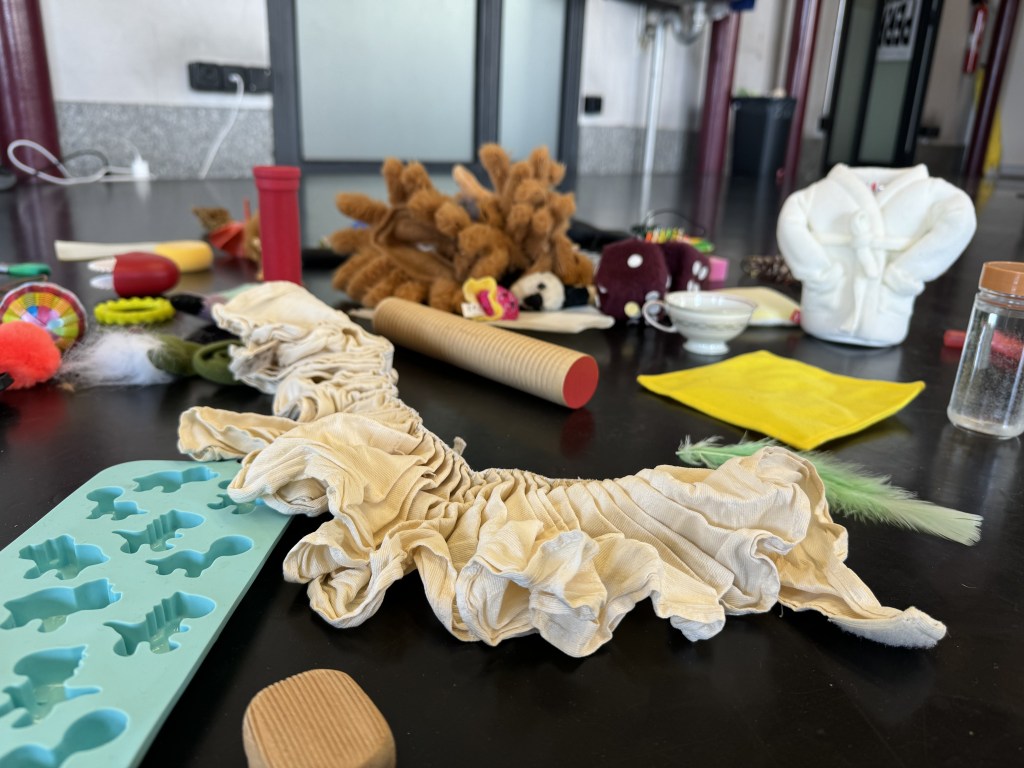
Taking place at ADC Geneva, Grütli studios, and co-organized in collaboration with ADC Geneva, the third day of the festival will focus on keeping performative legacies alive through archiving and documenting. Topics will range from the somatic and political dimensions of conserving and archiving knowledge, through self-archivization and documentation, to concepts of embodied stewardship and community involvement. Jointly organized by ADC Geneva and the research project Performance: Conservation, Materiality, Knowledge, the day will consist of two participatory workshops, film screenings, and a roundtable discussion with artists, performers, dancers, archivists, scholars, and museum professionals. With Cori Olighouse, Thomas Plischke, Eszter Salamon, Rachel Mader, Joanna Leśnierowska and others. For the French description on the ADC website, follow this link.
10:00 a.m. – 12:30 p.m.
Cori Olinghouse: Haptic Writing
This session draws from Olinghouse’s living archives methodology that uses a poetics of language to enrich the descriptive text used in performance archives. Utilizing methods of oral history gathering, visual mapping, thick description, and access work, this approach is meant to expand accessibility to the embodied practices that inform an artist’s work. Together we will move and write, drawing from Jane Bennett’s notion of “words as sticky substances,” as a way to approach words at the “level of their sensuous specificity.” We will also experiment with Laura Mark’s notion of haptic visuality, where the “eyes themselves function like organs of touch,” inviting a tactile relation—a touching, more than looking. Follow this link for a detailed description and this link for additional materials and references to Cori’s work.
Rachel Mader: Response and discussion.
12:30 p.m. – 1:30 p.m. Lunch break

1:30 p.m. – 4:00 p.m.
Thomas Plischke, of Deufert & Plischke: Bodies as Anarchives
Deufert & Plischke’s work primarily consists of ongoing performance and media projects. They travel the world, creating new works on-site with local communities. Over time, they collect material from various places and people. These collections are not systematic; they are emotional and always interwoven with personal stories and memories. They call these works Anarchives. Following this methodology, the project Just in Time (since 2016), celebrates dance culture as a diverse, accessible, and community-building art form. It has already visited more than twenty cities, organized over eighty local workshops, collected more than two thousand letters dedicated to dance and favorite movements and portrayed fifty people whose lives revolve around dance. Each stage of the project begins with local communities and is carefully prepared to ensure that the multitude of dance forms—from casual dancers, passionate club dancers, traditional dance forms and subcultures to stage dance—can transition from coexistence in the city to coexistence in a diverse dance reality. Commencing with a short documentary film about the project, Thomas Plischke’s workshop will propose a common practice that includes a discussion game, dancing and writing letters to dance.
Joanna Leśnierowska: Response and discussion.
4:00 p.m. – 4:30 p.m. Short break

4:30 p.m. – 7:00 p.m.
Film screenings: Eszter Salamon Reappearance (2022) and Sommerspiele (2023) from the series Reappearances. Eszter Salamon’s film series Reappearances is a cinematic speculation on history and memory. It reflects on the physical and artistic impermanence of performance and the potential the moving image has for constituting a space to alter the historical canon, while also creating a “tunnel to the future,” a trans-historical space of artistic and political dimensions. As a cinematic manifesto against oblivion, the series celebrates the genealogy that connects female artists from different periods by composing a transhistorical body, a kind of hybridization formed of the visions and gestures of two artists, Valeska Gert and Eszter Salamon. For a detailed description of these works, consult this link.
Followed by a discussion including the project Monument and The Valeska and Gert Museum.
Language: English and French.
Moderation and coordination: Hanna B. Hölling, Joanna Leśnierowska, Andrej Mirčev, Emilie Magnin and Charles Wrapner.
Location: ADC, Maison des arts du Grütli Rue du Général-Dufour 16, 1204 Genève, CH.
Organized with the generous support of ADC Geneva, the HKB Bern Academy of the Arts Research Division and the Swiss National Science Foundation.
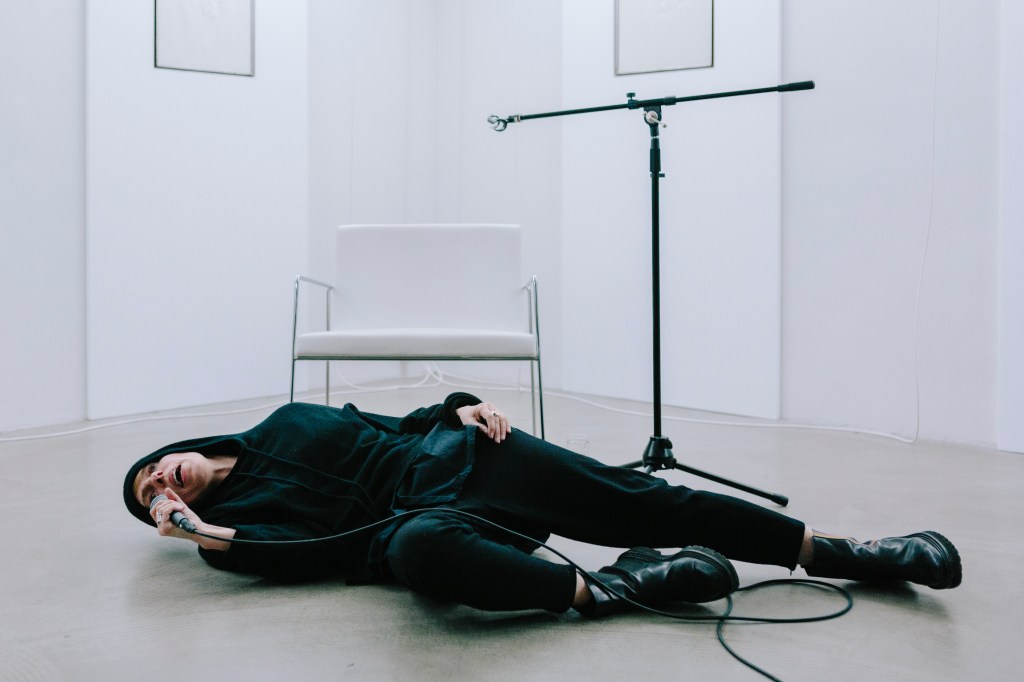
Sunday, September 22, 2024, 4:00 p.m. – 5:30 p.m.
DAY 4: REVISITATIONS: Eszter Salamon, Dance for Nothing (Revisited, 2024), MCBA | Musée cantonal des Beaux-Arts Lausanne | Plateforme 10
Choreographer, filmmaker and performer Eszter Salamon revisits John Cage’s Lecture on Nothing (1949), a piece she initially engaged with in 2010 through her solo performance Dance for Nothing, which paired Cage’s words with her movements. This time, Salamon experiments with the modulation and transformation of physical movements, focusing on the sonic aspect of this seminal lecture on nothingness and the void. She adds depth by listening to one of her past performances in which she repeated the text after a slowed-down recording by the American cellist and composer Frances-Marie Uitti, creating an auditory exploration of transmission and transformation. Salamon’s fusion of body, voice, and score sets the framework for a meditation on the simultaneity of movement and sound, and on interpretation. Followed by a public Q&A.
Language: French, discussion in French and English.
Coordination: Pierre-Henri Foulon and Joanna Leśnierowska.
Location: Musée cantonal des Beaux-Arts, PLATEFORME 10, Place de la Gare 16, 1003 Lausanne, Suisse.
Organized with the generous support of MCBA Lausanne/Plateforme 10, the HKB Bern Academy of the Arts Research Division and the Swiss National Science Foundation.
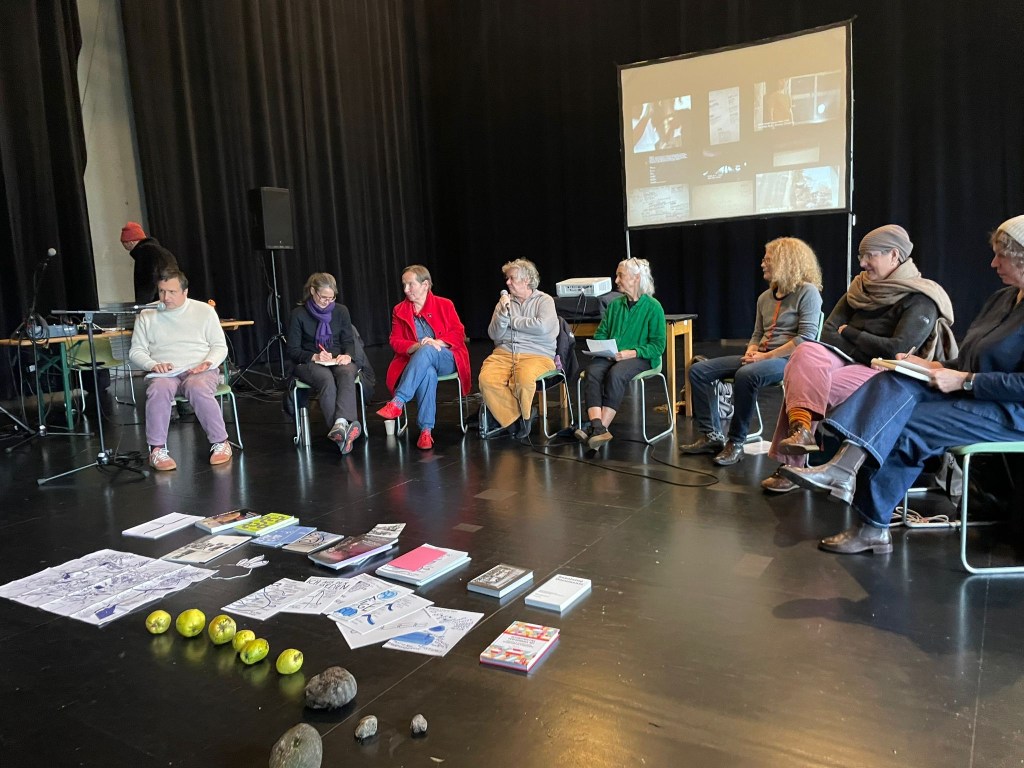
Saturday, September 28, 2024, 10:00 a.m. – 7:00 p.m.
DAY 5: COLLECTING AND PRESERVING AS AN ACT OF CARE | Dampfzentrale Bern
The final day of our festival will feature a workshop, a roundtable and several presentations and discussions focused on the notions of “care” and “collecting and preservation as an act of care.” Workshops will survey how artists with disabilities address the present and the past of performance works through memory, activation and enactment. One of the key events of the day will be a roundtable discussion, “Networks of Care” focused on the strategies for preserving performance in the Performance Art Network in Switzerland. Performers, curators and archivists of live-performance collections as well as scholars will contribute to discussions. With Saša Asentić, Nina Mühlemann, Rebecca Gordon, Sally Labern, Sabine Gebhardt Fink, Muda Mathis, Andrea Saemann, Dorothea Rust, Chris Regn, Gisela Hochuli, Tabea Lurk, Julia Asperska and the organizers.
10:00 a.m. – 12:30 p.m.
Saša Asentić: Aesthetics of Access and Politics of Memory
Saša Asentić’s research is rooted in contemporary dance and disability-led artistic practice. He views accessibility as a fundamental aspect of an artwork, crucial for the emergence of an aesthetics of access that fosters new memories of solidarity and social justice. In his presentation, Asentić will share insights into his method of reconstruction used in the creation of a variety of performances. This method acts as a form of resistance against ableism and cultural oppression by reviving overlooked, forgotten and erased perspectives. Asentić, a non-disabled artist and activist, is currently pursuing an artistic-doctoral research project on these themes. By critically examining the historicization of dance, his research addresses key questions: How can the aesthetics of access create new memories and alter the affective state from which the past, present and future are perceived?
Nina Mühlemann and Saša Asentić: In Discussion
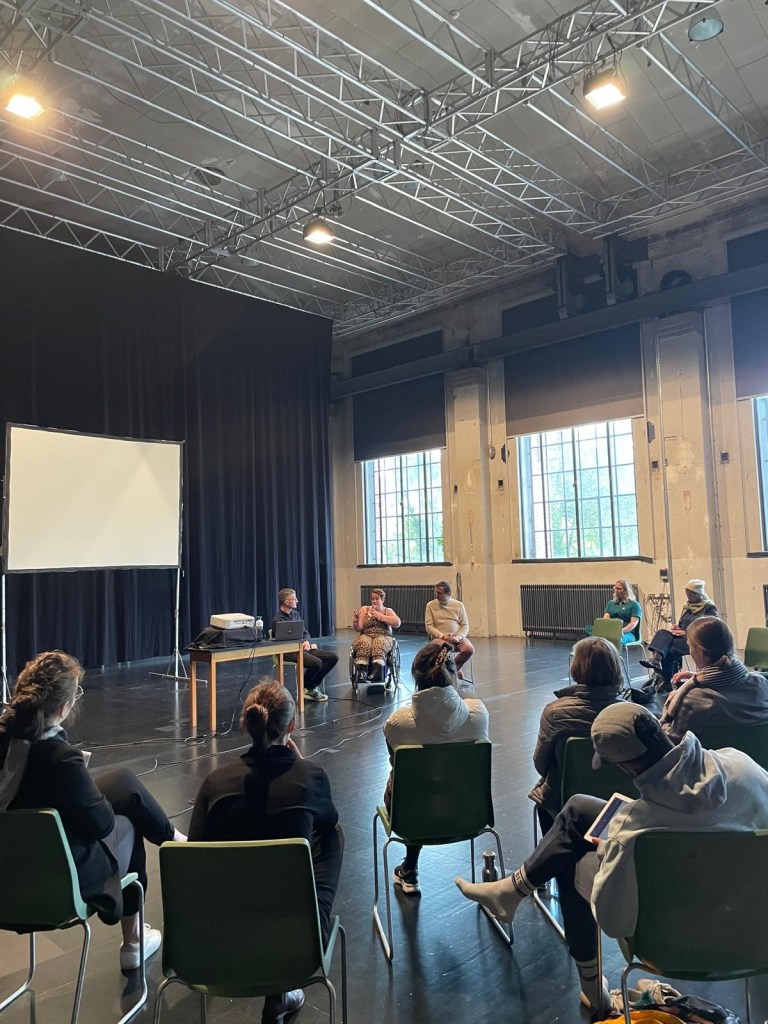
Nina Mühlemann is an artist, scholar and activist working as a postdoctoral researcher on the Swiss National Science Foundation (SNF)-funded project “Aesthetics of the Im/Mobile” at the Bern Academy of the Arts. Mühlemann’s research centers on the im/mobile practices of disabled and chronically ill artists.
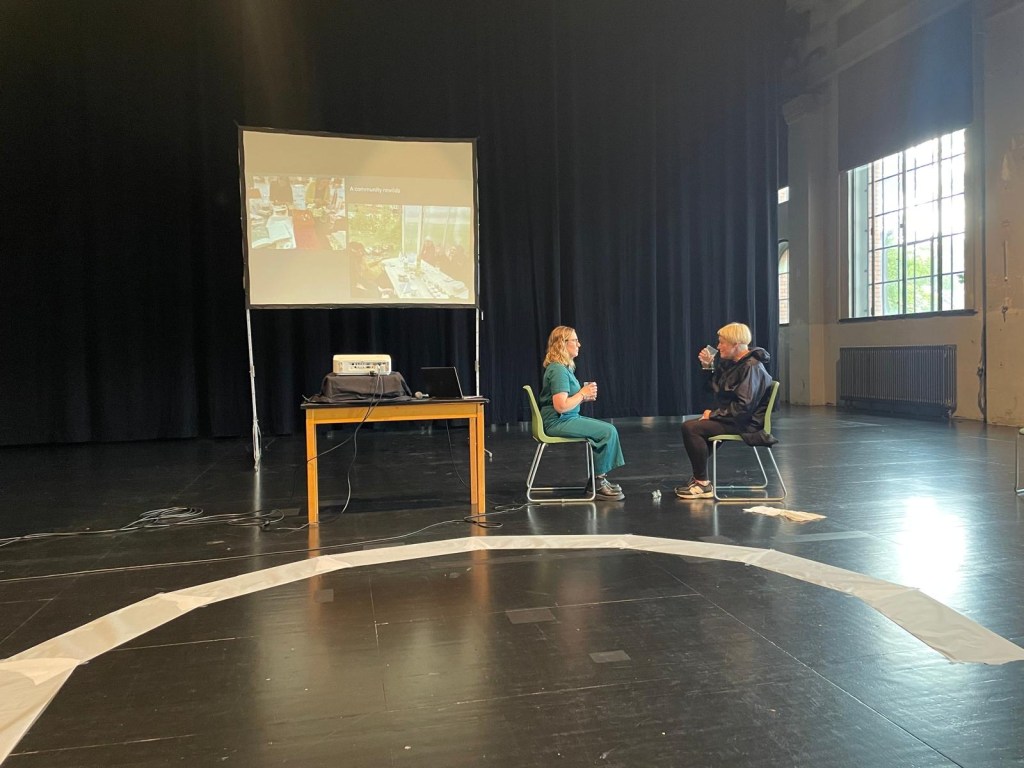
Rebecca Gordon and Sally Labern: Communities of Caring with: Thinking-through-making and Slowing the Flow
This contribution focuses on beginning differently, with slowness as a means of resistance. It considers the highly relational act of “caring with” (Tronto 2013) in a reimagining of power dynamics and a methodology of thinking-through-making. The climate response project “Slowing the flow” – co-curated by artist Sally Labern and resident women living on two East London housing estates with familial and cultural connections in Guinea, Pakistan and Nigeria – will help us think through how to create porosity and agency within social art practices, centred around an ethics of care. How do conservation ethics and practice fit with such communities of care? How do we move beyond performing care to caring with?
12:30 p.m. – 1:30 p.m. Lunch break
1:30 p.m. – 4:00 p.m.
Muda Mathis, Andrea Saemann, Dorothea Rust, Chris Regn, Gisela Hochuli, Sabine Gebhardt Fink and Tabea Lurk: Networks of Care
Performance artists Muda Mathis, Andrea Saemann, Dorothea Rust, Chris Regn, and Gisela Hochuli, along with art historian Sabine Gebhardt Fink and archivist Tabea Lurk, will discuss the strategies for preserving performance that have been not only present in the Performance Art Network in Switzerland but also well articulated in an array of activities, such as the recent “Revolving Histories,” an exhibition and research project organized in collaboration with Museum Tinguely in Basel. Mathis, Saemann, Rust, Regn, and Hochuli will also address their individual creative practices and how they engage with the ideas of performance’s afterlife, ongoingness, and care. What mechanisms of preservation, mutual support, care, archiving, and collective work exist, and what can be learned from them transgenerationally? How do we manage works that are no longer “new” and thus require a certain level of attention? Gebhardt Fink will offer insights into her scholarly work on these and related topics, and Lurk will present insights into the ambitious and invaluable digital archive Collections Performance Art Switzerland, which she created in collaboration with Jürgen Enge.
Moderated by Sabine Gebhardt Fink, with Andrej Mirčev
4:00 p.m. – 4:30 p.m. Short break
4:30 p.m. – 7:00 p.m.
Julia Asperska: Collecting as Caring
Having worked across genres as a curator, advisor, mediator, facilitator, producer, and manager, Julia Asperska helped create and served as Collection Manager (2020-2022) of the Something Great Collection, an independent project dedicated to the presentation and conservation of contemporary performing arts. The project began in 2020 with the acquisition of works created in the 21st century. By reflecting on the history of international performing arts and its recent developments, the collection aimed to recontextualize that history from a more inclusive and transcultural perspective. The project was an attempt to rethink the logic of the production and dissemination of performing arts. In this talk, Asperska will offer insights into her work with this collection, an experience that later led her to implement conservation practices for two works by South American choreographer Tamara Cubas: Multitud (2014) and Offering for a Monster (2023).
CONCLUSIONS: What’s Next? And Experiments in Caring
The final part of the festival will gather speakers and discussants to reflect on the present and future of performance care and conservation. The interactive mind map, “Conserving Performance, Performing Conservation,” will be discussed and enhanced with new insights to be presented on the project’s website. Among others, Hanna Hölling, Andrej Mirčev, Joanna Leśnierowska, Emilie Magnin and Charles Wrapner will provide insights into the main concepts behind the festival’s accompanying exhibition, “Yet to Come: Experiments in Reverse-Engineering and Conserving Performance,” and discuss why performance conservation can never be the domain of a single disciplinary specialty but rather requires a “village” of hands and minds, and, not least, imaginations.
Language: English. We will facilitate discussions in German if required.
Moderation and coordination: Hanna B. Hölling, Joanna Leśnierowska, Andrej Mirčev, Emilie Magnin and Charles Wrapner.
Location: Dampfzentrale Bern, Marzilistrasse 47, 3005 Bern.
Accessibility: Wheelchair accessible. Contact us for further access needs.
Organized with the generous support of Dampfzenrale Bern, the HKB Bern Academy of the Arts Research Division and the Swiss National Science Foundation.
The majority of our venues are wheelchair accessible. For any specific access needs or additional assistance, please contact us. Please note that this is a preliminary schedule of the festival. While times and themes are fixed, adjustments might occur.
Our sincerest thanks to all speakers and discussants, the venue directors, curators and coordinators at the Tanzhaus Zürich, Aargauer Kunsthaus, ADC Geneva, Musée cantonal des Beaux-Arts Lausanne, Plateforme 10, Dampfzentrale Bern, and the team of the HKB Bern. Special thanks to Catja Loepfe, Inés Maloigne, Katharina Ammann, Katrin Weilemann Moretto, Simona Ciuccio, Ann Davier, Lydia Pilatrino, Léo Chavaz, José Manuel Rodriguez, Anneli Binder, Bianca Gois Barbosa, Salome Rodríguez Bär, Cyril Ressnig, Pierre-Henri Foulon, Thomas Gartmann, Sebastian Dobrusskin, Carmen Effner, Daniela Wüthrich, Nathalie Pernet, Kerstin Linder, Christian Pauli, Jürg Bigler, Marco Matti, Elizaveta Skargina, Adrian von Niederhäusern, Petra Frey, Florian Weiss and Johannes M. Hedinger.
Supported by:




 Performance: Conservation, Materiality, Knowledge